

Understanding the Road to Recovery After a Car Accident
Early chiropractic evaluation is crucial because many auto‑injury symptoms, such as whiplash, neck stiffness, and low‑back pain, may not appear until hours or days after the crash. By seeing a chiropractor within the first 48‑72 hours, hidden joint misalignments, ligament strains and disc irritation can be identified before scar tissue forms, reducing the risk of chronic pain. Chiropractors commonly treat whiplash‑associated disorders, cervical and lumbar strain, herniated or bulging discs, nerve compression, shoulder and rib restrictions, and soft‑tissue inflammation. Their care integrates spinal adjustments, mechanical decompression, soft‑tissue therapies and rehabilitative exercises, complementing management and physical therapy. This approach restores mobility, controls inflammation, and accelerates recovery, helping patients return to activities faster.
First Steps After the Crash
First Steps After the Crash – Quick Reference
| Action | Timeline | Details |
|---|---|---|
| Schedule first chiropractic appointment | Within 72 hours of collision | Early evaluation catches hidden whiplash, soft‑tissue strain, and joint misalignments before inflammation & scar tissue develop. |
| Initial visit – intake & exam | At first appointment | Complete detailed intake (accident report, medical history, symptoms). Physical exam checks posture, ROM, tenderness, neuro function. Imaging (X‑ray/MRI) may be ordered/reviewed. |
| Paperwork & claim support | Throughout treatment | Bring accident reports, medical records, prior imaging. Clinic documents each treatment, generates progress notes, and coordinates with insurers/attorneys for settlement documentation. |
| Q&A Highlights | – | • See chiropractor within 72 hours.<br>• Chiropractor performs intake, exam, imaging, and creates a plan (adjustments, soft‑tissue work, exercises).<br>• Treatment can begin while filing auto claim; keep invoices/notes and inform insurer. |
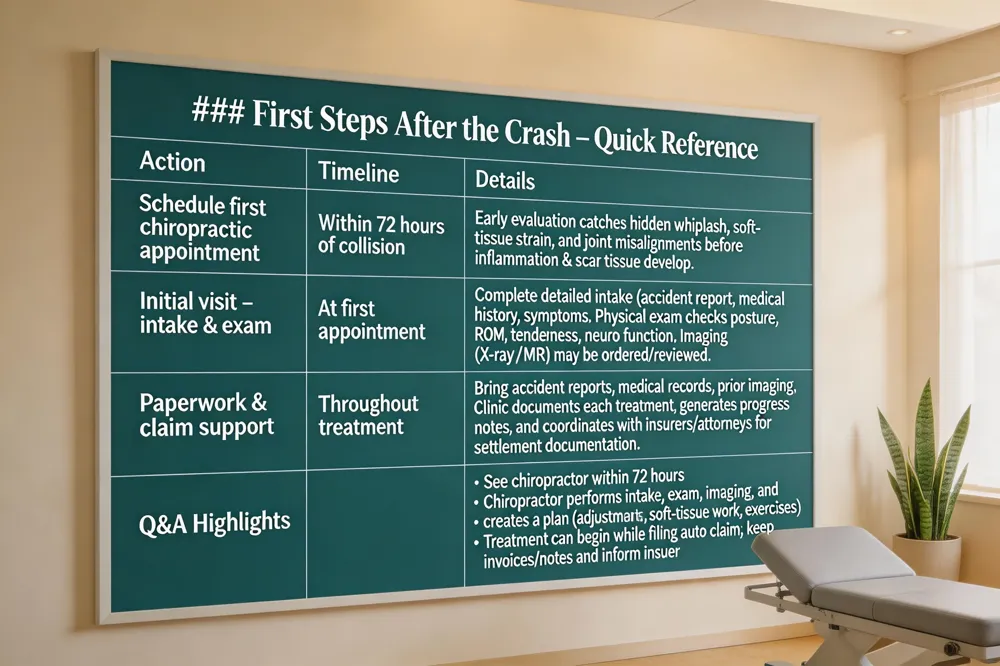 When to schedule your first chiropractic appointment: Aim to be seen within the first 72 hours after the collision, even if symptoms seem mild. Early evaluation catches hidden whiplash, soft‑tissue strain, and joint misalignments before inflammation and scar tissue develop, which can shorten recovery and reduce the total number of visits.
What a chiropractor does during the initial visit: You’ll complete a detailed intake covering accident reports, medical history, and current symptoms. The chiropractor performs a physical exam that checks posture, range of motion, tenderness, and neurological function. Imaging (X‑ray, MRI) may be ordered or reviewed to rule out fractures. Based on findings, a personalized plan is created—spinal adjustments , soft‑tissue therapy, and therapeutic exercises—to restore alignment, reduce inflammation, and improve mobility.
Managing paperwork while your claim is processed: Bring accident reports, medical records, and any prior imaging to the first appointment. The clinic will document each treatment, generate progress notes, and coordinate with insurers or attorneys, providing the detailed records needed for Personal and personal‑injury settlements.
Q&A:
How soon after a car accident should I see a chiropractor? You should schedule an appointment as soon as possible—ideally within 72 hours—to identify hidden injuries, limit inflammation, and create medical documentation for your claim.
What does a chiropractor do after a car accident? They conduct a thorough intake and exam, order or review imaging, then design a treatment plan that includes adjustments, soft‑tissue work, and exercises, while monitoring progress and coordinating care.
Can I see a chiropractor while filing an auto claim? Yes—most auto‑insurance policies (PIP, MedPay) cover chiropractic care. Begin treatment early, keep invoices and notes, and inform your insurer; a personal‑injury attorney can assist if coverage issues arise.
Choosing the Right Car‑Accident Chiropractor in Gastonia
Choosing the Right Car‑Accident Chiropractor in Gastonia – Key Criteria
| Criterion | Why It Matters | How to Verify |
|---|---|---|
| Specialization in post‑collision care | Ensures experience with whiplash, spinal misalignments, soft‑tissue injuries. | Ask about years treating auto‑injury patients; request case studies or testimonials. |
| North Carolina licensure & extra certifications | Guarantees legal practice and advanced skills (e.g., spinal decompression, myofascial release). | Check NC Board of Chiropractic Examiners website; request copies of certifications. |
| On‑site imaging (X‑ray/MRI) | Speeds diagnosis and provides essential documentation for insurance/legal claims. | Confirm the office has imaging equipment or a fast‑track referral system. |
| Insurance & attorney paperwork handling | Reduces administrative burden; ensures timely claim processing. | Ask if they submit notes directly to insurers, accept attorney liens, and provide itemized billing. |
| Financing options | Helps manage out‑of‑pocket costs before settlement. | Look for “no‑pay‑until‑settlement,” payment plans, or transparent pricing charts. |
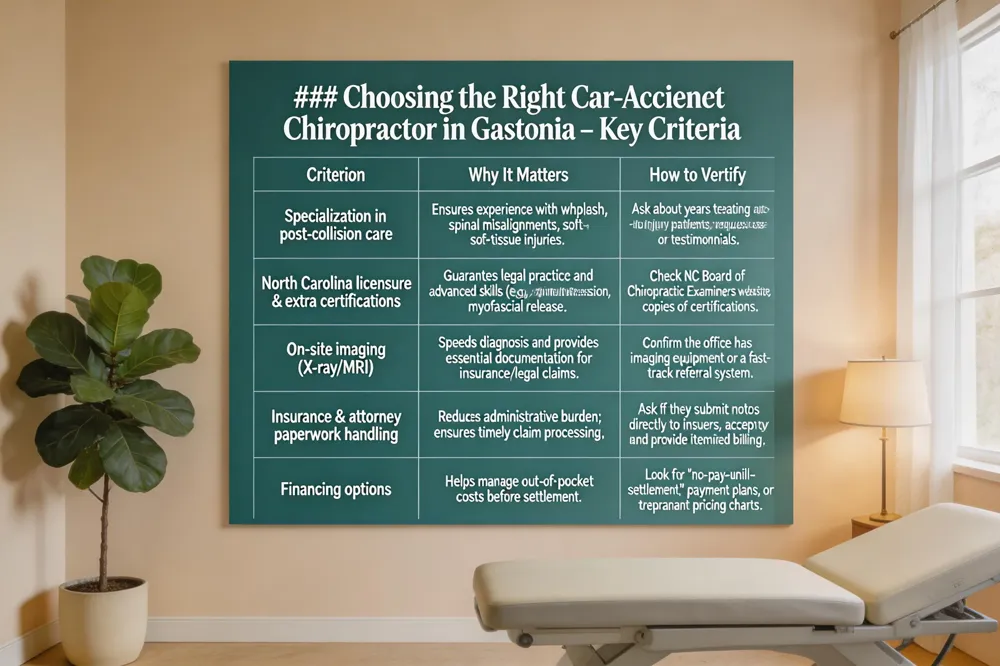 When selecting a chiropractor for an auto‑injury in Gastonia, NC, start by confirming that the clinician specializes in post‑collision care. Look for a practice that routinely treats whiplash, spinal misalignments, and soft‑tissue injuries, and that emphasizes early intervention—ideally within 48‑72 hours of the crash—to prevent chronic pain.
Licensure and certifications matter: verify a valid North Carolina chiropractic license and any additional training in accident‑related rehabilitation, such as certifications in spinal decompression or myofascial release. On‑site imaging (X‑rays, possibly MRI) speeds diagnosis and provides essential documentation for insurance claims and legal proceedings.
A chiropractor who handles insurance paperwork, accepts attorney liens, and offers financing options—like “no‑pay‑until‑settlement” or transparent payment plans—reduces administrative stress and lets you focus on healing.
What should I look for in a car‑accident chiropractor in Gastonia, NC? Choose a specialist with proven auto‑injury expertise, proper licensure, on‑site imaging capabilities, and a patient‑friendly office that manages insurance and attorney documentation while offering clear financing options.
Understanding Treatment Plans and Visit Frequency
Treatment Phases & Visit Frequency
Phase Overview
| Phase | Typical Duration | Visits per Week (Typical) | Primary Goals |
|---|---|---|---|
| Acute | First 2‑3 weeks | 2‑3 | Pain control, inflammation reduction, initial alignment. |
| Corrective | Weeks 3‑8 | 1‑2 | Restore joint alignment, muscle balance, improve ROM. |
| Stability | After 8 weeks | 1 (maintenance) or as‑needed | Maintain gains, prevent recurrence, transition to self‑care. |
Visit Frequency by Injury Severity
| Injury Type | Approx. Total Visits | Weekly Schedule |
|---|---|---|
| Minor soft‑tissue strain | 3‑5 | Once a week |
| Whiplash (moderate) | 8‑12 | 2‑3 times per week initially, taper to 1/week |
| Spinal misalignment/disc issue | 10‑15+ | 2‑3 times per week, then taper |
| Post‑surgical rehab | 12‑20+ | 2‑3 times per week, gradually reducing |
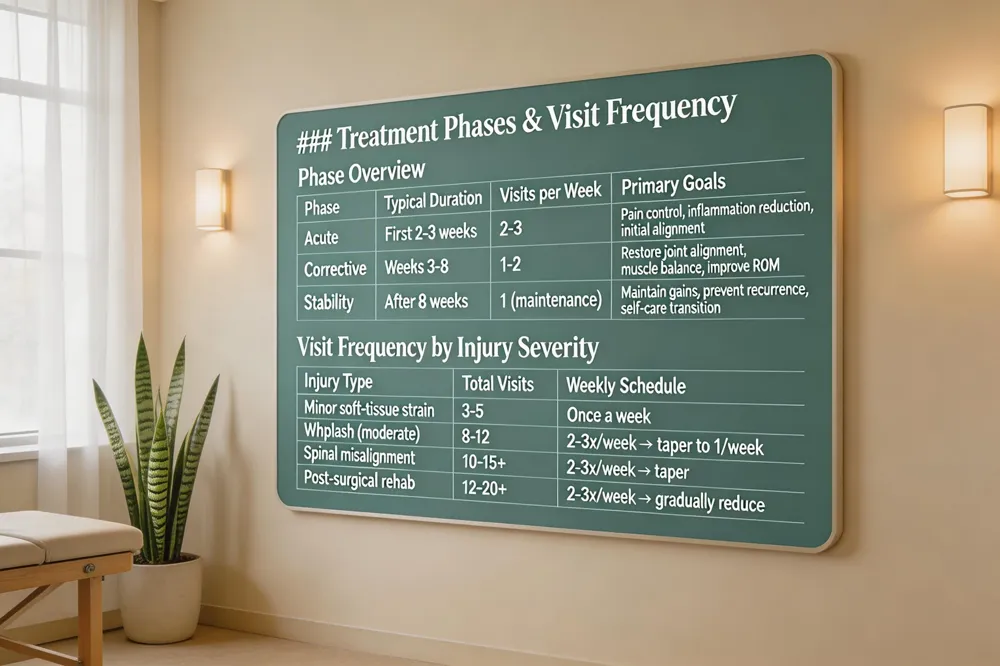 A post‑accident chiropractic program usually follows three phases: an acute stage (first 2‑3 weeks) focused on pain control and inflammation reduction, a corrective stage (weeks 3‑8) that restores joint alignment and muscle balance, and a stability phase (after 8 weeks) that maintains gains and prevents recurrence. For minor soft‑tissue strains, patients often need only 3‑5 appointments spaced a week apart, while more significant injuries such as whiplash or spinal misalignments typically start with 2‑3 visits per week and may require 8‑12 or more sessions before the schedule is tapered.
How many chiropractic visits are typically needed after a car‑accident injury? The exact number varies with injury severity and individual response; minor strains may resolve in a handful of visits, whereas whiplash or disc issues often need multiple weekly sessions before tapering.
What is the ideal timeline for chiropractic care after a car accident? Ideally, see a chiropractor within 24‑72 hours to catch hidden injuries early, but treatment can still be effective weeks or months later.
How long should I continue chiropractic treatment after a car‑accident injury? Continue until pain subsides, normal range of motion returns, and daily activities are pain‑free; then transition to a maintenance or as‑needed plan.
Financial Aspects, Insurance, and Compensation
Financial & Compensation Snapshot
| Funding Source | Coverage Details | Typical Limits / Notes |
|---|---|---|
| Personal Injury Protection (PIP) / MedPay | Covers medically necessary chiropractic adjustments, soft‑tissue therapy, and imaging. | Policy‑specific limits; often up to $10‑$25 K per person. |
| Fault Driver Liability Insurance | Pays for your treatment when the other driver is at fault. | May require lien or direct billing; limits vary by policy. |
| Health Insurance | Fills gaps after auto benefits are exhausted. | Usually requires co‑pay/deductible; may have visit caps. |
| Personal Injury Claim / Settlement | Reimbursement for medical bills, lost wages, pain & suffering. | Compensation ranges (approx.):<br>• 0‑3 mo: $4‑$13 K<br>• 3 mo‑2 yr: $13‑$20 K<br>• 2‑5 yr: $20‑$62 K<br>• Surgery/permanent injury: $62‑$260 K+ |
| ** lien / Direct Billing** | Clinics may bill insurer after claim resolution, reducing upfront cost. | Useful when settlement is pending. |
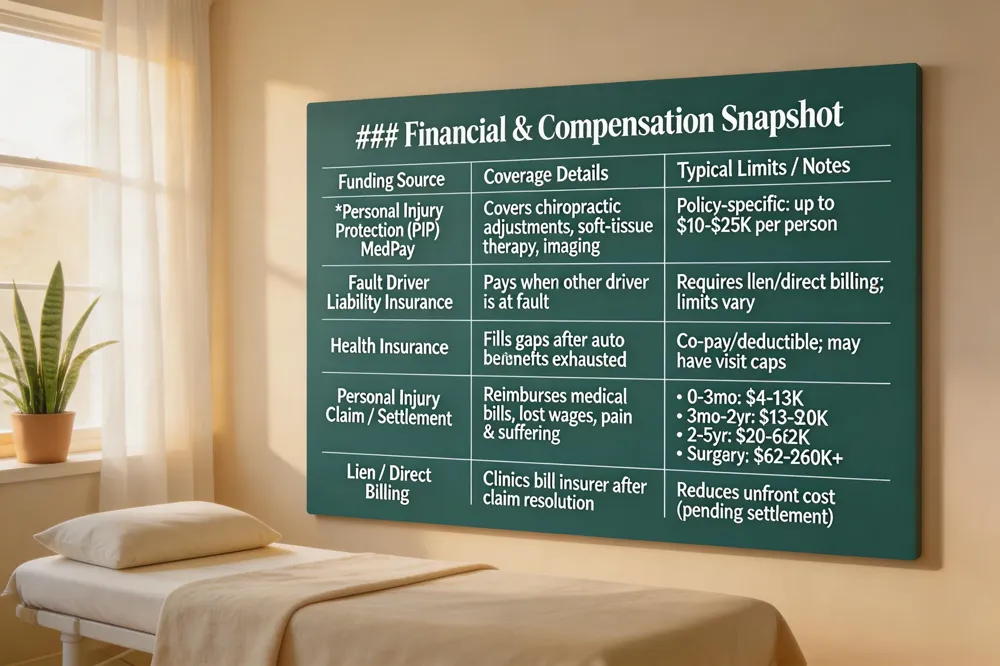 Chiropractic care after a crash is typically paid for by insurance rather than out‑of‑pocket. If you carry Personal Injury Protection (PIP) or MedPay, those benefits cover medically necessary adjustments up to policy limits. When another driver is at fault, their liability insurance usually pays for your chiropractic expenses, and you may also seek reimbursement through a personal‑injury claim or settlement. If auto benefits are insufficient, health‑insurance can fill the gap, often with a co‑pay or deductible. Most auto policies include a medical‑payment component that specifically covers chiropractic treatment, and many clinics work on a lien basis so the insurer pays after the claim resolves. Compensation for back‑pain varies with severity and duration: 0‑3 months ≈ $4‑13 K, 3 months‑2 years ≈ $13‑20 K, 2‑5 years ≈ $20‑62 K, and cases requiring surgery or permanent injury can reach $62‑260 K or more. Additional recovery for medical bills, lost wages, and out‑of‑pocket costs is also possible.
Symptoms, Healing, and the Release of Stored Trauma
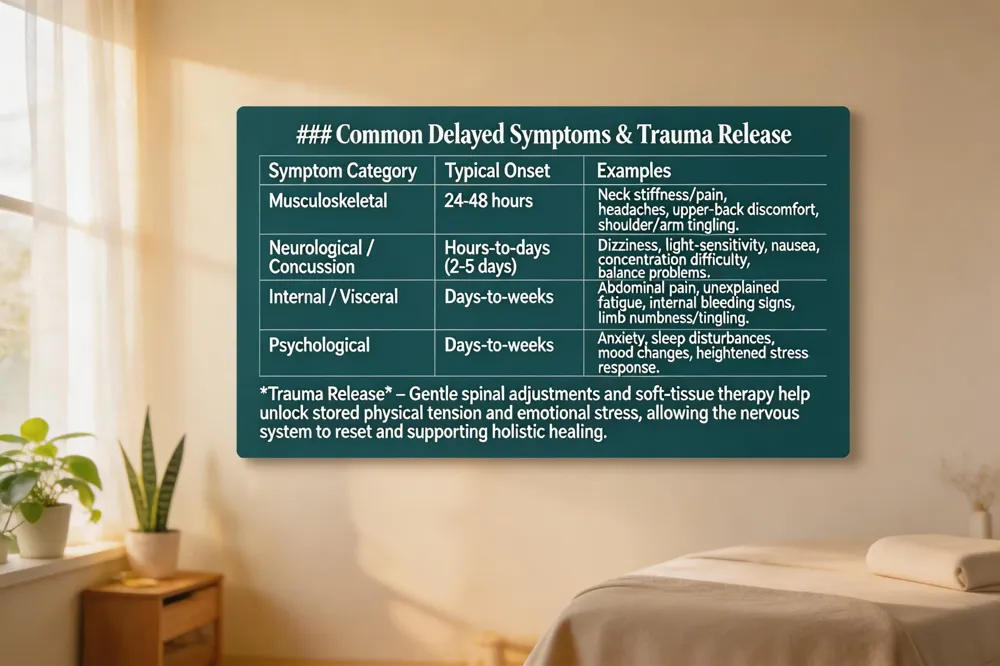
Common Delayed Symptoms & Trauma Release
| Symptom Category | Typical Onset | Examples |
|---|---|---|
| Musculoskeletal | 24‑48 hours | Neck stiffness/pain, headaches, upper‑back discomfort, shoulder/arm tingling. |
| Neurological / Concussion | Hours‑to‑days (often 2‑5 days) | Dizziness, light‑sensitivity, nausea, concentration difficulty, balance problems. |
| Internal / Visceral | Days‑to‑weeks | Abdominal pain, unexplained fatigue, internal bleeding signs, limb numbness/tingling. |
| Psychological | Days‑to‑weeks | Anxiety, sleep disturbances, mood changes, heightened stress response. |
Trauma Release – Gentle spinal adjustments and soft‑tissue therapy help unlock stored physical tension and emotional stress, allowing the nervous system to reset and supporting holistic healing. |
 What delayed symptoms can appear after a car accident?
After a crash, adrenaline and shock often mask injuries, so pain and other signs may not surface until hours or days later. Common delayed symptoms include neck stiffness or pain, headaches, and upper‑back discomfort that typically develop 24‑48 hours after impact. Concussion‑related signs—dizziness, light‑sensitivity, nausea, difficulty concentrating, or balance problems—can emerge gradually over several days. Abdominal pain, numbness or tingling in the limbs, and unexplained fatigue may indicate internal bleeding, nerve damage, or soft‑tissue injuries. Psychological effects such as anxiety, sleep disturbances, or mood changes can also appear weeks after the accident.
What delayed symptoms can appear after a car accident?
After a crash, adrenaline and shock often mask injuries, so pain and other signs may not surface until hours or days later. Common delayed symptoms include neck stiffness or pain, headaches, and upper‑back discomfort that typically develop 24‑48 hours after impact. Concussion‑related signs—dizziness, light‑sensitivity, nausea, difficulty concentrating, or balance problems—can emerge gradually over several days. Abdominal pain, numbness or tingling in the limbs, and unexplained fatigue may indicate internal bleeding, nerve damage, or soft‑tissue injuries. Psychological effects such as anxiety, sleep disturbances, or mood changes can also appear weeks after the accident.
Can a chiropractor help release stored trauma after an accident? Yes. The body often stores the physical tension and emotional stress of the crash in muscles, nerves, and spinal joints. Gentle spinal adjustments release that built‑up tension, allowing the nervous system to reset and promoting both physical and emotional healing. By correcting biomechanical disruptions, a chiropractor reduces the lingering “fight‑or‑flight” response that keeps trauma locked in the body. For deeper emotional issues, referrals to therapists are available, making chiropractic a key component of a holistic recovery.
Should I go to a chiropractor after a car accident? Absolutely—especially if you experience pain, stiffness, or delayed symptoms. After an initial medical clearance, a qualified car‑accident chiropractor can identify musculoskeletal damage that may not be obvious right away. Chiropractic care is drug‑free, non‑invasive, and uses adjustments and soft‑tissue therapies to reduce inflammation, restore spinal alignment, and improve mobility. Early treatment helps prevent minor injuries from becoming chronic problems and supports a faster, more complete recovery. Southeast Family Chiropractic tailors each plan to your specific injuries, helping you return to daily life safely and naturally.
Your Path to Healing Starts with Informed Choices
Early chiropractic care—ideally within the first 48‑72 hours after a crash—helps control inflammation, restores joint mobility, and prevents scar tissue that can lead to chronic neck or back pain. When choosing a Gastonia chiropractor, look for providers who conduct a thorough intake (accident reports, medical records, imaging), offer both adjustments and soft‑tissue therapies, and have experience coordinating care with insurers and attorneys. Clinics such as Bannon Clinic of Chiropractic, Thomas Chiropractic Center, and Southeast Family Chiropractic explicitly handle insurance paperwork, attorney liens, and Letters of Protection, allowing you to receive treatment before a settlement. These financial and legal support resources reduce out‑of‑pocket costs and strengthen personal‑injury claims while you focus on recovery.