Why Core Stability Matters
Core stability is the coordinated activation of deep abdominal, back, pelvic and hip muscles that keep the spine neutral during movement. Strong core support reduces strain on vertebrae, improves posture, and protects the back during everyday tasks such as lifting, bending or walking. Pilates trains these stabilizers through controlled motions, while chiropractic adjustments restore joint alignment and nerve flow. Together they create a synergistic loop: adjustments allow clearer muscle activation, and Pilates reinforces the alignment, enhancing spinal health.
The Science Behind Core Stability, Pilates, and Chiropractic Care
Core Stability, Pilates, & Chiropractic – Key Roles & Benefits
| Component | Primary Role | Key Benefits |
|---|---|---|
| Core Stability | Coordinated activation of deep stabilizers (transverse abdominis, multifidus, diaphragm, pelvic floor) and surface muscles to keep spine neutral. | Protects spine, improves posture, enhances force transfer, reduces injury risk. |
| Pilates | Low‑impact, breath‑focused movements that isolate deep core muscles. | Increases intra‑abdominal pressure, improves proprioception, promotes diaphragmatic breathing. |
| Chiropractic Care | Restores joint mobility and reduces nerve irritation. | Improves neuromuscular coordination, allows deeper muscle activation, speeds pain relief and functional gains. |
| Combined Approach | Align spine (chiropractic) + activate deep muscles (Pilates). | Faster pain relief, longer‑lasting functional improvements, better postural awareness. |
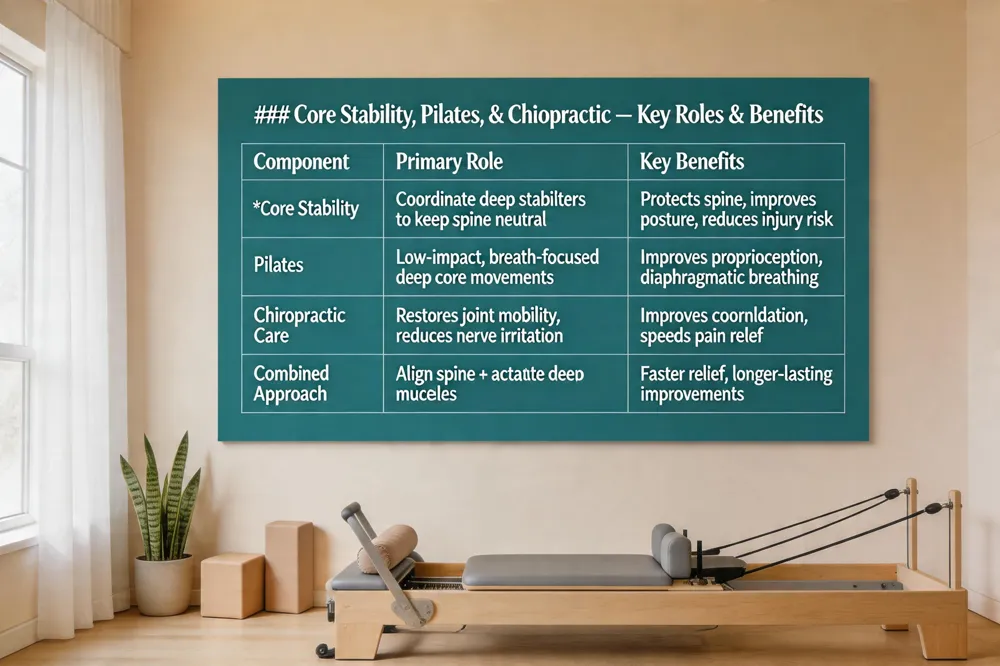 Core stability is the coordinated activation of deep stabilizers—transverse abdominis, multifidus, diaphragm, pelvic floor—and the stabilmuscles of the abdomen, lower back, hips, and pelvis that keep the spine neutral during movement. A stable core protects the spine, improves posture, and transfers force efficiently, reducing strain and lowering the risk of back pain and injury.
Pilates delivers low‑impact, breath‑focused training that isolates these deep muscles. Controlled movements such as the Hundred, Bird‑Dog, and Plank variations emphasize diaphragmatic breathing and a neutral spine, promoting intra‑abdominal pressure and enhancing proprioception.
Chiropractic adjustments restore proper joint motion and reduce nerve irritation, creating a biomechanically sound foundation for core muscles to fire without compensatory tension. Adjustments also improve neuromuscular coordination, allowing Pilates exercises to be performed with greater range and less discomfort.
When Pilates and chiropractic care are combined, patients experience faster pain relief, longer‑lasting functional gains, and better postural awareness. The synergistic effect stems from spinal alignment (chiropractic) and targeted deep‑muscle activation (Pilates), together supporting holistic spinal health.
Why is core stability important? A stable core acts as the central link that protects the spine, promotes proper posture, enhances balance, and improves force transfer in daily and athletic activities, reducing injury risk and pain.
nn apnea are benefits the of to preferred a chiropractor? Realigning the spine relieves nerve pressure, improves mobility, reduces reliance on medication, and provides personalized exercise and ergonomic guidance for overall wellness.
Chiropractic benefits and disadvantages? Benefits include rapid pain relief, improved joint mobility, and preventative health support; disadvantages may involve temporary soreness, a series of visits for lasting results, and rare risks such as vascular injury with high‑velocity neck adjustments, especially in patients with osteoporosis or severe spinal pathology.
Home‑Based Core Stability Routine
Home‑Based Core Routine – Exercise Guide
| Exercise | Sets | Reps / Hold Time | Progression Tips |
|---|---|---|---|
| Plank | 2‑3 | 30‑60 sec | Add instability (BOSU/ball) or light band. |
| Side Plank | 2‑3 | 30‑45 sec each side | Hip dips or weighted vest. |
| Bird‑Dog | 2‑3 | 12‑15 reps per side | Use resistance band around thigh. |
| Glute Bridge | 2‑3 | 12‑15 reps | Single‑leg variation, place a weight on hips. |
| Dead‑Bug | 2‑3 | 12‑15 reps per side | Add a stability ball under lower back. |
| Supine Heel Taps | 2‑3 | 12‑15 reps per side | Hold a light dumbbell on thighs. |
| Marching Glute Bridge | 2‑3 | 12‑15 reps per leg | Increase tempo, add ankle weights. |
Breathing cue: “Draw‑in” – exhale while pulling belly button toward spine to engage transverse abdominis. |
Frequency: 3‑4 × /week.
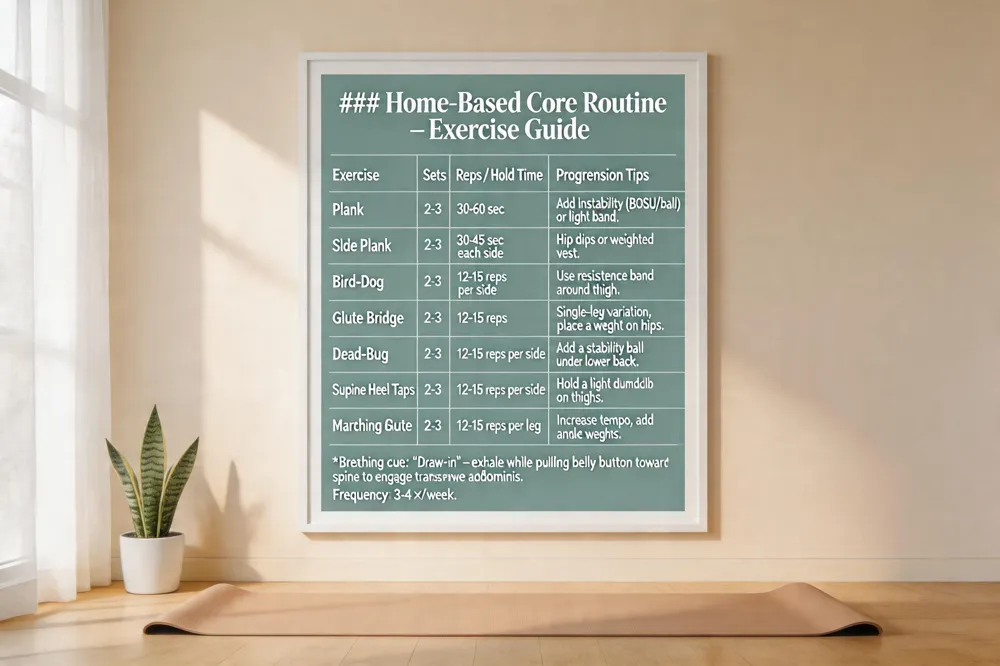 A home‑based core program should start with body‑weight moves that fire the deep stabilizers—plank, side plank, bird‑dog, glute bridge, dead‑bug, supine heel taps, and marching glute bridge. Perform each motion slowly, keeping the spine neutral and avoiding momentum.
Breathing technique – practice the “draw‑in” cue: exhale while pulling the belly button toward the spine, which activates the transverse abdominis and diaphragm, creating a hydraulic brace that protects the lumbar spine.
Progression – once you can hold a plank for 30‑60 seconds or complete 12‑15 controlled reps of the other moves, add instability (a stability ball, BOSU, or a rolled towel) or light resistance bands for extra challenge. Anti‑rotation drills such as Pallof presses or side‑plank with hip dips further improve lumbar‑pelvic‑hip (LPHC) control.
Frequency & set/rep guidelines – aim for 2‑3 sets of 12‑15 repetitions (or 30‑60 second holds) for each exercise, three to four times per week. Consistency is key; progressive overload should be modest—increase hold time or add a band once the current level feels easy.
How to improve core stability at home – combine the moves above with focused breathing, maintain proper form, and gradually increase difficulty through instability or resistance.
How can I improve my core stability? – master basic stabilization, emphasize quality over quantity, then integrate anti‑rotation and unstable‑surface work while keeping the deep core engaged.
What are five signs your core is weak? – frequent lower‑back pain, poor posture (slouching, rounded shoulders), balance problems, difficulty with everyday tasks (standing, lifting, bending), and rapid fatigue during core‑engaging exercises.
Pilates Foundations for Core Strength
Pilates Foundations – Core Strength Table
| Exercise | Reps / Pumps | Primary Focus | Progression |
|---|---|---|---|
| Hundred | 100 pumps (10 sets of 10) | Diaphragmatic breathing, transverse abdominis activation | Add light ankle weights or a Pilates ring. |
| Single‑Leg Stretch | 8‑12 reps per side | Pelvic stability, coordination | Increase tempo, add a small ball between knees. |
| Double‑Leg Stretch | 8‑12 reps | Full‑body coordination, core endurance | Perform on a reformer or with a resistance band. |
| Rolling‑Like‑a‑Ball | 8‑10 reps | Spinal flexion control, deep core | Use a softer ball for beginners, harder ball for advanced. |
| Modified Plank | 30‑60 sec | Global core bracing | Add shoulder taps or leg lifts. |
Progression timeline: After 4‑6 weeks (2‑3 sessions/week) move to intermediate variations (e.g., side‑plank with leg lift). |
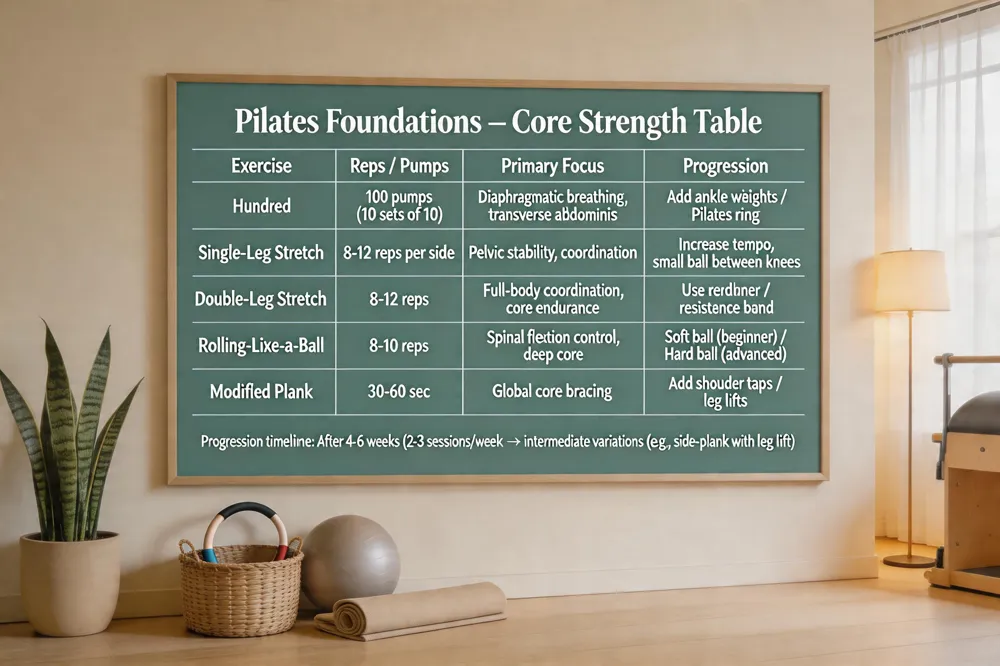 A solid Pilates routine for core strength begins with beginner‑friendly moves that teach proper spinal alignment and breath‑movement coordination. Core Hundred, Single‑Leg Stretch, Double‑Leg Stretch, Rolling‑Like‑a‑Ball and a Modified Plank are ideal first steps; each exercise emphasizes a neutral spine and the “draw‑in” maneuver—pulling the belly button toward the spine on every exhale—to engage the transverse abdominis and multifidus. Slow, controlled motions paired with a steady inhale‑exhale rhythm create intra‑abdominal pressure, stabilising the lumbar region and reducing strain.
After four to six weeks of consistent practice (2‑3 sessions per week, 8‑12 repetitions or 50‑100 pumps for the Hundred), the body gains enough endurance to progress to intermediate variations such as the Pilates Hundred with added resistance, side‑plank with leg lift, or reformer work that challenges the core further while maintaining spinal alignment.
Adaptations for seniors keep the same principles but reduce impact. Seated Marches, Modified Side‑Leg Lifts from a chair, Knee‑down Bent‑Arm Plank, and gentle Swimming or Saw movements provide low‑impact core activation, improve posture, and enhance balance. Performing these adaptations 2‑3 times weekly supports functional stability and a healthier spine.
Answering common questions: “Pilates for core strength beginners” begins with the foundational moves described above, focusing on breath coordination and gradual progression. “10 basic Pilates exercises” include the Hundred, Roll‑Up, Single‑Leg Stretch, Double‑Leg Stretch, Spine Stretch Forward, Saw, Swan, Side‑Kick Series, a Modified Teaser, and a Kneeling Plank, offering a balanced core workout. “Pilates core exercises for seniors” consist of seated marches, chair planks, and gentle swimming motions, all designed to strengthen the deep stabilizers while protecting the lower back.
Athlete‑Focused Core Training and Gym Strategies
Athlete‑Focused Core & Gym Strategies
| Exercise | Equipment | Sets | Reps / Hold | Targeted Core Function |
|---|---|---|---|---|
| Pallof Press | Cable or band | 3 | 12‑15 reps each side | Anti‑rotation stability |
| BOSU Bird‑Dog | BOSU | 3 | 12‑15 reps per side | Posterior chain activation |
| Stability‑Ball Dead‑Bug | Stability ball | 3 | 12‑15 reps per side | Deep core bracing |
| Weighted Plank | Weight plate or kettlebell | 3 | 45‑60 sec | Global endurance |
| Cable Rotation | Cable machine | 3 | 8‑12 reps each side | Anti‑flexion/rotation |
| Medicine‑Ball Wood Chop | Medicine ball | 3 | 8‑12 reps each side | Oblique power |
| Kettlebell Swing | Kettlebell | 3 | 15‑20 reps | Hip‑hinge core integration |
| Turkish Get‑Up | Kettlebell | 3 | 5‑6 reps per side | Full‑body stability |
Strategy Tip: Combine chiropractic adjustments weekly to maintain joint mobility, allowing higher quality execution of these drills. |
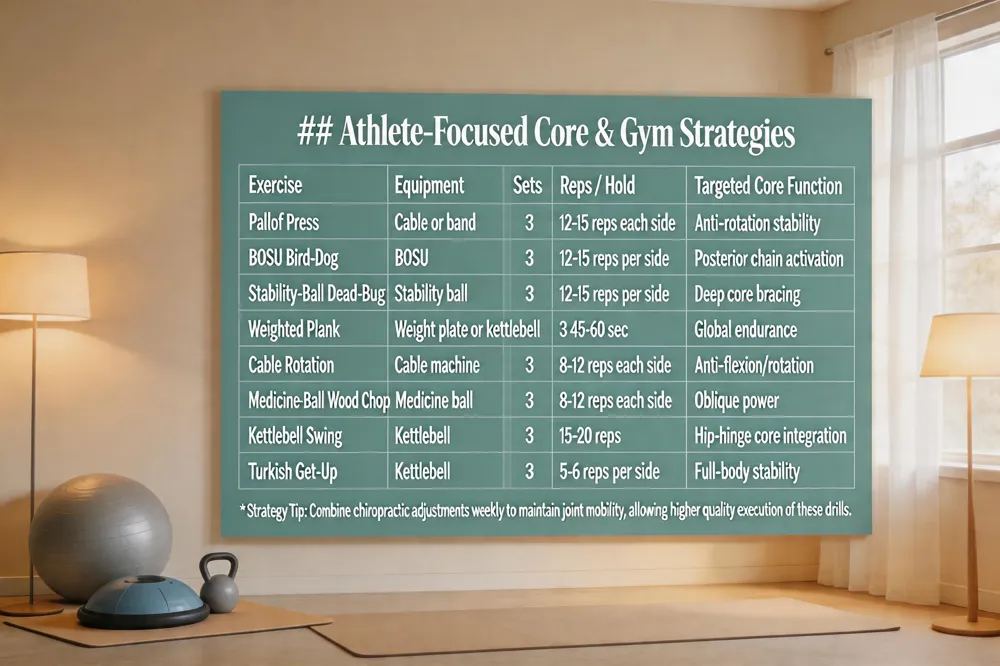 Because a strong, stable core underpins every athletic movement, integrating Pilates‑based core work with chiropractic care yields faster, longer‑lasting gains.
Anti‑rotation & anti‑flexion drills – Exercises such as the Pallof press, BOSU bird‑dog, and stability‑ball dead‑bug resist unwanted spine and pelvis motion while encouraging a braced, neutral spine. These patterns, deep stabilizers (transverse abdominis, multifidus) and improve proprioception, which research shows reduces low‑back pain and boosts functional performance.
Gym equipment adaptations – Replace traditional crunches with controlled, low‑impact moves on a BOSU, medicine ball, or cable station. Cable rotations and medicine‑ball wood chops add anti‑rotational loading, while weighted plank variations and side‑plank hip dips develop endurance without excessive lumbar flexion.
Kettlebell core integration – The off‑center weight of kettlebell swings, goblet squats, Turkish get‑ups, and single‑arm presses forces continuous activation of the deep core, enhancing spinal alignment and balance. “Around the World” swings and Russian twists add anti‑rotational control, complementing the diaphragmatic breathing emphasized in Pilates.
Functional strength transfer – By combining chiropractic adjustments (which restore joint mobility and reduce nerve irritation) with the above core drills, athletes experience faster recovery, improved postural awareness, and a more efficient transfer of force from the lower to the upper body.
Answers to common questions
- Core stability exercises for athletes: Focus on anti‑movement patterns—Pallof press, bird‑dog, side‑plank with hip dips, single‑leg Romanian deadlifts, stability‑ball dead‑bugs, marching glute bridges—performed slowly with a braced core, progressing load or instability over time.
- Core stability exercises for the gym: Use BOSU bird‑dog, stability‑ball dead‑bug, weighted planks, cable rotations, medicine‑ball wood chops, marching glute bridges, and single‑leg abdominal presses; aim for 8‑12 controlled reps, three sets, finishing with a short endurance hold.
- Core stability exercises with kettlebell: Incorporate kettlebell swings, goblet squats, Turkish get‑ups, single‑arm presses, “Around the World,” and Russian twists, maintaining a neutral spine and diaphragmatic breathing for optimal activation.
Physiotherapy Perspective and Safe Progression
Physiotherapy Core Progression Blueprint
| Phase | Exercise | Sets | Reps / Hold | Progression Criteria |
|---|---|---|---|---|
| Motor‑Control | Bird‑Dog, Dead‑Bug, Supine Marching, Resisted Hip‑Abduction | 2‑3 | 12‑15 reps per side | Able to maintain neutral spine with <5 % compensation. |
| Static Holds | Front Plank, Side‑Bridge, Modified McGill Curl‑up | 2‑3 | 30‑60 sec (planks) / 10‑12 reps (curl‑up) | Hold time >45 sec without lumbar arching. |
| Dynamic Resistance | Light bands, ankle weights, resisted dead‑bugs | 3 | 12‑15 reps | Increased resistance while preserving form. |
| Advanced Integration | Anti‑rotation Pallof Press, Weighted Bird‑Dog | 3 | 12‑15 reps per side | Load added with no pain flare‑up. |
Big 3 (McGill): Curl‑up, Side Plank, Bird‑Dog – performed daily for balanced core resilience. |
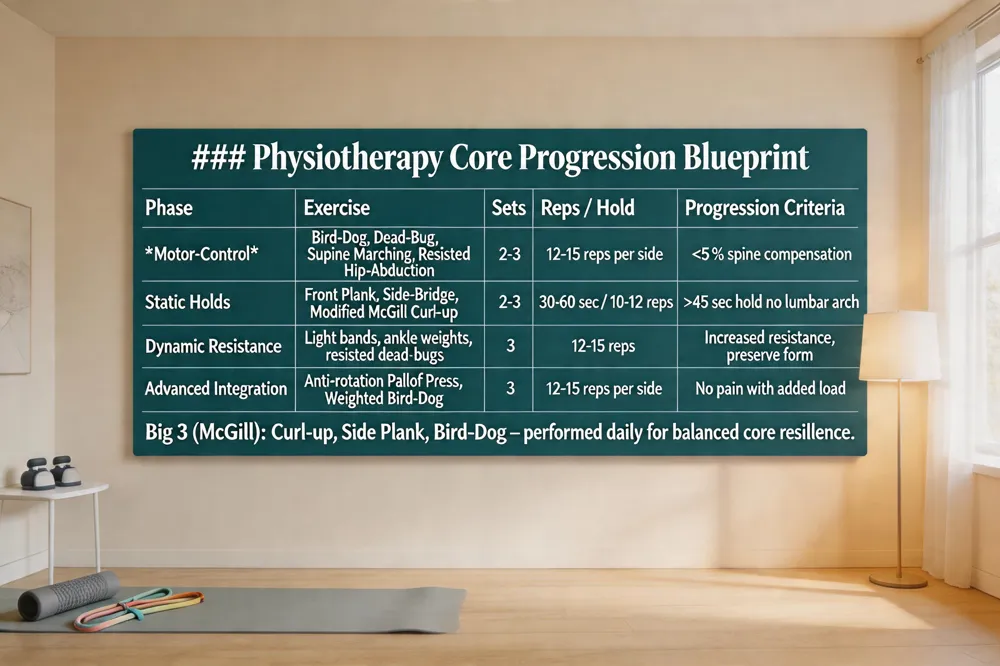 Physiotherapists typically start core‑stability training with low‑impact motor‑control drills that teach patients to engage deep trunk muscles while maintaining a neutral spine. Classic examples are the bird‑dog, dead‑bug, supine marching, and resisted hip‑abduction—movements that promote spinal posture and lumbar‑pelvic awareness without excessive loading. Once patients demonstrate reliable activation of the transverse abdominis and multifidus, clinicians shift to static holds such as the front plank, side‑bridge, and the modified McGill curl‑up, emphasizing diaphragmatic breathing and a bracing sensation throughout the torso. Light resistance bands or ankle weights can then be added for dynamic variations, progressively challenging core endurance and neuromuscular coordination.
The “Big 3” core‑stability exercises identified by Dr. Stuart McGill are the curl‑up, side plank (or side bridge), and bird‑dog. The curl‑up strengthens the abdominal wall while preserving lumbar neutrality; the side plank targets lateral stabilizers—including obliques, quadratus lumborum, and hip abductors; and the bird‑dog activates the posterior chain (erector spinae, glutes, shoulder stabilizers) through opposite‑limb extension. Performing these three movements daily builds balanced, resilient core control that protects the spine.
For individuals with scoliosis, exercises that force excessive forward flexion, side‑flexion, or rotation should be avoided. Traditional crunches, sit‑ups, weighted Russian twists, and heavy overhead presses can aggravate the curved spine and increase pain. Instead, focus on neutral‑spine Pilates moves (e.g., pelvic tilts, modified planks) and the McGill exercises, which reinforce stability without imposing harmful shear or rotational forces.
Chiropractic Care Practicalities
Chiropractic Care Practicalities
| Topic | Details |
|---|---|
| Pricing (Gastonia, NC) | New‑patient consult: $75‑$120; Follow‑up adjustment: $40‑$70. US average cash visit: $60‑$200 (≈$65 avg). |
| Common Side Effects | Mild soreness, stiffness, fatigue, light‑headedness (24‑48 h). Rare headache, transient nerve irritation. |
| Serious Risks | Extremely rare vertebral‑artery dissection or stroke (high‑velocity neck). |
| Post‑Adjustment Relief | Hydration, warm compress (15‑20 min) or ice (first 24‑48 h), light dynamic stretches, short walks, avoid heavy lifting for the day. OTC NSAID if needed. |
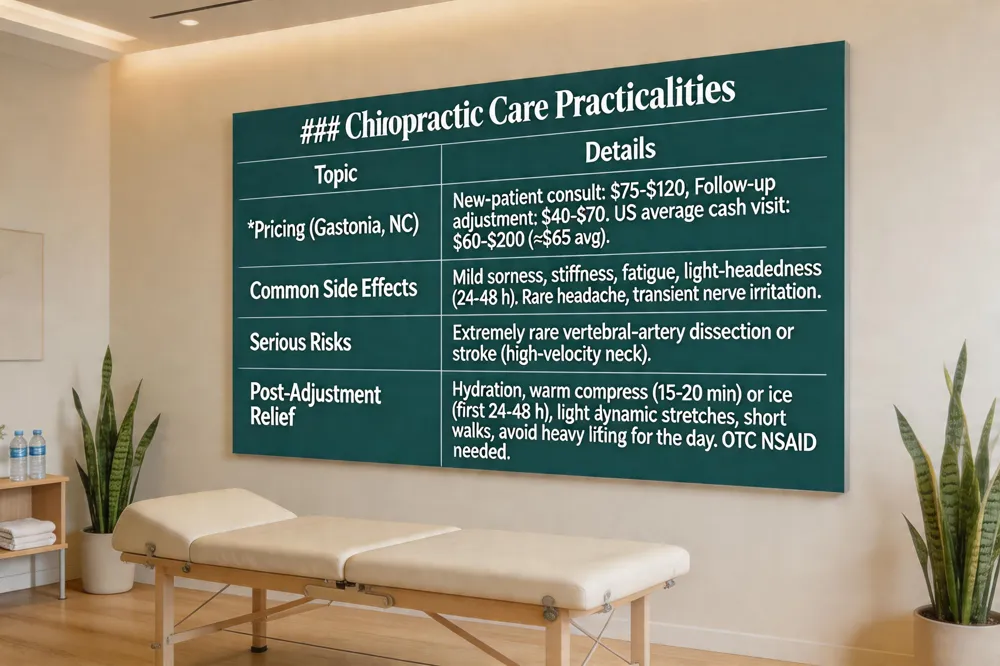 Pricing in Gastonia, NC
In Gastonia, NC, a new‑patient chiropractic consultation and exam typically costs between $75 and $120, depending on the provider and any diagnostic testing that may be included. Follow‑up adjustments for established patients are usually priced from $40 to $70 per visit. On a broader scale, the average cash‑based chiropractic visit in the United States ranges from $60 to $200, with many practices reporting an average of about $65 per session. Clinics often offer package discounts or cash‑payment incentives that lower the per‑visit price, and insurance may cover a portion of these fees.
Pricing in Gastonia, NC
In Gastonia, NC, a new‑patient chiropractic consultation and exam typically costs between $75 and $120, depending on the provider and any diagnostic testing that may be included. Follow‑up adjustments for established patients are usually priced from $40 to $70 per visit. On a broader scale, the average cash‑based chiropractic visit in the United States ranges from $60 to $200, with many practices reporting an average of about $65 per session. Clinics often offer package discounts or cash‑payment incentives that lower the per‑visit price, and insurance may cover a portion of these fees.
Common adjustment side effects Most patients experience mild, short‑term reactions such as soreness or stiffness in the treated area, a feeling of fatigue, or light‑headedness that typically resolves within 24‑48 hours. Occasionally a temporary headache may occur, usually subsiding within a few hours. Rarely, an adjustment can aggravate a pre‑existing herniated disc or compress a nerve, leading to heightened pain or radiating symptoms. The most serious, but extremely uncommon, complications include vertebral‑artery dissection or stroke after high‑velocity neck manipulations. Serious adverse events are exceedingly rare when performed by a licensed chiropractor.
Post‑adjustment pain relief strategies Stay well‑hydrated to help flush out released toxins and support muscle recovery. Apply a warm compress or gentle heat for 15‑20 minutes to relax muscles, or use an ice pack for the first 24‑48 hours if inflammation is present. Perform light, dynamic stretches and short walks to keep joints mobile, avoid heavy lifting or intense exercise for the rest of the day, and rest adequately. If discomfort persists beyond a day or two, an over‑the‑counter NSAID may be used as directed; contact your chiropractor if pain worsens.
Myths, Evidence, and the 3‑2‑1 Core Method
Myths, Evidence & the 3‑2‑1 Core Method
| Concept | Evidence / Explanation |
|---|---|
| Is chiropractic pseudoscience? | Spinal manipulation has strong evidence for low‑back, neck pain, and certain headaches; endorsed by major guidelines. The “subluxation” theory lacks support, but evidence‑based practice focuses on musculoskeletal conditions. |
| Evidence Base | Systematic reviews show combined chiropractic + core‑strengthening (Pilates) yields up to 40 % greater pain reduction vs. either alone. |
| 3‑2‑1 Core Method | 3 × strength‑training days, 2 × Pilates sessions, 1 × cardio day + rest/active‑recovery. Pilates moves (Hundred, Bird‑Dog, Side‑Plank) + weekly chiropractic adjustments = synergistic spinal health. |
| Implementation | Perform Pilates 2‑3 × /week, schedule chiropractic check‑ups every 1‑2 weeks initially, then monthly for maintenance. |
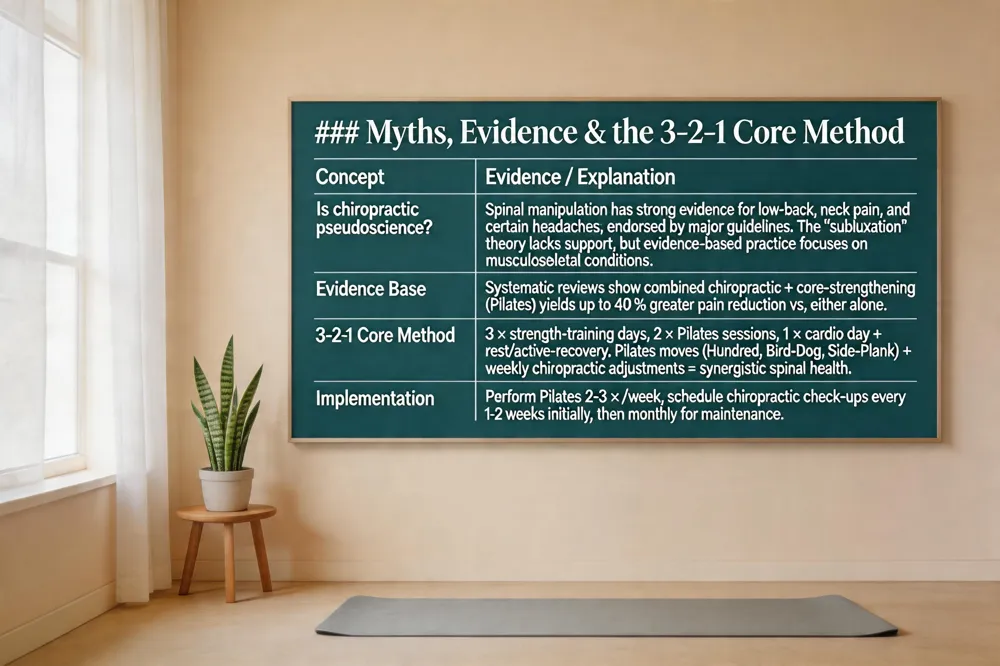 Is chiropractic care pseudoscience?
Chiropractic care is not a blanket pseudoscience. Its core technique—spinal manipulation—has robust evidence for relieving low‑back pain, neck pain, and certain headaches, and is endorsed by major medical guidelines such as the American College of Physicians. While some practitioners still invoke the unproven concept of “subluxation” to explain systemic disease, the majority of evidence‑based chiropractors focus on musculoskeletal conditions, where safety profiles are strong and serious adverse events are rare.
Is chiropractic care pseudoscience?
Chiropractic care is not a blanket pseudoscience. Its core technique—spinal manipulation—has robust evidence for relieving low‑back pain, neck pain, and certain headaches, and is endorsed by major medical guidelines such as the American College of Physicians. While some practitioners still invoke the unproven concept of “subluxation” to explain systemic disease, the majority of evidence‑based chiropractors focus on musculoskeletal conditions, where safety profiles are strong and serious adverse events are rare.
Evidence base for chiropractic Systematic reviews in journals like the Journal of Manipulative and Physiological Therapeutics and Spine show that combined chiropractic adjustments and core‑strengthening exercises produce greater pain reduction and functional improvement than either approach alone. Studies on chronic low‑back pain report up to a 40 % decrease in pain scores when spinal manipulation is paired with targeted exercises such as Pilates.
Integrating Pilates and chiropractic in a weekly plan A practical schedule follows the 3‑2‑1 core method: three strength‑training days, two Pilates‑focused sessions, and one cardio day, with a rest or active‑recovery day. Pilates moves—The Hundred, Bird‑Dog, and side‑plank—activate deep stabilizers (transverse abdominis, multifidus) while chiropractic adjustments restore joint mobility, creating a synergistic environment for spinal health. Consistent practice 2–3 times per week, supplemented by regular chiropractic check‑ups, supports posture, reduces pain, and enhances overall functional fitness.
Putting It All Together for a Stronger Spine
Pilates and chiropractic care work hand‑in‑hand: Pilates builds deep core strength and flexibility while adjustments restore joint motion and reduce nerve irritation, creating a stable, pain‑free spine. Starting a personalized routine—10‑15 minutes of mat Pilates a few times weekly, plus regular adjustments—can quickly improve posture, balance, and daily function. Contact Southeast Family Chiropractic in Gastonia, NC, today to receive a tailored program and begin your journey toward lasting spinal health and enjoy a stronger, more resilient, everyday you.