Why Early Prevention Matters
Whiplash, the most frequent neck injury from rear‑end crashes, results from a rapid forward‑then‑backward thrust that stretches cervical muscles, ligaments and discs. Because the soft‑tissue damage can be hidden on X‑ray, symptoms often appear 24‑48 hours after the impact, and untreated cases may evolve into chronic pain, headaches and reduced mobility. Prompt medical evaluation—even after a minor fender‑bender—allows clinicians to identify subtle subluxations, begin ice therapy, and start gentle range‑of‑motion exercises before inflammation solidifies. Southeast Family Chiropractic embraces this early‑intervention philosophy by educating drivers on proper seat‑belt use, head‑rest positioning and safe following distances, then offering same‑day assessments and chiropractic adjustments that restore vertebral alignment, relieve muscle tension and reinforce neck‑strengthening programs. By coupling preventative education with evidence‑based treatment, the clinic helps patients avoid long‑term whiplash complications and return to daily activities faster. Patients also receive personalized home‑exercise plans, posture coaching, and regular follow‑up to monitor progress and prevent future flare‑ups.
Immediate Post‑Crash Actions to Reduce Whiplash
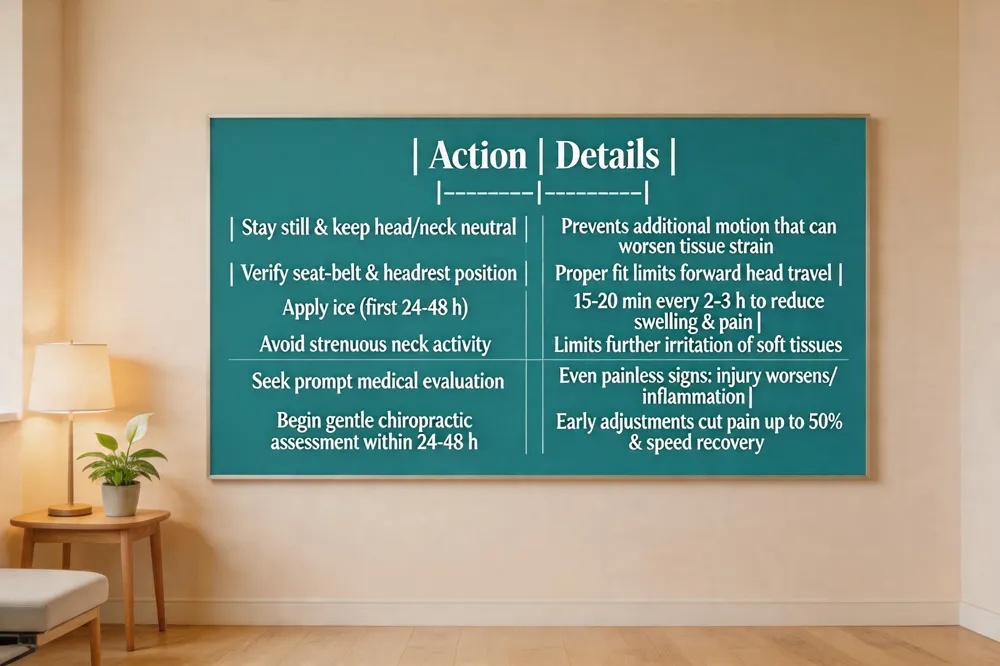
| Action | Details |
|---|---|
| Stay still & keep head/neck neutral | Prevents additional motion that can worsen tissue strain |
| Verify seat‑belt & headrest position | Proper fit limits forward head travel |
| Apply ice (first 24‑48 h) | 15‑20 min every 2‑3 h to reduce swelling & pain |
| Avoid strenuous neck activity | Limits further irritation of soft tissues |
| Seek prompt medical evaluation (even painless)))s signs of Development injury of worsens inflammation | |
| Begin gentle chiropractic assessment within 24‑48 h | Early adjustments can cut pain intensity up to 50 % and speed recovery |
 How to prevent whiplash after a car accident
Immediately after a crash, stay still, keep the head and neck neutral, ensure proper seat‑belt and headrest positioning, apply ice for the first 24‑48 hours, and avoid strenuous neck activity. Prompt medical evaluation, even without pain, catches early signs of whiplash before inflammation worsens.
How to prevent whiplash after a car accident
Immediately after a crash, stay still, keep the head and neck neutral, ensure proper seat‑belt and headrest positioning, apply ice for the first 24‑48 hours, and avoid strenuous neck activity. Prompt medical evaluation, even without pain, catches early signs of whiplash before inflammation worsens.
Whiplash after car accident Whiplash is a soft‑tissue neck injury caused by rapid forward‑and‑backward motion of the head, stretching muscles, ligaments, discs and nerves. Symptoms—neck pain, stiffness, headaches, reduced range of motion, shoulder or arm pain, tingling, dizziness—may be delayed 24‑48 hours. Early chiropractic care with gentle spinal adjustments can reduce pain, restore mobility, and accelerate healing.
Delayed neck pain after car accident Neck pain that appears days after a crash is a classic whiplash sign. Untreated, it can progress to chronic stiffness, headaches, or disc degeneration. Early chiropractic evaluation identifies tissue damage, reduces inflammation, and restores alignment before chronicity sets in.
Whiplash symptoms delayed Delayed whiplash signs include persistent neck stiffness, base‑of‑skull headaches, dizziness, arm tingling, and sleep disturbances. If any develop after an impact, schedule a professional assessment promptly to begin a non‑invasive, personalized rehabilitation plan.
The Mechanics and Modern Terminology of Whiplash
| Phase | Description |
|---|---|
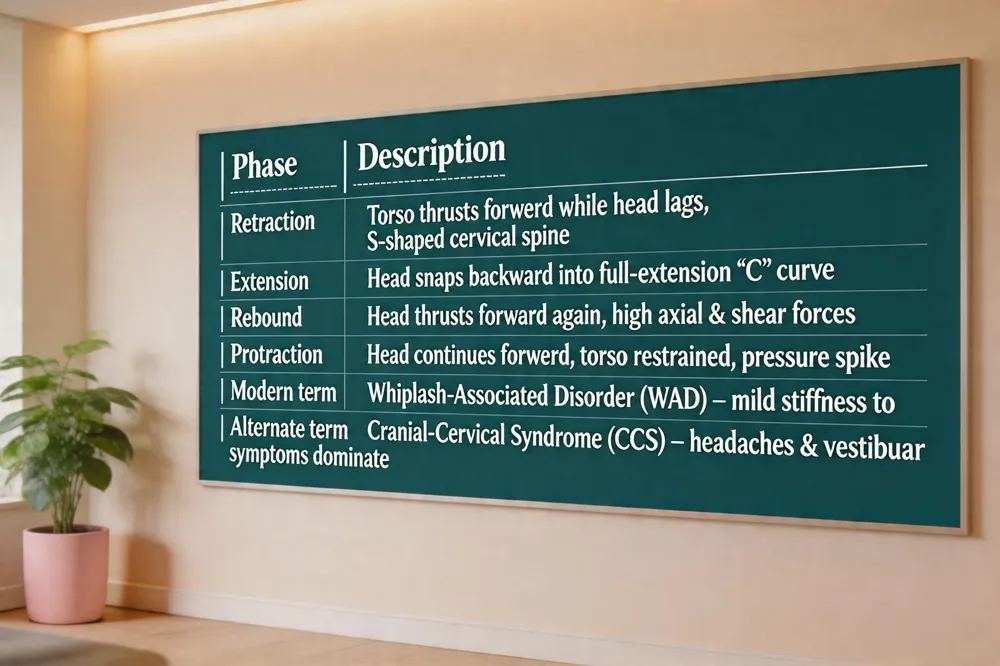
| Retraction | Torso thrusts forward while head lags, creating an S‑shaped cervical spine |
| Extension | Head snaps backward into a full‑extension “C” curve |
| Rebound | Head thrusts forward again, generating high axial & shear forces |
| Protraction | Head continues forward while torso restrained, producing another pressure spike |
| Modern term | Whiplash‑Associated Disorder (WAD) – grades severity from mild stiffness to chronic pain |
| Alternate term | Cranial‑Cervical Syndrome (CCS) – used when headaches & vestibular symptoms dominate |
What are the 4 phases of whiplash?
The four phases occur in rapid succession: retraction (torso thrust forward while the head lags, creating an S‑shaped cervical spine), extension (the head snaps backward into a full‑extension "C" curve), rebound (the head thrust forward again, producing high axial and shear forces as the neck flexes), and protraction (the head continues forward while the torso is restrained, generating another pressure spike within the spinal canal).
Whiplash meaning
Whiplash is a neck injury caused by a sudden backward‑then‑forward motion of the head, producing a rapid “whipping” of the cervical spine. It most often follows rear‑end collisions but can also arise from sports impacts, falls, or abuse. Typical symptoms include neck pain, stiffness, limited range of motion, headaches, shoulder or upper‑back discomfort, and arm tingling. Early diagnosis and a personalized treatment plan are essential to prevent chronic pain.
What is whiplash called now?
The condition is now commonly labeled Whiplash‑Associated Disorder (WAD), a classification that grades severity from mild stiffness to chronic pain with neurological or psychosocial signs. Some literature also uses Cranial‑Cervical Syndrome (CCS) when headaches and vestibular symptoms dominate. These modern terms replace the vague "whiplash" label and guide evidence‑based, non‑surgical care such as chiropractic adjustments and targeted rehabilitation.
Vehicle Safety Features and Proper Positioning
| Feature | How it reduces whiplash risk |
|---|---|
| Seat‑belt (lap‑and‑shoulder) | Primary restraint; limits torso forward motion, directly reducing head‑to‑torso surge |
| Headrest (2‑4 inches gap) | Keeps head from hyper‑extending; aligns top of headrest with driver’s head |
| Active head restraints | Move forward on impact, cutting neck forces up to ~50 % |
| Crumple zones | Deform to absorb kinetic energy, lengthening crash pulse and lowering average force |
| Airbags (with belt) | Protect head/chest; optimal performance only when belt is fastened |
| Safe following distance (3‑second rule) | Gives drivers reaction time, decreasing rear‑end collisions |
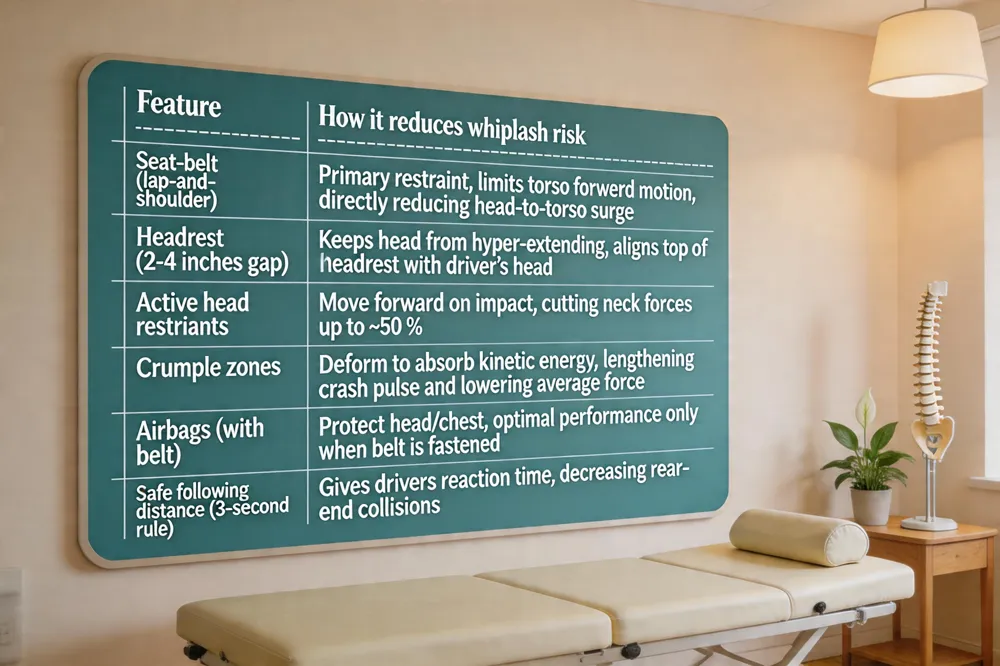 Seat‑belt as the primary protective device – A properly worn lap‑and‑shoulder belt restrains the torso, limiting forward head motion and cutting whiplash risk more effectively than any other device. Airbags complement the belt but cannot replace it.
Headrest height and distance guidelines (2‑4 inches) – Adjust the headrest so its top is level with the driver’s head and the gap behind the head is no more than 2–4 inches (5–10 cm). This minimizes neck hyperextension and hyperflexion in a rear‑impact crash.
Active head restraints and their impact on force reduction – Modern active headrests move forward during a collision, reducing neck forces by up to 50 %.
Crumple zones and energy absorption – Crumple zones are engineered sections that deform in a controlled manner, absorbing kinetic energy and extending the time over which momentum changes, thereby lowering the average force transmitted to occupants.
Airbag systems work in conjunction with seat‑belts – Airbags deploy to protect the head and chest but achieve optimal performance only when the belt is fastened, sharing the load and preventing excessive forward motion.
Safe following distance and defensive driving – Maintaining at least a three‑second gap (or one car length per 10 mph) gives drivers reaction time, reducing rear‑end collisions that cause whiplash.
The best safety feature for preventing whiplash is the airbag
False – seatbelts are the single most effective safety feature for preventing whiplash. They restrain the body and limit forward head‑to‑torso motion; airbags work with seatbelts, not as a substitute.
What are the crumple zones of a car specially designed to do
Crumple zones are engineered sections of a vehicle’s structure that deform in a controlled way during a collision, absorbing and dissipating kinetic energy. By lengthening the crash pulse, they lower the average impact force transferred to occupants while the rigid passenger‑cage remains intact.
What are 90% of accidents caused by?
More than 90 % of motor‑vehicle accidents in the United States result from human error—speeding, distracted driving, fatigue, impairment, and poor judgment. Driver behavior remains the primary factor, underscoring the need for safe habits and prompt chiropractic care after a collision.
Therapeutic Interventions and Rehabilitation
| Intervention | Typical timing & purpose |
|---|---|
| Ice (first 48 h) | 15‑20 min q2‑3 h – reduces swelling & pain |
| Heat (after swelling) | Improves tissue extensibility |
| NSAIDs (e.g., ibuprofen) | Analgesic & anti‑inflammatory |
| Gentle cervical chiropractic | Within 24‑48 h – realigns vertebrae, eases muscle tension |
| Soft‑tissue therapies (massage, trigger‑point) | Loosen tight muscles, enhance circulation |
| Early ROM & strengthening (chin tucks, scapular retractions) | Maintain mobility, prevent chronic stiffness |
| Modalities (ultrasound, TENS) | Analgesic effects, promote tissue repair |
| Activity pacing (≤3 h collar/day, ≤48 h total) | Avoid prolonged immobilization while staying lightly active |
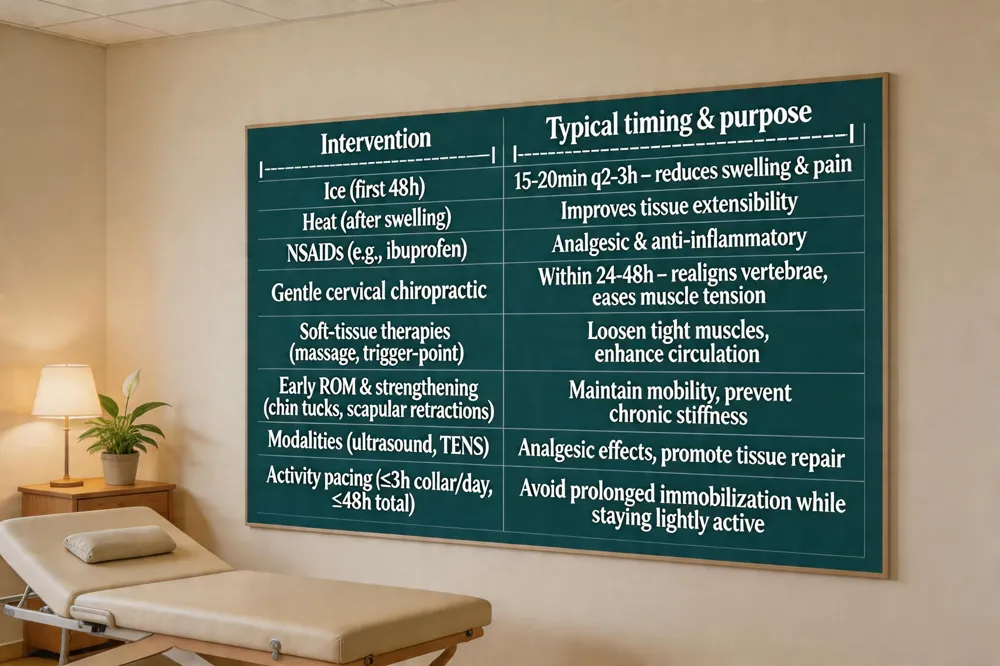 Whiplash treatment – The primary goal is to relieve pain, restore neck motion, and return to daily activities quickly and safely. Initial care includes brief rest, alternating ice (15‑20 min every 2‑3 h for the first 48 h) and heat after swelling subsides, and over‑the‑counter NSAIDs such as ibuprofen. Prolonged bed‑rest is avoided because it can delay healing and increase stiffness.
Early chiropractic spinal adjustments – Within 24‑48 h of injury, a qualified chiropractor can perform gentle cervical adjustments that realign vertebrae, reduce muscle tension, and improve blood flow. Studies show early adjustments may cut pain intensity by up to 50 % and shorten recovery.
Soft‑tissue therapies – Massage, trigger‑point release, and myofascial techniques complement adjustments by loosening tight muscles, decreasing inflammation, and enhancing circulation.
Gentle range‑of‑motion and strengthening exercises – Early, pain‑free neck rotations, chin tucks, scapular retractions, and shoulder rolls maintain mobility and prevent chronic stiffness. Progressive strengthening of deep neck flexors and upper‑back muscles builds cervical stability for future impact resistance.
Modalities – Therapeutic ultrasound and low‑frequency TENS provide analgesic effects and promote tissue repair. After the acute phase, moist heat improves muscle extensibility, while ice remains useful for flare‑ups.
Guidelines on activity pacing and avoiding prolonged immobilization – Patients should stay lightly active, resuming normal tasks as tolerated, and limit collar use to short periods (≤3 h/ day, ≤48 h total). Gradual return to low‑impact aerobic activity (e.g., walking) supports circulation without stressing healing tissues.
Whiplash injury – A rapid forward‑then‑backward neck motion, most often in rear‑end collisions, stretches ligaments, muscles, and discs, producing pain, stiffness, headaches, and occasional neurological signs.
How long does whiplash last – Mild cases improve in 2‑4 weeks; moderate injuries may persist 6‑12 weeks; severe cases can last months to a year. Early, multimodal care shortens this timeline.
Whiplash nerve‑damage symptoms – Tingling, numbness, arm weakness, and shooting pains indicate nerve involvement and warrant prompt evaluation.
How to sleep with whiplash – Use a supportive cervical pillow that aligns the head with the spine, sleep on the back with a pillow under the knees, and avoid stomach‑lying.
Is whiplash dangerous – While many recover fully, untreated whiplash can become chronic, leading to persistent pain, disability, and reduced quality of life; early intervention is essential.
Legal, Financial, and Settlement Considerations
| Factor | Typical impact on settlement |
|---|---|
| Injury severity (soft‑tissue vs nerve damage) | Soft‑tissue: $5‑15 k; moderate: $30‑75 k; severe/nerve: $100 k+ |
| Documented medical costs & lost wages | Increases compensation proportionally |
| Clear liability (police report, witnesses) | Strengthens claim, leads to higher offers |
| Early professional evaluation | Provides timely records, supports higher payout |
| Pre‑existing conditions | May reduce settlement amount if not clearly aggravated |
 When a whiplash injury occurs, the typical settlement amount falls between $12,000 and $30,000 for non‑permanent cases with clear liability. Milder injuries that require only a few doctor visits may settle for $5,000‑$15,000, while moderate cases with ongoing treatment often reach $30,000‑$75,000. High‑value settlements—$100,000 or more—are possible when nerve damage, surgery, or significant lost wages are involved. In general, most claims settle in the low‑to‑mid‑tens of thousands, driven by injury severity, documented medical costs, liability clarity, and additional damages.
The amount you can receive for a neck‑pain car accident settlement varies widely, ranging from roughly $11,000 to $90,000, with many cases clustering around $30,000‑$80,000. Serious injuries such as herniated discs or pinched nerves can push settlements over $100,000, while soft‑tissue strains usually result in lower offers. Factors that influence the payout include medical expenses, lost wages, pain and suffering and any pre‑existing conditions.
Early documentation and prompt professional evaluation are crucial. A thorough medical record—detailing treatment costs, therapy sessions, and time off work—strengthens the claim and helps justify higher compensation. Clear liability, supported by police reports or witness statements, further enhances the settlement potential, ensuring the injured party receives a fair recovery for their losses.
Everyday Preventive Practices and Travel Safety
| Practice | Recommendation |
|---|---|
| Roller‑coaster rides | Ride only if no neck/back issues; follow health warnings |
| Pre‑ride stretching | Gentle neck & back stretches to improve flexibility |
| Hydration | Stay well‑hydrated to maintain tissue elasticity |
| Proper restraint use | Use bars, seatbelts, headrests exactly as instructed |
| Neutral head posture | Sit upright, avoid forward‑leaning or twisting during ride |
| Post‑ride monitoring | Seek chiropractic evaluation if any discomfort appears |
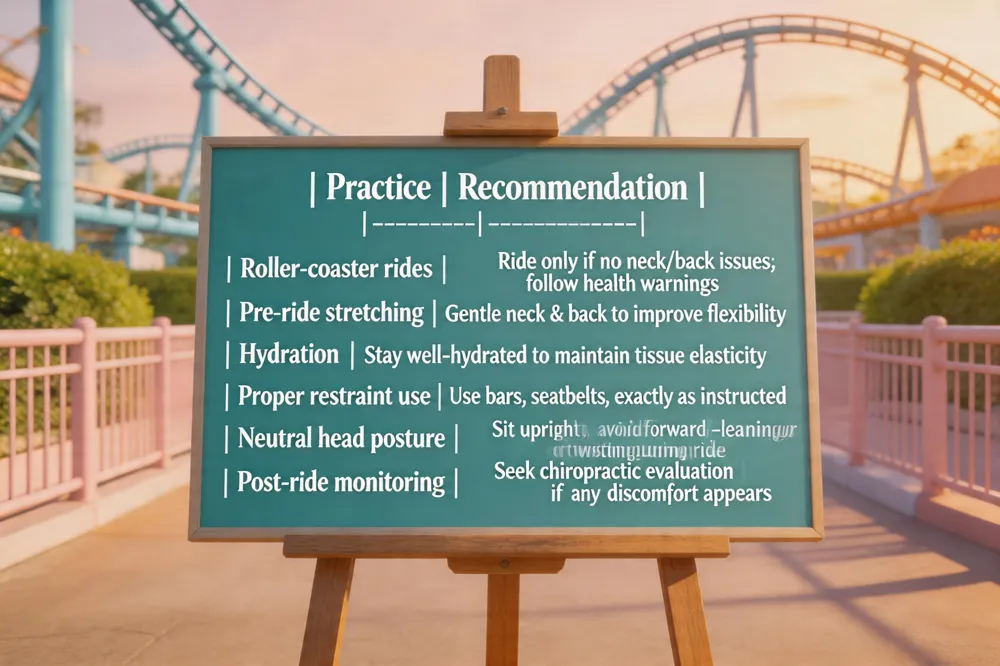 How to avoid whiplash on roller coasters
To keep whiplash at bay, only ride if you have no existing neck or back problems and always heed the park’s health warnings. Before a trip, do gentle neck‑ and back‑stretching and strengthening exercises to improve flexibility and muscle support. Stay well‑hydrated and use the provided restraints—bars, seatbelts, and headrests—exactly as instructed. Sit upright with your head in a neutral position, avoiding forward‑leaning or twisting motions during the ride. If you feel any discomfort afterward, seek a prompt evaluation from a qualified chiropractor.
Take Control of Your Neck Health Today
A quick recap of the eight essential steps that keep whiplash at bay: 1) wear your seat belt snugly across the hips and shoulders; 2) adjust the headrest so its top is level with your head and the gap is no more than 2–4 inches; 3) sit upright with shoulders relaxed and knees slightly bent; 4) maintain a safe following distance (the 2‑second rule) to avoid sudden stops; 5) keep your vehicle’s safety systems—active head restraints, ABS, lane‑departure warnings—functioning; 6) perform regular neck‑strengthening and flexibility exercises such as chin tucks and scapular retractions; 7) avoid prolonged poor posture, especially while using phones or computers; and 8) seek a professional evaluation within 24‑48 hours of any collision, applying ice early to curb inflammation.
At Southeast Family Chiropractic we combine gentle spinal adjustments, soft‑tissue therapies, and personalized rehab programs to restore alignment, reduce pain, and rebuild cervical strength. Our team guides you through every phase of recovery, from acute care to long‑term prevention.
Don’t wait—schedule a prompt evaluation today and protect your neck for tomorrow.