Why Acting Quickly Matters
Car crashes often hide soft‑tissue damage—whiplash, ligament strains, and micro‑tears—that may not be painful until hours or days later. Early chiropractic assessment (ideally within the first 24‑72 hours) can detect these hidden injuries before inflammation solidifies into scar tissue, a key factor that drives chronic pain and reduced mobility. Prompt adjustments improve blood flow, reduce swelling, and halt the cascade that leads to long‑term stiffness or nerve irritation. Acting fast also yields comprehensive medical documentation, which is essential for personal‑injury claims and insurance reimbursement; many policies require timely records to approve coverage. In short, the first three days after an accident are critical for preventing chronic problems and securing the paperwork needed for a smooth claim.
Understanding the Role of Chiropractic in Auto‑Injury Claims
Role of Chiropractic in Auto‑Injury Claims
| Claim Aspect | How Chiropractic Contributes |
|---|---|
| Medical Expense Classification | Most states treat chiropractic care as a reimbursable medical expense, allowing billing to liability insurance, MedPay, PIP, or health plans. |
| Timely Notification | Prompt treatment (within 48‑72 hrs) satisfies policy timelines and preserves benefits. |
| Objective Evidence | Detailed invoices, X‑ray reports, and treatment notes provide quantifiable proof of injury severity and causation. |
| Settlement Value Support | Early documented care prevents chronic pain, helping maintain higher settlement amounts. |
| Reimbursement Pathways | Initial fees covered by MedPay/PIP; remaining balances pursued from at‑fault driver’s liability insurer or health insurance after claim resolution. |
 Car‑accident injuries—whiplash, neck stiffness, back pain, headaches, and nerve irritation—are often hidden at first, so prompt chiropractic evaluation within 48‑72 hours is essential. Because most states classify chiropractic treatment as a medical expense, it can be billed to the at‑fault driver’s liability insurance, MedPay, Personal Injury Protection (PIP), or your own health plan. The first step is to notify both your insurer and the other driver’s insurer promptly; many policies require a timely claim to preserve benefits. Provide the adjuster with detailed invoices, X‑ray reports, and the chiropractor’s treatment notes, which serve as objective evidence of injury severity and support the claim’s value. Early, documented care not only speeds recovery but also prevents the development of chronic pain that could diminish settlement amounts. If your policy includes MedPay or PIP, those funds will cover the initial fees, while any remaining balance may be pursued from the at‑fault driver’s liability insurer or reimbursed through health insurance after the claim is resolved.
Immediate Benefits of Early Chiropractic Intervention
Immediate Benefits of Early Chiropractic Intervention
| Benefit | Description |
|---|---|
| Early detection of hidden injuries | Identifies soft‑tissue damage, spinal misalignments, and nerve irritation that may be masked by adrenaline. |
| Reduced inflammation & swelling | Gentle adjustments and soft‑tissue therapies limit inflammatory response, preventing chronic pain. |
| Faster pain relief & improved ROM | Restores joint motion and reduces muscle spasm, enhancing range of motion. |
| Detailed medical documentation | Generates objective records (clinical notes, X‑ray reports, treatment plans) that support insurance and personal‑injury claims. |
| Prevention of chronic issues | Prompt care lowers risk of long‑term complications that can diminish settlement values. |
 After a car accident, seeing a chiropractor within the first 24‑72 hours is highly advisable. Early evaluation can uncover hidden soft‑tissue injuries and spinal misalignments that adrenaline often masks, allowing the practitioner to address inflammation, swelling, and nerve irritation before they become chronic. Gentle, drug‑free adjustments restore proper joint motion, reduce pain, and improve range of motion, while soft‑tissue therapies promote tissue healing and prevent scar tissue formation. Prompt care also generates detailed medical documentation that supports personal‑injury and insurance claims. In short, an appointment scheduled as soon as possible—ideally within the first two days—provides the best chance for a swift, lasting recovery and helps avoid long‑term complications.
Typical Treatment Course and Session Frequency
Typical Treatment Course & Session Frequency
| Phase | Sessions per Week | Duration (Weeks) | Primary Focus |
|---|---|---|---|
| Intensive Acute Phase | 3‑5 | 1‑2 | Gentle adjustments, soft‑tissue release, spinal decompression to reduce inflammation and restore alignment. |
| Early Recovery Phase | 1‑2 | 3‑6 | Pain reduction, range‑of‑motion restoration, functional mobility exercises. |
| Maintenance / Tapering Phase | 1 | 7‑12 | Strengthening, core stability, preventive care, and final symptom resolution. |
Typical Total Visits | — | — | 6‑12 visits for mild soft‑tissue injuries; 12‑24 visits for disc irritation, nerve compression, or severe trauma. |
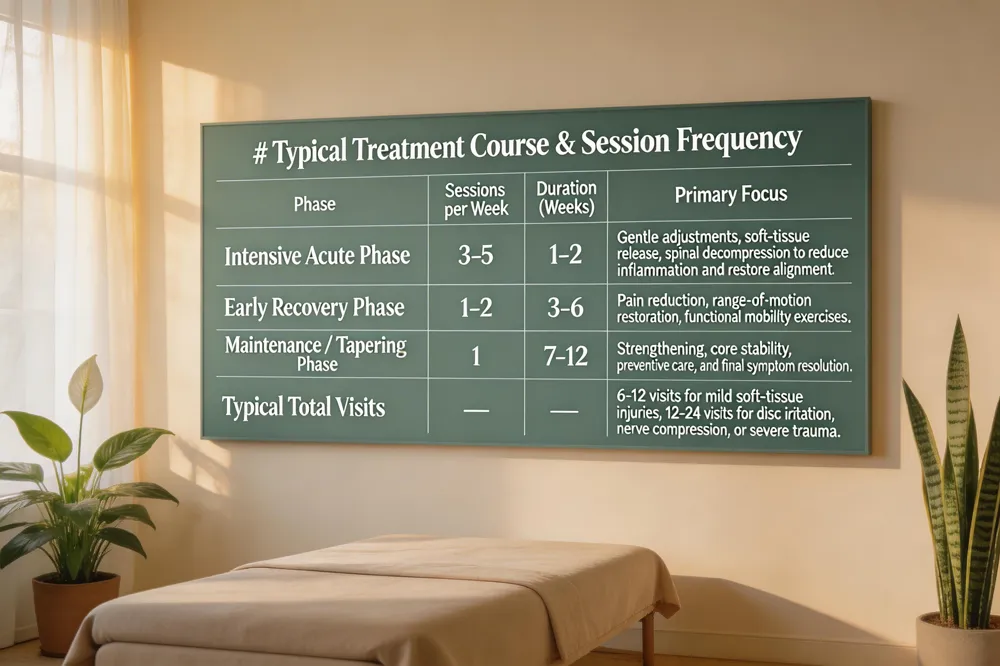 Most patients recovering from a car‑accident injury need between six and twelve chiropractic sessions spread over four to six weeks for common soft‑tissue damage such as whiplash, muscle sprains, and neck stiffness. When the injury involves disc irritation, nerve compression, multiple sprains, or more severe trauma, the plan typically expands to twelve‑twenty‑four visits lasting eight to twelve weeks. The initial intensive phase usually includes three to five visits per week for the first one to two weeks, focusing on gentle adjustments, soft‑tissue release, and spinal decompression to reduce inflammation and restore alignment. After the acute phase, the schedule tapers to one or two sessions per week as pain subsides and range of motion improves. Factors that affect total visit count include the patient’s age, overall health, injury severity (e.g., simple whiplash versus a herniated disc), and how quickly the body responds to treatment. The goal is full symptom resolution and functional mobility before tapering off care.
Preparing for Your First Chiropractic Visit
Preparing for Your First Chiropractic Visit
| Item | Details |
|---|---|
| Crash Timeline | Date, time, location, vehicle collision dynamics, direction of impact. |
| Symptom List | Neck/back pain, stiffness, headaches, dizziness, tingling, reduced ROM, visual changes – include onset time and intensity. |
| Pre‑existing Conditions | Chronic injuries, prior surgeries, ongoing treatments, medications. |
| Prior Medical Care | ER visits, X‑rays, MRIs, physical‑therapy notes, prescription drugs. |
| Documentation | Police/insurance reports, photos of scene & vehicle damage, symptom log, medical records, medication list. |
| Goal for Visit | Provide chiropractor with comprehensive picture to create a safe, effective treatment plan. |
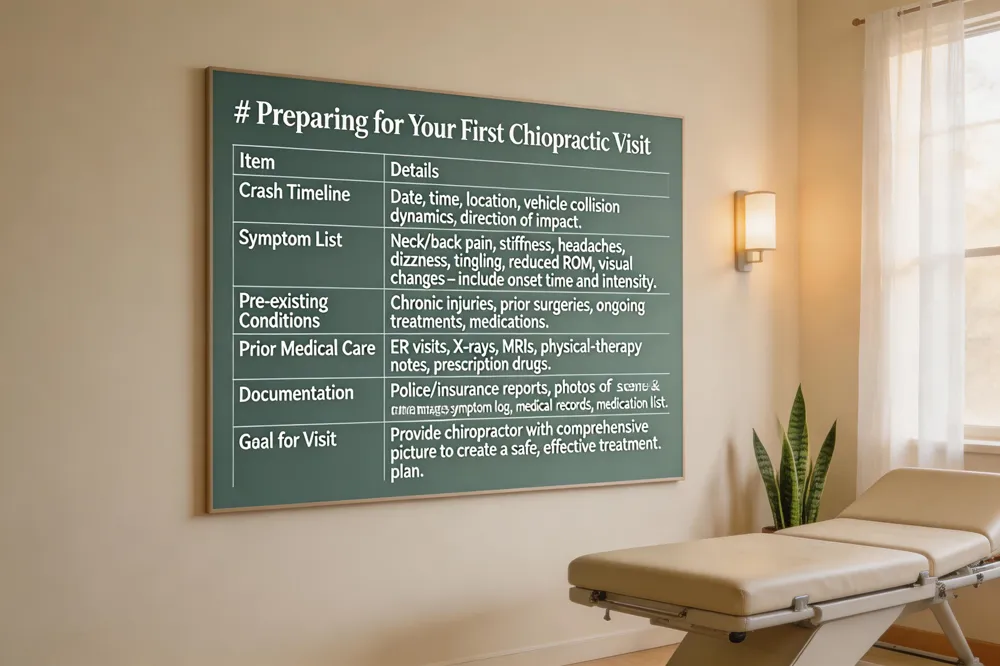 When you schedule your initial appointment, bring a clear timeline of the crash: date, time, location, how the vehicles collided, and the direction of impact. List every symptom—neck or back pain, stiffness, headaches, dizziness, tingling, reduced range of motion, or visual changes—along with when each began and its intensity. Note any pre‑existing injuries, chronic conditions, or prior treatments (e.g., emergency‑room visits, X‑rays, MRIs, physical therapy). Gather all documentation: police or insurance reports, photos of the scene and vehicle damage, a symptom log you’ve kept, and any medical records or medication lists.
What information should I give my chiropractor after an accident? Give your chiropractor a detailed account of the accident, including the date, time, location, how the vehicles collided, and the direction of impact. List every symptom you’ve experienced—neck or back pain, headaches, tingling, stiffness, reduced range of motion, or any other discomfort—and note when each began and its severity. Mention any pre‑existing injuries or chronic conditions, as well as any medical care you’ve already received, such as emergency‑room visits, X‑rays, MRIs, or physician reports. Bring any documentation you have: police or insurance reports, photographs of the scene and vehicle damage, and a symptom log you’ve kept since the crash. Finally, tell the chiropractor about any medications, braces, or therapies you’re currently using so they can tailor a safe, effective treatment plan.
Holistic Recovery: Integrating Therapies for Long‑Term Wellness
Holistic Recovery – Integrated Therapies
| Therapy | Goal | Typical Frequency |
|---|---|---|
| Myofascial Release / Instrument‑Assisted Soft‑Tissue Work | Loosen scar tissue, improve circulation, reduce muscle spasm. | 1‑2 sessions per week (early phase) |
| Spinal Decompression | Reduce disc pressure, promote re‑hydration of discs, alleviate nerve irritation. | 2‑3 sessions per week (first 2‑3 weeks) |
| Therapeutic Exercise & Core Strengthening | Restore biomechanics, enhance stability, prevent re‑injury. | Daily home program + 1‑2 supervised sessions per week |
| Coordinated Care (referrals to orthopedists, neurologists, PT) | Address bone injuries, nerve deficits, or functional limitations. | As needed, based on clinical findings |
| Lifestyle & Ergonomic Education | Teach proper posture, ergonomics, and injury‑prevention strategies. | Integrated into each visit and follow‑up |
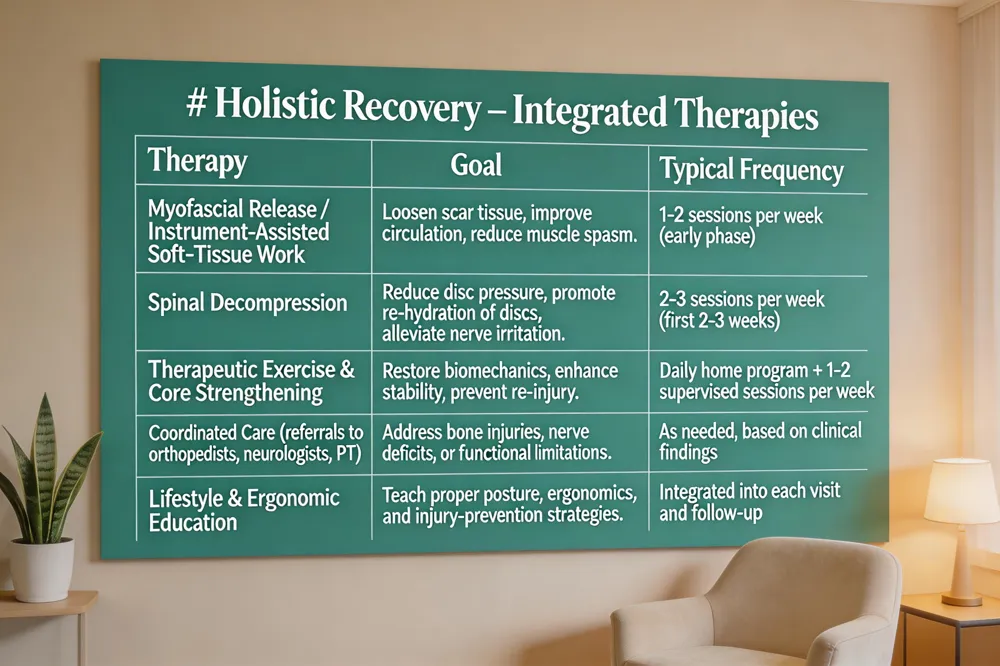 A comprehensive post‑accident program begins with soft‑tissue work—myofascial release and instrument‑assisted therapy to loosen scar tissue, improve circulation, and reduce muscle spasm. Gentle spinal decompression follows, creating negative disc pressure that eases herniated or bulging discs and promotes re‑hydration of spinal structures. To sustain these gains, chiropractors prescribe therapeutic exercises and core‑strengthening routines that restore proper biomechanics, enhance stability, and protect the spine from future strain. Successful recovery often hinges on coordinated care; many clinics maintain active referral networks with orthopedists, neurologists, and physical therapists, ensuring that any bone injury, nerve irritation, or functional deficit is addressed promptly. Real‑world results speak loudly—patients report noticeable pain relief after just a few visits, regained range of motion, and a swift return to daily activities, reinforcing the value of an integrated, drug‑free approach to long‑term wellness.
Take the First Step Toward Healing
After a collision, book a same‑day or next‑day chiropractic evaluation—most clinics, such as those in Rancho Cucamonga and Gastonia, offer walk‑in appointments within the first 48‑72 hours. Early assessment catches hidden misalignments, whiplash, and soft‑tissue damage before scar tissue forms, speeding recovery. Use your auto‑insurance policy (PIP, medical benefits) to cover the visit; the chiropractor will prepare detailed medical records and lien paperwork that support personal‑injury claims. Finally, follow the individualized rehabilitation program the practitioner designs—spinal adjustments, soft‑tissue work, therapeutic exercises, and home‑care guidance—to restore motion, prevent chronic pain, and maintain long‑term spinal health and improve quality of life for you.