Why Injury Prevention Matters on Every Road
Motor‑vehicle crashes remain a leading public‑health threat. In the United States, traffic injuries cause more than 6 million police‑reported crashes each year, with drowsy driving alone accounting for roughly 100 000 collisions and 1,550 deaths. In New York State, motor‑vehicle injuries are the top cause of injury‑related death and the second leading cause of hospitalizations. Because crashes often jolt the spine, the condition of a driver’s vertebral column influences both immediate injury severity and long‑term recovery. Good posture, adequate lumbar support, and a neutral spine reduce the forces transmitted to the neck and lower back during impact, decreasing the risk of whiplash, disc herniation, and chronic pain. Regular chiropractic care reinforces these protective habits: adjustments restore spinal alignment, improve core strength, and enhance proprioception, while ergonomic advice helps drivers maintain safe seating positions. Together, vehicle safety measures and chiropractic wellness create a stronger defense against injury on every road for all travelers.
Fundamentals of Crash Prevention
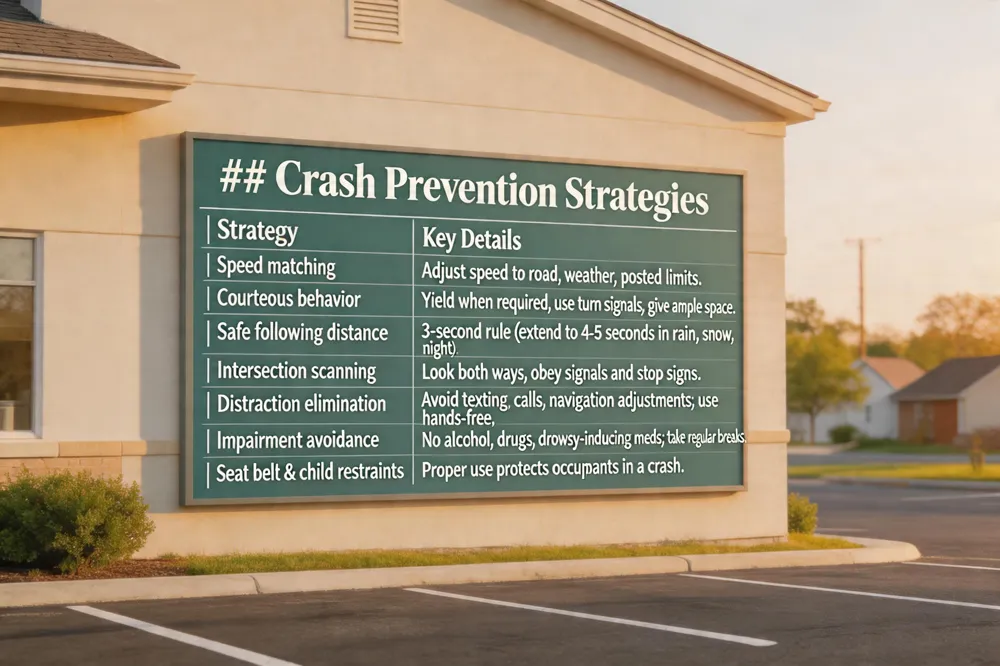
Crash Prevention Strategies
| Strategy | Key Details |
|---|---|
| Speed matching | Adjust speed to road, weather, and posted limits. |
| Courteous behavior | Yield when required, use turn signals, give ample space. |
| Safe following distance | 3‑second rule (extend to 4‑5 seconds in rain, snow, night). |
| Intersection scanning | Look both ways, obey signals and stop signs. |
| Distraction elimination | Avoid texting, calls, navigation adjustments; use hands‑free. |
| Impairment avoidance | No alcohol, drugs, drowsy‑inducing meds; take regular breaks. |
| Seat belt & child restraints | Proper use protects occupants in a crash. |
 How can drivers avoid being involved in a car crash?
Drivers can cut their crash risk by matching speed to road and weather conditions and always obeying posted limits. Courteous behavior—yielding when required, using turn signals, and giving other motorists ample space—creates a predictable traffic flow. Maintaining a safe following distance (the three‑second rule, extended to four or five seconds in rain, snow, or night) gives enough time to react to sudden stops and helps prevent rear‑end and side‑impact collisions. Before entering an intersection, drivers should scan both directions and obey traffic signals and stop signs. Distractions such as texting, phone calls, or adjusting navigation should be eliminated; hands‑free devices are a safer alternative. Never drive under the influence of alcohol, drugs, or medication that causes drowsiness, and take regular breaks on long trips to avoid fatigue. Finally, seat belts and properly installed child restraints protect occupants in the event of a crash.
What causes about 90% of motor vehicle accidents?
Approximately 90 percent of crashes stem from human error. The most common mistakes include speeding, aggressive driving, and failure to obey traffic signals. Distractions—texting, eating, adjusting the radio, or interacting with passengers—increase crash risk dramatically. Fatigue and impairment from alcohol, drugs, or medical conditions further degrade judgment and reaction time. In short, poor decision‑making and lapses in attention by the driver are the primary drivers of most accidents.
The Five E’s and Three C’s of Safe Road Behavior
Five E’s of Accident Prevention
| E | Description |
|---|---|
| Education | Teach safe walking, biking, and driving via curricula, assemblies, flyers. |
| Encouragement | Motivate active‑transport use with events (walking school buses, bike trains). |
| Engineering | Add/upgrade sidewalks, crosswalks, bike lanes, other protective infrastructure. |
| Enforcement | Partner with police to deter speeding, signal violations, etc. |
| Evaluation | Monitor travel data, parent concerns, traffic patterns to guide improvements. |
Three C’s of Safe Driving
| C | Description |
|---|---|
| Care | Take responsibility for your own safety and that of others. |
| Caution | Stay alert, drive defensively, maintain proper posture. |
| Courtesy | Show respect to other road users, follow etiquette. |
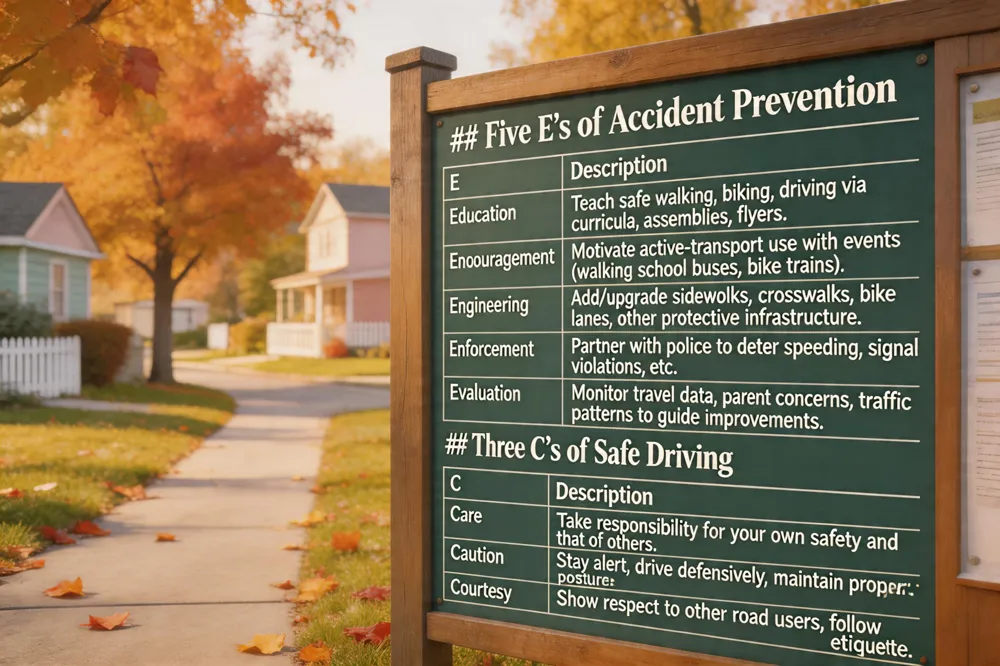 The Five E’s of accident prevention are Education, Encouragement, Engineering, Enforcement, and Evaluation. Education teaches students, families and the community safe walking and biking practices through curricula, assemblies, newsletters and flyers. Encouragement creates excitement and motivation to use active‑transport options by hosting events such as walking school buses, bike trains and friendly competitions. Engineering improves the physical environment by adding or upgrading sidewalks, crosswalks, bike lanes and other infrastructure that protect pedestrians and cyclists. Enforcement works with law‑enforcement officers to deter risky behaviors like speeding or ignoring traffic signals, while Evaluation monitors travel data, parent concerns and traffic patterns to assess program effectiveness and guide future improvements.
The Three C’s of safe driving are Care, Caution, Courtesy Courtesy These principles guide defensive drivers to act responsibly and respectfully on the road, maintaining proper posture, staying alert, and showing respect for other road users.
Community‑based safety programs blend these concepts: they deliver educational workshops, encourage local events, engineer safer streets, enforce traffic laws through partnerships, and evaluate outcomes with data. By fostering care, caution, and courtesy, such programs reduce crashes, protect vulnerable road users, and promote a culture of shared responsibility.
Seat Belts, Child Seats, and Airbags: Mechanical Protection
Mechanical Safeguards Effectiveness
| Safety Feature | Effectiveness | Key Points |
|---|---|---|
| Seat belts (front‑seat) | ~45 % reduction in fatal injury | Must be worn by all occupants. |
| Seat belts (rear‑seat) | ~25 % reduction in fatal injury | Still crucial for rear passengers. |
| Child safety seats (infants) | 71 % reduction in death risk | Use age/height/weight‑appropriate seat. |
| Child safety seats (toddlers) | 54 % reduction in death risk | Proper installation vital. |
| Airbags | Deploy in <0.05 s; complement belts | Keep seat 10 inches from cover, headrest 2‑4 inches behind head. |
| Tire pressure maintenance | Under‑inflated tires ↑ stopping distance ≤30 % | Regular checks prevent tire‑related failures. |
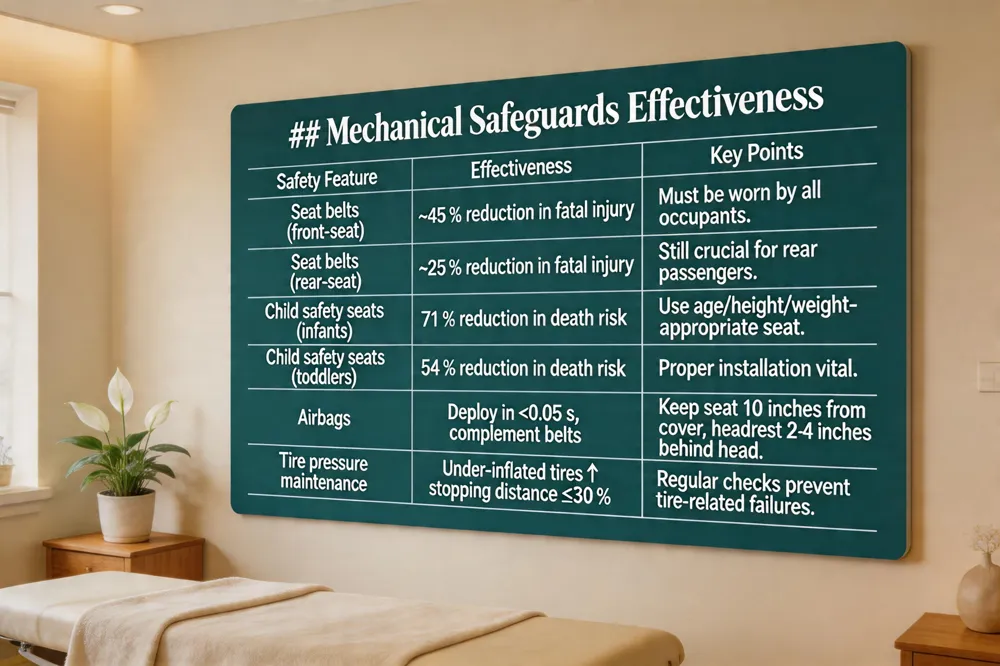 Seat belts are the single most effective mechanical safeguard on the road. In New York State, Wearing a seat belt reduces the risk of fatal injury by approximately 45% and the risk of serious injury by about 50% in a crash, while Seat belts reduce the risk of fatal injury for front‑seat occupants by about 45% and for rear‑seat occupants by about 25% according to NHTSA data. For children, age‑appropriate safety seats are vital: Using the appropriate child safety seat for a child’s age, height, and weight reduces the risk of death for infants by 71% and for toddlers by 54% compared with seat‑belt‑only use. Airbags complement belts by deploying in under 0.05 seconds (less than 1/20th of a second) during moderate to severe impacts, but they work best when the driver sits at least 10 inches from the cover and the seat is positioned as far back as comfortably possible. Proper positioning also helps keep the headrest 2‑4 inches behind the head, reducing whiplash risk by up to 60%. Vehicle maintenance, especially tire pressure, directly influences crash likelihood; Under‑inflated tires are the leading cause of tire‑related failures and can increase stopping distance by up to 30%, raising crash risk. Regular checks of brakes, lights, and fluid levels further lower the risk of mechanical failures that could trigger an accident.
Posture, Ergonomics, and Chiropractic Care for Drivers and Passengers
Chiropractic & Ergonomic Factors
| Factor | Impact on Driving Safety |
|---|---|
| Thoughts | Chronic stress keeps nervous system heightened, reducing focus. |
| Trauma | Poor posture, crashes cause vertebral misalignment, pain, reduced mobility. |
| Toxins | Diet/environmental toxins increase inflammation, aggravating discomfort. |
| Chiropractic adjustments | Restore spinal alignment, improve neck mobility, reduce whiplash risk. |
| Truck driver considerations | Prolonged sitting, vibration → shoulder/low‑back/knee pain; adjustments help. |
| Recommendations | Regular posture checks, ergonomic seat setup, periodic chiropractic care. |
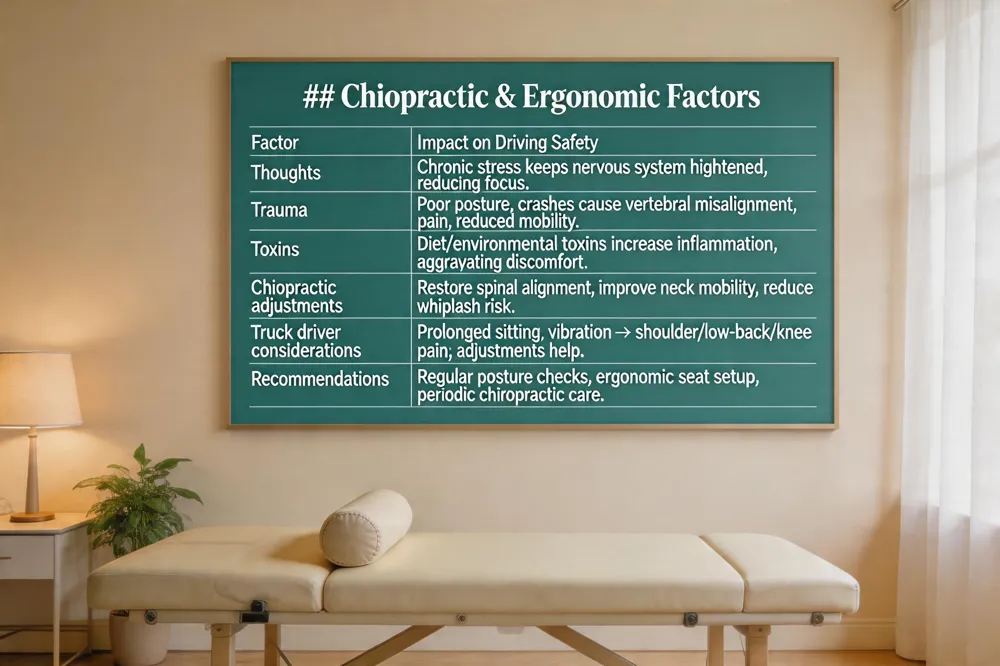 The Three T’s of chiropractic philosophy—Thoughts, Trauma, and Toxins—explain why many driving‑related injuries persist. Negative or chronic thoughts keep the nervous system in a heightened stress state, physical trauma from crashes or repetitive poor posture directly misaligns vertebrae, and toxins from diet or environment amplify inflammation. Addressing all three factors helps restore natural nerve function and promotes self‑healing.
After a collision, chiropractic adjustments can quickly restore proper spinal positioning, reduce inflammation, and alleviate whiplash or soft‑tissue pain. Adjustments improve neck mobility and proprioception, which are critical for safe vehicle operation. Early evaluation also identifies hidden injuries before they become chronic.
Special considerations for truck drivers include prolonged sitting, vibration, and limited stretch breaks. Chiropractic care can alleviate shoulder, low‑back, and knee discomfort without medication, allowing drivers to stay alert and perform their duties safely.
Q: What are the Three T’s in chiropractic philosophy? A: The Three T’s are Thoughts, Trauma, and Toxins—primary sources of subluxation that disrupt healing.
Q: Should truck drivers seek chiropractic care for work‑related pain? A: Yes. Adjustments can relieve shoulder, low‑back, knee, or neck pain, enabling safer, more efficient driving.
Practical Trip Planning and Emergency Preparedness
Trip Planning & Emergency Checklist
| Preparation Step | Details |
|---|---|
| Rest breaks | Stop every ~2 hours (or 30‑45 min on long trips) to combat fatigue. |
| Vehicle inspection | Check tire pressure & tread (≥2/32 in), brakes, lights, fluid levels. |
| Emergency kit | Spare tire, jumper cables, first‑aid, flashlight, fully charged phone. |
| Fatigue response | Pull over, stretch, hydrate, nap if drowsy. |
| Driver‑assist tech | Use forward‑collision warning, lane‑keep assist, adaptive cruise control correctly. |
| Safety net | Combine rest, maintenance, kit, and tech for comprehensive protection. |
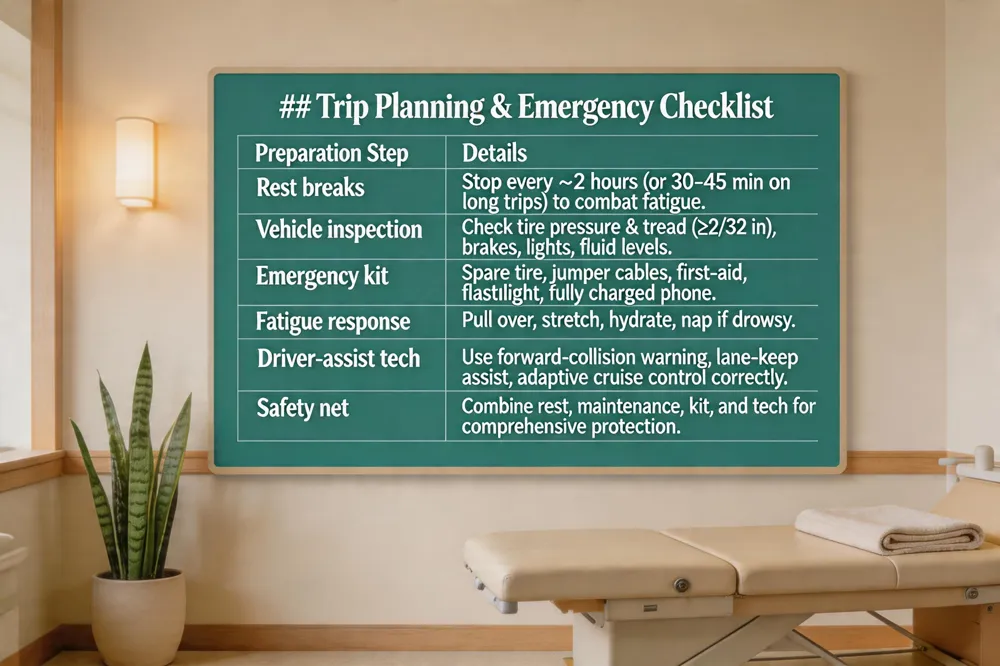 Effective road‑trip safety begins with thoughtful planning and proactive preparedness.
Regular rest breaks—about every two hours or every 30‑45 minutes on longer trips help combat driver fatigue, a factor linked to roughly 100,000 U.S. crashes each year. If you feel drowsy, pull over safely, stretch, and hydrate; a short nap can restore alertness and reduce the crash risk associated with impaired reaction time. Before you hit the road, conduct a thorough vehicle inspection: check tire pressure and tread depth (minimum 2/32 inch), confirm brake and light function, and verify fluid levels. A well‑stocked emergency kit—including a spare tire, jumper cables, first‑aid supplies, a flashlight, and a fully charged phone—can turn a minor breakdown into a controlled situation and prevent secondary accidents. Modern driver‑assistance technologies such as forward‑collision warning, lane‑keep assist, and adaptive cruise control further lower rear‑end crash rates by up to 50% when drivers understand and correctly use them. Combining disciplined rest, vehicle maintenance, emergency readiness, and smart use of assistance systems creates a comprehensive safety net for any road‑trip adventure.
Putting Knowledge Into Action for Safer Journeys
Combining proven safety practices with chiropractic wellness creates a powerful defense against crash‑related injuries. Drivers should follow the Five E’s—Engage (stay alert), Educate (know traffic rules), Equip (seat‑belt, child seat, proper posture), Execute (defensive driving, safe following distance), and Evaluate (review driving habits). Families add the Three C’s—Check (vehicle condition), Communicate (share road alerts), and Calm (maintain a relaxed cabin environment). Regular chiropractic check‑ups reinforce proper spinal alignment, improve core strength, and keep the neck and back resilient during sudden stops or collisions. A schedule of quarterly visits, plus post‑trip evaluations after long drives, ensures lingering tension is addressed before it becomes chronic, supporting overall health and safer journeys for every passenger. Together, they promote confidence on the road and lower risk.