Why Safety Matters
Class 4 lasers emit more than 500 mW of power and can cause severe eye burns, retinal damage, and skin burns even from diffuse reflections; a 1 W visible beam can injure skin within a meter and a eye a 225 m. Regulatory agencies enforce strict controls: the FDA requires FDA‑cleared devices and labeling; OSHA mandates eye‑ and fire‑protective PPE, hazard signage, and a designated Laser Safety Officer; and ANSI Z136 standards define Maximum Permissible Exposure, Nominal Hazard Zones, and required optical‑density eyewear. Patient education is essential—users must never point beams at people, animals, aircraft, or reflective surfaces, must wear wavelength‑specific goggles, and understand contraindications such as untreated eye disease or pregnancy. Informed patients reduce accidental exposure and ensure therapeutic benefits are delivered safely.
Understanding OSHA Laser‑Safety Requirements
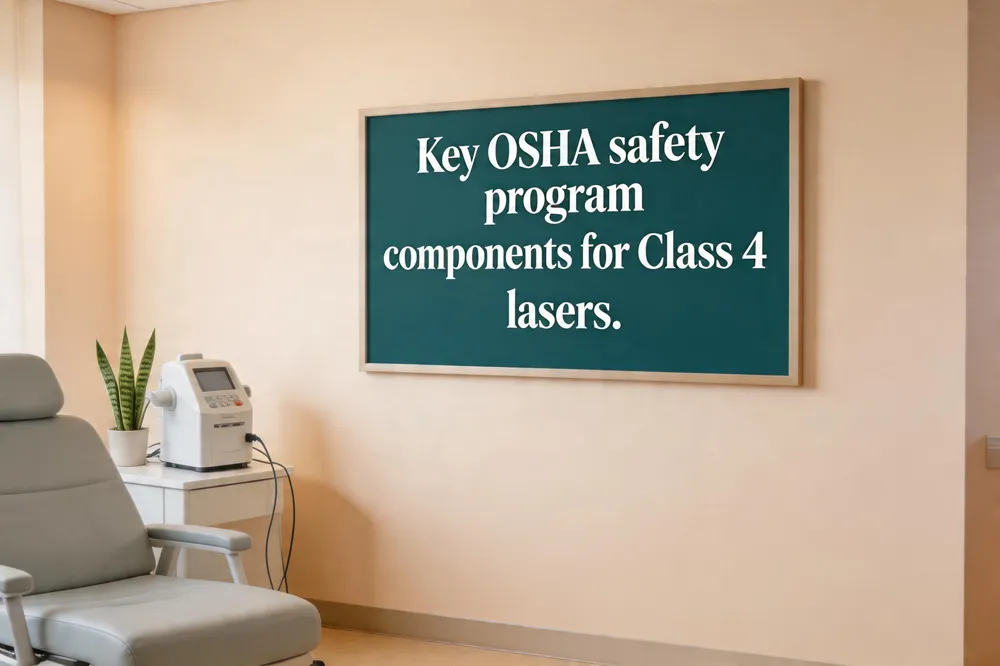 A compliant OSHA laser‑safety program must be written, approved, and regularly reviewed. It should list every laser, its classification, and power output; define safe operating procedures (SOPs); designate a qualified Laser Safety Officer; and require routine inspections of generators, beam‑delivery optics, interlocks, and protective eyewear. Hazard labeling, signage, and restricted‑access zones are mandatory: each laser must display its class and power, warning signs (ANSI DANGER format) must be posted at the door and inside the treatment area, and the Nominal Hazard Zone must be clearly marked with controlled‑access barriers. All personnel who operate, service, or work near lasers must complete documented training covering hazard recognition, PPE use, SOPs, and emergency shutdown. Personnel must wear ANSI‑approved goggles with the correct optical density for the laser’s wavelength and power level; other PPE such as flame‑resistant clothing may be required. OSHA requires a medical‑surveillance program to monitor for eye or skin injury and to report incidents promptly. These controls together ensure that Class 4 lasers are used safely, minimizing the risk of retinal burns, skin burns, fire, and other hazards.
Class 4 Laser Therapy Machines and Their Action
 Class 4 laser therapy machine** A Class 4 laser therapy machine is a high‑power medical device delivering > 500 mW, often 30–90 W, of coherent light that can penetrate up to 10 cm, stimulating cellular repair and pain relief. Modern units combine multiple wavelengths (e.g., 660‑915 nm) so clinicians can tailor energy density. Devices are available as tabletop consoles, portable handheld heads, or articulated arms, fitting both busy clinics and dedicated treatment rooms.
What does a Class 4 laser do?**
Photons are absorbed by mitochondria, increasing ATP production, vasodilation and lymphatic drainage. This deep photobiomodulation reduces inflammation, edema and pro‑inflammatory mediators, while providing analgesia by modulating C‑fiber pain signals. The result is faster tissue healing without excessive thermal buildup.
Class 4 laser therapy side effects
When proper dosing and protective goggles are used, side effects are mild and transient: brief warmth, slight erythema, occasional tingling or mild swelling. Rare over‑exposure can cause superficial burns or bruising, and failure to wear eye protection risks retinal injury.
Can a Class 4 laser cause cancer?
Therapeutic Class 4 lasers emit non‑ionizing light; FDA‑cleared protocols do not damage DNA. Laboratory data show that only extreme, non‑clinical doses affect tumor growth. Therefore, when used according to approved settings, there is no credible evidence of carcinogenic risk.
Contraindications and Practical Drawbacks
 Therapeutic lasers should not be applied over active malignancy, recent radiation fields, or large untreated wounds because the light can stimulate rapidly dividing cells and cause tissue injury. Pregnancy is a relative contraindication for high‑dose uterine exposure, while uncontrolled epilepsy, photosensitivity disorders, and direct ocular irradiation are also prohibited. Patient‑specific factors such as skin tone, medication‑induced photosensitivity, and implanted cardiac devices influence outcomes and safety; clinicians must adjust dosage or avoid treatment altogether in these cases. Laser therapy usually requires 8‑12 sessions, extending the time commitment and increasing out‑of‑pocket costs (≈ $75‑$125 per visit, $600‑$1,500 total). Variable individual response makes results unpredictable, so realistic expectations and financial planning are essential before beginning a Class IV laser program.
Personal Protective Equipment and Hazard Controls
 Class 4 laser procedures require strict PPE and engineering safeguards.
Wavelength‑specific laser goggles – All personnel in the Nominal Hazard Zone must wear laser‑rated safety glasses or goggles that match the device’s wavelength (e.g., 650 nm, 810 nm, 1064 nm) and have an optical density sufficient to reduce exposure below the Maximum Permissible Exposure (OD ≥ 5 for most therapeutic wavelengths).
Protective clothing, shields, and gloves – A flame‑resistant lab coat or disposable gown that fully covers skin is mandatory, along with laser‑resistant gloves when handling the hand‑piece or patient. Face shields or full‑face masks may be added for extra protection of the eyes, nose and mouth.
Engineering controls – The laser must be mounted on a stable, non‑conductive base and equipped with interlocks, a key‑switch, and a visible/audible alarm that de‑energizes the beam if the enclosure is opened. Beam stops or attenuators terminate the useful beam, and the path should be enclosed or positioned well above/below eye level. Reflective surfaces are removed or covered, and a non‑reflective, fire‑resistant drape is used on the treatment area.
Laser safety precautions – Work is limited to a clearly marked, restricted area with “Laser In Use” signage. Only trained, authorized staff may operate the system, following documented SOPs and periodic audits.
Laser hazards and safety measures – Direct or reflected beams can cause permanent retinal burns, skin burns, fire, electrical shock, and toxic plume generation. Engineering controls (enclosures, beam dumps), PPE (goggles, gowns, gloves), removal of jewelry and reflective objects, and regular training and equipment inspection together mitigate these risks.
Legal, Regulatory, and Cost Considerations
 Class 4 lasers are not outright illegal in the United States, but their use is tightly regulated. They may be sold and operated for medical, scientific, industrial, or research purposes provided the manufacturer follows FDA and OSHA requirements for labeling, safety features, and user training. However, using a Class 4 lasers as a handheld “laser pointer” or aiming it at people, aircraft, or vehicles is prohibited and can result in criminal penalties. Individuals must also wear appropriate protective eyewear and follow strict safety protocols to prevent eye or skin injuries. In short, the lasers are legal only in controlled, professional settings, not for consumer or recreational pointing.
Class IV laser therapy typically costs between $75 and $125 per session, depending on the clinic’s location, equipment, and provider expertise. A complete treatment plan usually consists of 8‑12 sessions, bringing the total out‑of‑pocket expense to roughly $600‑$1,500. Many practices offer discounted package rates, making the per‑session price lower when you purchase a series upfront. Insurance coverage varies; some plans may cover a portion of the cost while others treat it as a self‑pay service. Overall, Class IV laser therapy is priced higher than lower‑power laser options because of its deeper tissue penetration and faster healing results.
Patients in the Gastonia, NC area can receive Class IV (Class 4) laser therapy at Southeast Family Chiropractic, a trusted local practice that integrates this advanced “hot” laser into its holistic treatment plans. The Class 4 laser delivers deep, photobiomodulation energy that reduces inflammation, accelerates tissue repair, and provides lasting pain relief for conditions such as back pain, sciatica, tendonitis, and sports‑related injuries. Because the therapy is non‑invasive and FDA‑cleared, it can be safely combined with chiropractic adjustments, massage, and rehabilitative exercises during a single office visit. To schedule an appointment, simply call the clinic directly or use the online booking form on the Southeast Family Chiropractic website. Their experienced doctors will assess your needs and tailor a laser‑therapy protocol to help you achieve faster recovery and improved overall wellness.
Yes, Class IV (or Class 4) laser therapy is a legitimate, FDA‑cleared medical treatment. It delivers more than 500 mW of power, allowing deep tissue penetration—often up to several centimeters—to reduce inflammation, pain, and promote cellular healing. Numerous clinical studies support its effectiveness for musculoskeletal conditions, and it is widely used by licensed chiropractors, physical therapists, and physicians. When administered by a trained professional, the therapy is considered safe and non‑invasive, with only mild warmth felt during treatment. As part of a comprehensive, non‑pharmacologic care plan, Class IV laser can be a valuable tool for improving spinal health and overall wellness.
Therapeutic Benefits Compared With Red‑Light Therapy
 Class IV lasers emit >500 mW, delivering coherent, focused energy that reaches several centimeters into muscle, tendon, ligament and bone. Red‑light therapy uses low‑intensity LEDs that affect only the superficial skin layers. Because of this depth, Class IV laser can treat deep musculoskeletal pain, chronic inflammation and post‑injury recovery, while red‑light panels are suited for skin health, mild inflammation and general wellness.
Clinical indications for Class IV include acute back pain, arthritis, tendonitis, sports strains, neuropathy and post‑surgical healing. Red‑light is used for skin rejuvenation, mild joint stiffness and preventive wellness. Safety requires a Laser Safety Officer, eyewear with optical density, access and trained personnel; exposure zones (NHZ) must be restricted. Red‑light devices are low‑risk, can be used at home with instruction and no mandatory goggles.
The laser’s focused beam stimulates cellular metabolism, ATP production and microcirculation, providing pain relief, whereas red‑light offers gentler stimulation.
Training, Documentation, and Home‑Use Implementation
 Most clinicians schedule Class 4 laser therapy two to three times per week, leaving three to four days between sessions; a typical course spans four to six weeks (8‑12 treatments).
Laser hazards include permanent eye injury, skin burns, fire ignition, electrical shock, toxic fumes, and hazardous reflections. Protective measures involve enclosed beam paths, removal of reflective objects, use of flame‑resistant drapes, and mandatory laser‑rated PPE for anyone in the treatment area.
The OSHA laser safety checklist requires a documented safety program, clear signage, controlled‑access zones, proper labeling, and regular training for all operators. Protective equipment must be inspected before each use, and interlocks and emergency shut‑off switches must be functional at all times.
Putting Safety First at Home
When operating a Class 4 therapeutic laser in a home setting, ongoing training and regular equipment checks are essential. All users should complete a certified laser‑safety course, review the device’s operating manual before each session, and verify that output power, interlocks, and protective eyewear meet the manufacturer’s specifications. The treatment area must be a controlled environment: eliminate reflective surfaces, post ANSI‑compliant warning signs, keep a fire extinguisher and water container nearby, and restrict access to authorized personnel only. Finally, consult a qualified clinician or Laser Safety Officer to establish appropriate dosing, verify safety protocols, and ensure optimal therapeutic results while minimizing risk.