Why Core Stability Matters
Deep core muscles—including the transverse abdominis, multifidus, pelvic floor, and diaphragm—act as an internal brace that keeps the spine neutral, protects intervertebral discs, and improves posture. Pilates deliberately activates these stabilizers through breath‑linked, low‑impact movements, reinforcing the muscular support that chiropractic adjustments create and helping the spine stay aligned between visits. This article first explains the anatomy of the deep core, then shows how Pilates complements chiropractic care, and finally outlines the six core exercises, evidence‑based benefits, and practical tips for integrating Pilates into a regular spinal‑health routine for patients of all ages and for clinicians seeking evidence‑based protocols.
Beginner‑Friendly Pilates Foundations
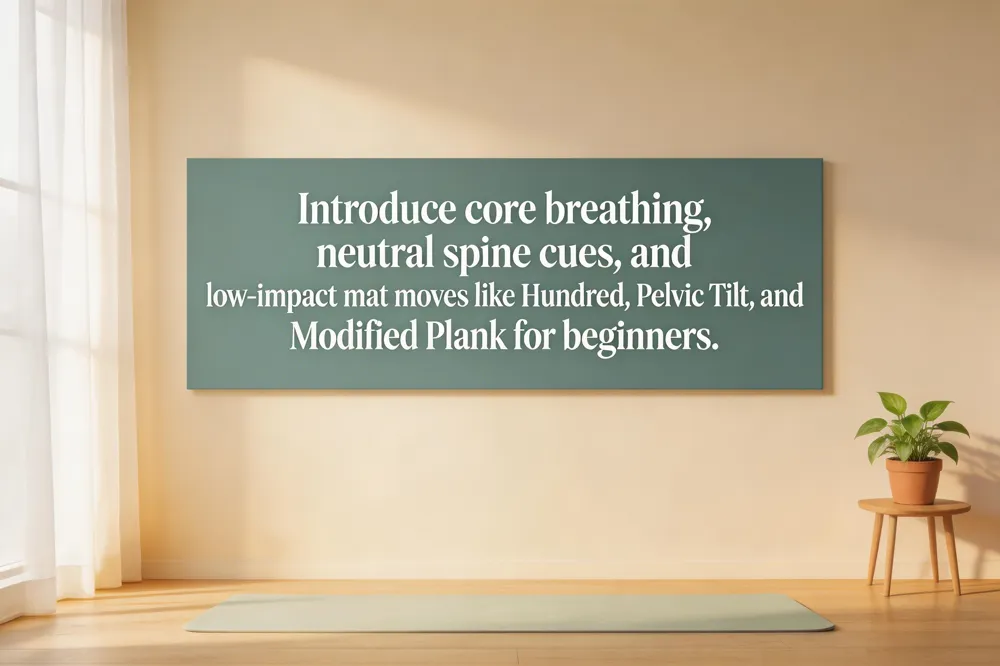 Developing a strong, stable core is the foundation of both Pilates and chiropractic care. The first step is mastering basic breathing and neutral‑spine cues: inhale into the lower ribs, exhale while drawing the navel toward the spine, and keep the pelvis in a neutral position. This diaphragmatic breath creates intra‑abdominal pressure that protects the lumbar vertebrae during movement.
Low‑impact mat exercises that follow these cues are ideal for beginners. The Hundred activates the transverse abdominis and improves circulation; the Pelvic Tilt teaches gentle spinal alignment; the Single Leg Stretch and Double Leg Stretch engage the rectus abdominis, hip flexors, and deep stabilizers while keeping the low back pressed to the mat. Rolling Like a Ball massages the spine and reinforces full‑body core control. A Modified Forearm Plank (knees bent) builds endurance without over‑loading the lower back.
Progression from beginner to a 15‑minute routine is seamless. Start with 5‑minute flows (Hundred, Pelvic Tilt, Single Leg Stretch) and add 30‑second intervals of side‑lying leg lifts or a gentle Bridge. As strength improves, extend each segment to 45‑60 seconds and finish with a spinal roll‑down and a few minutes of stretch. This graduated approach matches the chiropractic goal of maintaining spinal alignment while strengthening the supporting musculature.
Frequently asked questions:
- Pilates core exercises for beginners – The Hundred, Single Leg Stretch, Double Leg Stretch, Pelvic Tilt, Modified Plank, Rolling Like a Ball.
- Core stability exercises for beginners – Cat‑Cow warm‑up, Bridge, Single‑Leg Abdominal Press, Forearm Plank with knees bent, performed 30‑45 seconds each.
- Pilates core workout for beginners – Begin with breath activation, then Hundred, Single Leg Stretch, Rolling Like a Ball, and Modified Plank, 8‑12 reps each.
- Pilates core workout no equipment – Hundred, Single‑Leg Stretch, Roll‑Up, Side‑Plank Leg Lifts, Pilates‑style planks.
- Pilates core workout at home – Hundred, Roll‑Up, Single‑Leg Stretch or Straight‑Leg Circles, Side‑Lying Leg Lifts, Forearm Plank.
- Pilates core workout 15 minutes – 2‑minute breath warm‑up, Hundred, Single Leg Stretch, Plank variations (30‑45 seconds each), roll‑down, and gentle stretching.
These beginner‑friendly moves can be practiced 2‑3 times per week, supporting posture, reducing back pain, and complementing any chiropractic treatment plan.
Professional Resources & Guided PDFs
 Free Printable Core‑Stability Guide
Our complimentary "Core Stability Exercises" PDF delivers a step‑by‑step, printable handbook for patients of all fitness levels. It features clear photos and concise cues for the Table‑Top, 4‑Point Kneeling, and Plank series, plus progressions for beginners, intermediates, and advanced users. Each move emphasizes neutral spine alignment, diaphragmatic breathing, and activation of the transversus abdominis, multifidus, pelvic floor, and supporting musculature—principles echoed by the NHS and Mayo Clinic for spinal health. A weekly schedule balances flexibility work with strengthening, helping users safely build endurance and reduce low‑back pain. Download the file from the Core Stability page and begin your at‑home routine today.
Physiotherapy‑Focused Core Programs
Core stability is a cornerstone of physiotherapy, targeting deep abdominal, back, and pelvic muscles that protect the spine and enhance functional movement. Typical programs start with supine bracing, dead‑bug, and alternating leg marching, then progress to prone arm‑leg lifts and partial bridges that challenge balance and coordination. Each exercise stresses a neutral spine, controlled breathing, and gradual increases in hold time or repetitions—mirroring the motor‑control training highlighted by Physiopedia and the ACE blog. A therapist customizes the regimen to individual goals, ensuring safe progression from clinic instruction to independent home practice.
Senior‑Friendly Core Stability
For seniors, core work supports posture, balance, and fall prevention, as noted by the Premier Health Chiropractors and NHS sources. Safe moves such as seated dead‑bug, modified bird‑dog, standing marches with a neutral spine, gentle glute bridges, and pelvic‑tilt exercises engage deep stabilizers without straining the neck or hip flexors. Performing these 2–3 times per week for 10–15 minutes maintains functional independence. Use a chair or wall for support, increase repetitions gradually, and combine with light walking or resistance training for a comprehensive wellness plan.
Chiropractic Integration & Core Benefits
 Why chiropractors endorse Pilates
Pilates aligns perfectly with chiropractic goals. After an adjustment, chiropractors identify spinal or muscular imbalances and prescribe targeted Pilates movements that reinforce deep core muscles, improve posture, and protect alignment. The low‑impact, controlled nature of Pilates helps maintain adjustment benefits while reducing future injury risk, leading to faster pain relief and longer‑lasting results. Southeast Family Chiropractic tailors Pilates recommendations to each patient for optimal spinal health.
Why chiropractors endorse Pilates
Pilates aligns perfectly with chiropractic goals. After an adjustment, chiropractors identify spinal or muscular imbalances and prescribe targeted Pilates movements that reinforce deep core muscles, improve posture, and protect alignment. The low‑impact, controlled nature of Pilates helps maintain adjustment benefits while reducing future injury risk, leading to faster pain relief and longer‑lasting results. Southeast Family Chiropractic tailors Pilates recommendations to each patient for optimal spinal health.
Key benefits of a strong Pilates core A solid Pilates "powerhouse"—the transverse abdominis, multifidus, and pelvic floor—creates intra‑abdominal pressure that stabilizes the spine and diminishes low‑back pain. Coordinated breath with movement enhances postural alignment, balance, and functional strength, making everyday activities more efficient and less injury‑prone. Regular practice also promotes diaphragmatic breathing, relieving tension and supporting overall respiratory function, which complements the holistic, non‑invasive approach emphasized by chiropractors.
Big three core stabilizers The three foundational stabilizers are the Bird Dog, Side Plank, and Modified Curl‑Up. Bird Dog (quadruped opposite arm‑leg extension) engages the multifidus and transversus abdominis, Side Plank targets the obliques, quadratus lumborum, and shoulder stabilizers, and Modified Curl‑Up activates the rectus abdominis and deep core while keeping the lower back neutral. Mastery of these moves builds spinal stiffness, endurance, and overall core stability.
How to strengthen the center core Begin by drawing the belly button toward the spine to fire the transversus abdominis. Perform forearm planks, side planks, and bird‑dog holds, progressing holds from 20‑30 seconds to longer durations. Add glute bridges and diaphragmatic breathing to engage the pelvic floor and support lumbar protection. Consistent practice of these principles yields a resilient core that supports chiropractic care and everyday movement.
Advanced and Reformer‑Based Pilates
 For students who have mastered the basic mat series, Pilates offers a progressive ladder of core challenges that deepen spinal stability and enhance functional strength. Progressive challenges for experienced students begin with a precise spinal warm‑up (pelvic tilts, thoracic rotations) and move into advanced mat moves such as the Double‑Leg Stretch with a “C‑circle,” Scissor, Teaser II, and the Advanced Criss‑Cross. These exercises demand sustained deep‑core engagement, coordinated breath, and a strong mind‑body connection, delivering measurable improvements in posture and low‑back pain reduction.
Reformer equipment fundamentals provide controlled, low‑impact resistance that amplifies core activation. Classic reformer staples— the Hundred, Knee Tucks, Plank‑to‑Pike, and Side Plank Reach—use spring tension to challenge the transverse abdominis, rectus abdominis, and pelvic floor while protecting the spine. The carriage’s motion encourages a neutral pelvis and diaphragmatic breathing, making the reformer an ideal bridge between chiropractic adjustments and muscular support.
Deep‑core activation techniques focus on the transverse abdominis, multifidus, and pelvic floor. Cueing the belly button toward the spine, pausing at the top of a Pelvic Curl, and integrating mini‑pulses in moves like the Hundred or Swimming ensure these stabilizers stay engaged throughout each range of motion. Prop‑based variations (small ball, magic circle, resistance band) add instability, forcing the deep stabilizers to work harder and enhancing lateral and rotational control.
Advanced Pilates core exercises such as the Teaser II and Double‑Leg Stretch with a “C‑circle” combine precise breathing with resistance, targeting both deep and superficial muscles for total‑body control.
Pilates core exercises reformer and Pilates core workout reformer routines—featuring Knee Lifts, Leg Circles with straps, and the Hundred—provide a balanced, low‑impact strength stimulus that complements chiropractic care by reinforcing spinal alignment and reducing future injury risk.
Deep core Pilates exercises like the Single‑Leg Stretch, Roll‑Up, and Swimming further reinforce a neutral spine and pelvic positioning, supporting the holistic wellness goals of a chiropractic practice.
Athlete‑Focused Core Training & Performance
 Core stability exercises for athletes
Core stability for athletes hinges on training the deep abdominal, pelvic floor, and multifidus muscles to create a fixed, immobile point for the spine, pelvis, and shoulder girdle. Anti‑movement drills such as Pallof presses, dead‑bugs, and lunge‑banded rotations teach the body to resist flexion, lateral bending, and rotation—mirroring the demands of most sports actions. Dynamic moves like super‑mans and kettlebell “teapots” add spinal extension and rotational control, ensuring the kinetic chain stays integrated. Regular chiropractic check‑ins fine‑tune alignment, keeping the core program on track for optimal performance.
Core stability exercises for athletes
Core stability for athletes hinges on training the deep abdominal, pelvic floor, and multifidus muscles to create a fixed, immobile point for the spine, pelvis, and shoulder girdle. Anti‑movement drills such as Pallof presses, dead‑bugs, and lunge‑banded rotations teach the body to resist flexion, lateral bending, and rotation—mirroring the demands of most sports actions. Dynamic moves like super‑mans and kettlebell “teapots” add spinal extension and rotational control, ensuring the kinetic chain stays integrated. Regular chiropractic check‑ins fine‑tune alignment, keeping the core program on track for optimal performance.
Core stability exercises kettlebell Kettlebell Around the World forces the core to resist rotation as the weight circles the waist, building anti‑rotational strength that supports spinal alignment. A Farmer’s March or Single‑Arm Suitcase Deadlift requires a tall, braced torso, training deep abdominal and lumbar muscles essential for posture. Holding a Goblet Squat at the bottom creates a sustained “vertical plank” that engages the transverse abdominis and stabilizes the pelvis. Russian Twists add controlled rotation for functional oblique strength. Performing these 2‑3 times weekly enhances core stability and reduces lower‑back strain, complementing chiropractic care.
Core stability exercises gym Gym‑based core work emphasizes deep muscle activation. Start with a BOSU Bird‑Dog (knee on dome, opposite arm/leg extension) to challenge lateral stability. Follow with a marching glute bridge, keeping hips lifted while alternating legs to strengthen the lumbar‑pelvic region. Incorporate a stability‑ball Dead‑Bug, holding the ball between hands and knees while extending opposite arm‑leg pairs for coordinated control. Finish with supine heel taps or marching glute bridges on a mat, using controlled movements to keep the core engaged throughout.
Core stability exercises standing Standing drills engage deep abdominals against gravity, ideal for posture and spinal protection. Simple moves—marching in place with a knee‑to‑chest twist, overhead side bends, and standing hip abductions—activate the rectus abdominis, transverse abdominis, obliques, and supporting back muscles. Slow tempo and steady breath reinforce the bracing technique chiropractors recommend. Perform 2‑3 sets of 10‑15 reps a few times a week to improve balance, reduce lower‑back strain, and complement any chiropractic treatment plan.
Condition‑Specific Pilates Programs
 Pilates exercises for lower back pain – Core‑stabilizing moves such as the Pelvic Tilt (Imprinting) teach neutral spinal alignment, while the Dead Bug provides coordinated activation of the transverse abdominis and multifidus without loading the lumbar discs. Hip‑hinge bridges and Toe Taps build glute‑hamstring strength and hip stability, and Prone Press or Reverse Bridge engage deep back extensors to restore natural curvature. Perform each motion slowly, breathing deeply, for 8‑10 controlled reps per side, progressing as comfort improves.
Pilates for lower back pain and sciatica – Gentle, low‑impact exercises relieve nerve irritation by strengthening the deep core and improving hip flexibility. Start with pelvic tilts, Single‑Leg Stretch, and Spine‑Stretch Forward to reduce pressure on the sciatic nerve while mobilizing the hamstrings. Avoid sharp or shooting pain; work with a qualified chiropractor or clinical‑Pilates instructor to tailor progressions and monitor form for optimal recovery.
Pilates for back pain at home – A safe home routine can include Pelvic Tilt, Dead Bug, Bridge, and targeted back work such as Prone Press and Swimming. Aim for 8‑10 slow repetitions, keeping the abdomen lightly engaged like a corset. Consistency (2‑3 sessions weekly) improves spinal stability, posture, and flexibility, reducing future flare‑ups. Consult a healthcare professional before starting, especially after recent injury or during pregnancy.
Pilates for back pain beginners – Beginners should focus on basic core activation (Pelvic Tilt, Dead Bug, Bridge, Toe‑Tap) with emphasis on breath and alignment. Perform 8‑10 controlled reps per exercise, three times a week, to gradually reduce stiffness and discomfort. Medical clearance is advisable for anyone with recent injuries or special health concerns.
Can core exercises help scoliosis? – Targeted core work can modestly reduce the Cobb angle and improve quality of life in the short term.
What core exercises should a person with scoliosis avoid? – Skip high‑flexion moves (crunches, sit‑ups), aggressive side‑flexion, and strong rotational drills that overload the concave side of the curve. Any exercise that forces the spine out of neutral or creates one‑sided compression should be avoided.
Lifestyle, Fertility & Aging Benefits
 Does Pilates help conceive?
Research shows that stress, poor sleep, and misaligned pelvis can impair fertility. Pilates emphasizes deep core activation—including the transverse abdominis and pelvic floor—while promoting spinal alignment and diaphragmatic breathing. By reducing back pain, improving pelvic positioning, and encouraging relaxation, Pilates can create a more fertile‑friendly environment. The NHS notes that Pilates improves posture, muscle tone, and stress reduction, all of which support reproductive health.
Does Pilates help conceive?
Research shows that stress, poor sleep, and misaligned pelvis can impair fertility. Pilates emphasizes deep core activation—including the transverse abdominis and pelvic floor—while promoting spinal alignment and diaphragmatic breathing. By reducing back pain, improving pelvic positioning, and encouraging relaxation, Pilates can create a more fertile‑friendly environment. The NHS notes that Pilates improves posture, muscle tone, and stress reduction, all of which support reproductive health.
Is Pilates good for sarcopenia? Sarcopenia, the age‑related loss of muscle mass, is mitigated by regular core‑strength work. Pilates movements such as Alternating Heel Taps, Single Leg Stretch, and Side‑Lying Oblique Lift engage deep stabilizers (transverse abdominis, multifidus) and global muscles (obliques, hip flexors), preserving lean tissue and functional strength. The Journal of Aging and Physical Activity reports that Pilates improves muscle strength and balance in older adults, helping them maintain independence and reduce fall risk. When combined with a protein‑rich diet, Pilates offers a low‑impact, joint‑friendly strategy to combat sarcopenia.
Pilates core workout YouTube For guided sessions, the "Pilates Teaser" video by Well+Good demonstrates a V‑shape move that targets the deep transverse abdominis and enhances spinal stability—ideal for protecting the lower back after chiropractic adjustments. The Heather Miller channel offers a "12‑Week Pilates for Beginners" playlist with short, mat‑only workouts suitable for all fitness levels. Southeast Family Chiropractic’s "Family Pilates Core Flow" blends gentle core activation with breath cues, aligning with a holistic wellness approach. All three resources stress proper form, neutral spine, and mindful breathing—key principles that complement chiropractic care and support overall musculoskeletal health.
Putting It All Together for a Stronger Spine
Pilates and chiropractic care share a common goal: a stable, well‑aligned spine. Deep‑core work—transverse abdominis, multifidus, pelvic floor—creates an internal brace that protects vertebrae, while adjustments restore joint mobility and relieve tension. Together they improve posture, reduce low‑back pain, and enhance functional movement. To start, choose a qualified instructor or chiropractor, begin with beginner‑friendly moves such as Alternating Heel Taps or the Hundred, and practice 2–3 times weekly. Track how you feel, and adjust intensity as stability grows. Ready for lasting results? Schedule a personalized assessment to develop a custom Pilates‑chiropractic program tailored to your goals.