Why Preparing for Your DOT Physical Matters
A DOT physical protects public safety by confirming that a driver’s vision, hearing, cardiovascular health, and neurological function meet federal standards; deficiencies can lead to delayed reaction times, fatigue, or medical emergencies on the road. Failing to meet these standards directly jeopardizes a Commercial Driver’s License, resulting in a revoked or limited medical examiner’s certificate, loss of driving privileges, and potential income loss. Chiropractic clinics that specialize in occupational health often partner with FMCSA‑certified medical examiners, offering on‑site spinal assessments, posture correction, and musculoskeletal conditioning that address common disqualifying issues such as back pain or limited range of motion. By integrating chiropractic care into pre‑exam preparation, drivers improve their physical readiness, reduce the risk of certification delays, and maintain uninterrupted CDL status.
Understanding the DOT Physical Requirements
 The FMCSA mandates that every commercial driver operating a CMV undergo a DOT physical performed by a certified medical examiner listed on the FMCSA National Registry (MD, DO, PA, APN, or DC). The exam reviews medical history, vital signs and includes a hands‑on assessment of vision, hearing, blood pressure, cardiovascular health, musculoskeletal and neurological function. Vision must be at least 20/40 acuity (corrected allowed) with a 70‑degree peripheral field; hearing must detect a forced whisper at five feet; blood pressure must be ≤140/90 mm Hg unless a monitoring plan is in place.
A driver who meets all standards receives a Medical Examiner’s Certificate (MEC), often called a DOT medical card, which is valid for up to 24 months. Shorter certification periods are issued when conditions such as hypertension, diabetes, or sleep‑apnea require closer monitoring. The MEC must be submitted to the state licensing agency for non‑excepted CDL holders and is stored in the electronic driving record; carriers verify certification via the driver’s motor‑vehicle record.
Since June 23 2025, exam results are electronically submitted to FMCSA, eliminating the need to carry a paper card for verification, though drivers still receive a personal copy. Drivers must bring identification, a complete medication list, corrective lenses or hearing aids, and any condition‑specific documentation (e.g., recent HbA1c, CPAP compliance, cardiologist letters) to the exam. Failure to obtain or renew a valid MEC results in loss or downgrade of commercial driving privileges.
Preparing Your Health and Paperwork
 A successful DOT physical starts with organized paperwork and smart lifestyle choices.
Medication list and specialist letters – Bring a complete, up‑to‑date list of every prescription, over‑the‑counter drug, supplement, dosage, and prescribing clinician’s contact information. If you have chronic conditions such as hypertension, diabetes, sleep apnea, or a cardiac history, include the latest specialist letters (e.g., cardiologist, endocrinologist, sleep‑medicine doctor) that confirm you are medically cleared to drive.
Vision and hearing aids – Bring your current glasses, contacts, or hearing aids for the examiner’s vision‑acuity (≥20/40 per eye) and forced‑whisper hearing tests. Drivers with monocular vision or severe hearing loss must also submit the FMCSA‑required evaluation forms completed by an eye‑care or audiology professional.
Lab results for diabetes, sleep apnea, heart conditions – For insulin‑treated diabetes provide the most recent HbA1c (≤6 months) and a CMV Driver Medication Form. Sleep‑apnea patients need a CPAP compliance report covering at least 90 days and a sleep‑specialist letter. Cardiac patients must supply a cardiologist’s note plus recent ECG, stress test, or echocardiogram results.
Pre‑exam lifestyle tips – Stay well‑hydrated, avoid caffeine, nicotine, and high‑sodium foods the 24‑hours to keep blood pressure below 140/90 mm Hg. Get 7‑9 hours of sleep the night before, eat a light balanced meal, and wear loose clothing to the appointment.
Key FAQs
- DOT medical card renewal: Schedule a DOT with an exam must be performed by a medical examiner listed on the FMCSA registry before your certificate expires, bring your CDL, expiring card, and all medical documents. The examiner submits the new MEC electronically; file a copy with your state DMV to avoid a lapse.
- DOT medical card online: The MEC is issued after the exam and uploaded to the FMCSA National Registry. Verify status on the FMCSA website; most states now require this electronic record instead of a paper card.
- What to bring: Complete medication list, corrective lenses/hearing aids, recent HbA1c, CPAP usage logs, cardiologist letter, and any other condition‑specific documentation.
- DOT physical form: The exam is recorded on MER MCSA‑5875 and MEC MCSA‑5876; these forms capture health history, test results, and the examiner’s certification.
- What does a DOT physical consist of?: A history review, vision and hearing screens, blood pressure/pulse check, urinalysis, and a full physical covering cardiovascular, respiratory, musculoskeletal, and neurological systems.
- DOT physical urine test: Screens for glucose, protein, blood, ketones, specific gravity, and pH to detect diabetes, kidney disease, infection, or dehydration.
- How to pass the urine test: Remain hydrated, limit caffeine/salt, control blood sugar, follow any prescribed treatment plans, and disclose all medications.
Common Disqualifiers and How to Address Them
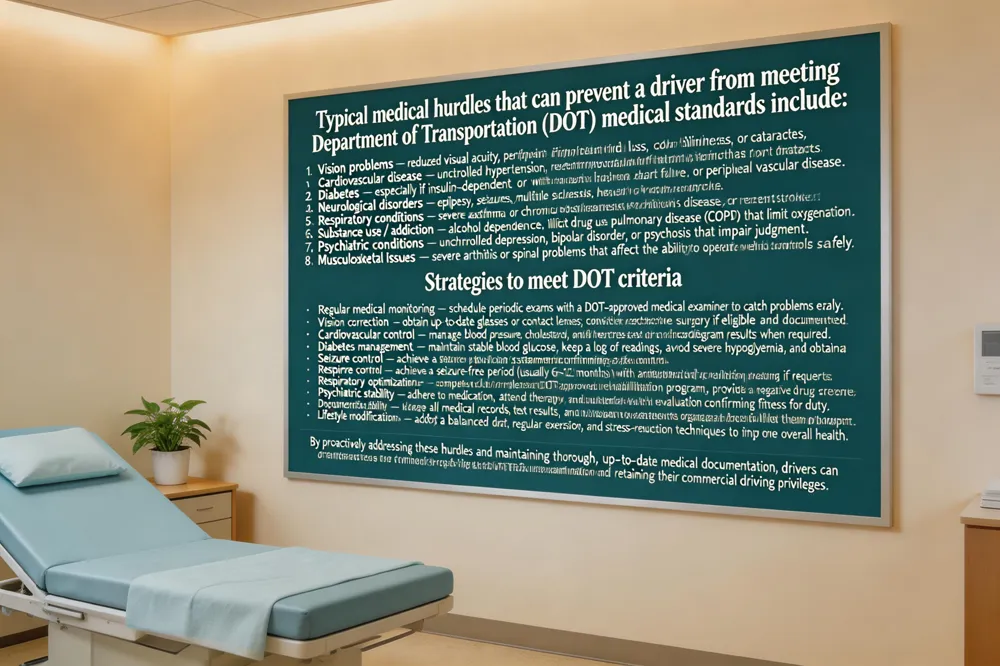 A DOT physical can be denied for any condition that threatens safe operation of a commercial vehicle. Common disqualifiers include uncontrolled hypertension, severe or untreated sleep apnea, unmanaged diabetes (especially an A1C ≥ 10 %), recent myocardial infarction, angina, heart failure, epilepsy or other seizure disorders, severe visual acuity loss, and inability to meet the hearing standard. Certain sedating medications, substance‑abuse history, and serious mental‑health issues may also lead to a fail.
Management strategies: Keep blood pressure at or below 140/90 mm Hg by limiting sodium, caffeine, and nicotine before the exam, taking prescribed antihypertensives, and documenting stable readings with a physician’s note. For diabetes, maintain tight glucose control, bring the latest HbA1C (within six months), and provide a completed MCSA‑5870 or MCSA‑5872 form. Sleep‑apnea drivers should use CPAP nightly, record at least 90 days of compliance, and submit a sleep‑study report and specialist letter.
When a temporary certificate may be issued: If a driver’s blood pressure is mildly elevated (140‑159/90‑99 mm Hg) or a condition is being treated but not fully resolved, the examiner can issue a one‑year or three‑month certificate pending further documentation or follow‑up testing. This allows continued driving while the driver addresses the underlying health issue.
Logistics: Timing, Costs, and Finding an Examiner
 A DOT physical typically lasts 30‑45 minutes, though a full hour is a safe estimate when the examiner also orders a urinalysis, blood work, or additional labs. Most certified medical examiners complete the entire evaluation in a single visit, reviewing medical history, vital signs, vision, hearing, and musculoskeletal health.
Cost varies by location and provider. Expect to pay $75‑$150 for the basic exam; low‑cost urgent‑care centers may charge around $60, while specialized clinics can exceed $200. The fee is usually a flat, self‑pay charge because insurance does not cover the certification. Added testing (vision, hearing, cardiac studies) can increase the total price.
To locate a qualified examiner, search the FMCSA National Registry for a Certified Medical Examiner (CME) in your area. The registry includes MDs, DOs, physician assistants, advanced practice nurses, and chiropractors. In North Carolina, providers such as Southeast Family Chiropractic (Dr. Corey Skinner, DC) offer DOT exams and can be booked online or by phone. Walk‑in options like CVS MinuteClinic or Concentra urgent‑care centers also perform DOT physicals.
Before your appointment, avoid alcohol, caffeine, and heavy salty meals for at least 24 hours, skip vigorous exercise on the day of the exam, and refrain from taking new medications without notifying the examiner. Arrive well‑rested, hydrated, and with any required documentation (ID, medication list, corrective lenses, specialist reports) to ensure a smooth, successful certification process.
Frequently Asked Questions and Myths
 Below are the most common myths drivers encounter when scheduling a DOT physical and the factual answers.
Do they check your private parts in a DOT physical? No. The exam includes a brief hernia screen, which may involve a hand placed on the groin while you cough, but you are not required to fully disrobe. Wear loose clothing; the focus is vision, hearing, blood pressure, urinalysis, and overall health.
Does a DOT physical include a drug test? The DOT physical itself does not test for illicit substances. The urine sample is used only for medical screening (glucose, protein, etc.). Employers often require a separate drug screen, but it is not part of the medical exam.
Can I update my CDL medical card online in Florida? Yes, but the update is done electronically by the certified medical examiner through the FMCSA National Registry. Drivers cannot edit the card themselves; any correction requires a new examiner‑issued certificate.
Do DOT physicals drug test? No. The medical exam and the FMCSA‑mandated drug test are distinct. The drug test is usually administered by the employer before hire or during random/post‑accident checks.
Is methadone disqualifying for DOT? Historically it was, but current FMCSA guidelines no longer list methadone as an automatic disqualifier. Approval depends on a physician’s note confirming safe driving and no excessive daytime sleepiness.
Final Takeaways for a Successful DOT Physical
Recap the preparation steps: gather a complete medication list, bring corrective lenses or hearing aids, schedule a pre‑exam check‑up with your primary or specialty doctor, and bring any required condition‑specific forms (vision, diabetes, sleep‑apnea, cardiac, neurologic). Keep blood pressure, blood sugar, and weight under control by limiting caffeine, sodium, and stress, and get a good night’s sleep before the appointment. Staying compliant with FMCSA standards protects your CDL, your employer, and public safety. Southeast Family Chiropractic can streamline the process—our team can review your medical history, provide documentation for vision or musculoskeletal issues, and coordinate with FMCSA‑certified examiners to ensure you arrive fully prepared and confident.