Why Understanding Triggers Matters
Every headache episode reflects a combination of lifestyle choices—irregular meals, poor sleep, dehydration, stress, and excessive caffeine or alcohol—can tip the nervous system into pain mode. Recognising these patterns lets sufferers replace harmful habits with evidence‑based, non‑medication tools such as regular hydration, balanced meals every 3‑4 hours, consistent 7‑9 hour sleep, and stress‑reduction practices (mindfulness, yoga, deep‑breathing). These strategies empower patients to lower attack frequency without relying on analgesics. Moreover, the spine plays a pivotal role: forward‑head posture, neck strain, and musculoskeletal tension can amplify sensory triggers, while chiropractic adjustments, ergonomic coaching, and targeted neck‑strengthening exercises restore alignment and reduce nerve irritation. Together, lifestyle optimisation and spinal health create a proactive, drug‑free defence against headaches.
Common Headache Triggers You Can Modify
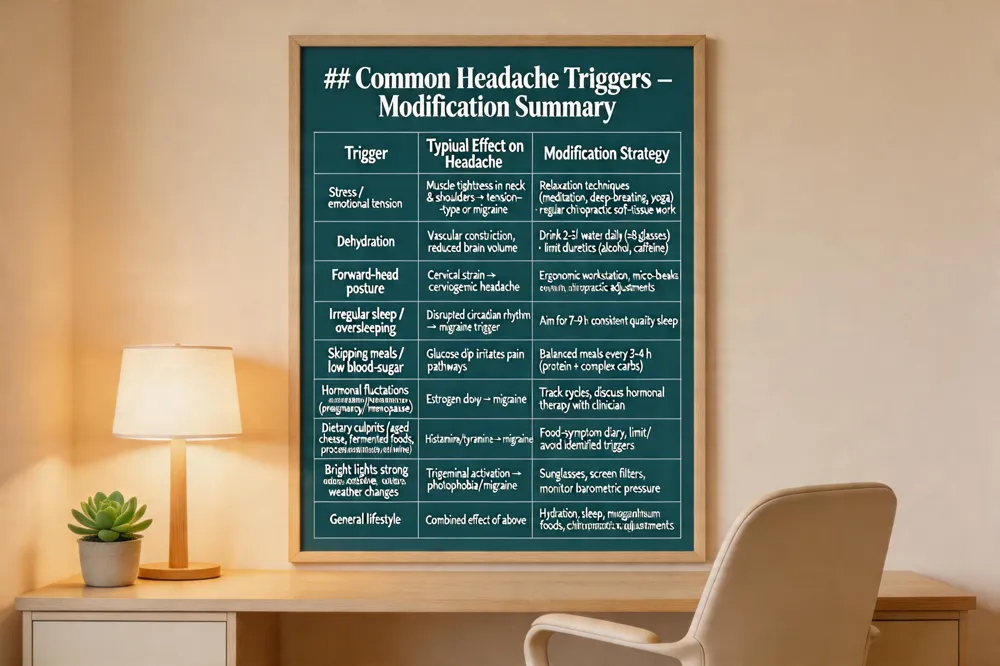
Common Headache Triggers – Modification Summary
| Trigger | Typical Effect on Headache | Modification Strategy |
|---|---|---|
| Stress / emotional tension | Muscle tightness in neck & shoulders → tension‑type or migraine | Relaxation techniques (meditation, deep‑breathing, yoga) + regular chiropractic soft‑tissue work |
| Dehydration | Vascular constriction, reduced brain volume | Drink 2–3 L water daily (≈8 glasses) and limit diuretic drinks (alcohol, caffeine) |
| Forward‑head posture | Cervical strain → cervicogenic headache | Ergonomic workstation, micro‑breaks every 30‑60 min, chiropractic adjustments |
| Irregular sleep / oversleeping | Disrupted circadian rhythm → migraine trigger | Aim for 7–9 h of consistent, quality sleep |
| Skipping meals / low blood‑sugar | Glucose dip irritates pain pathways | Balanced meals every 3–4 h (protein + complex carbs) |
| Hormonal fluctuations (menstruation, pregnancy, menopause) | Estrogen drop → migraine | Track cycles, discuss hormonal therapy with clinician |
| Dietary culprits (aged cheese, fermented foods, processed meats, MSG, excess caffeine, red wine) | Histamine/tyramine or nitrates trigger migraine | Food‑symptom diary, limit/avoid identified triggers |
| Bright lights, strong odors, weather changes | Trigeminal activation → photophobia or migraine | Sunglasses, screen filters, good ventilation, monitor barometric pressure |
| General lifestyle | Combined effect of above | Hydration, regular sleep, mindfulness, cold/heat packs, magnesium‑rich anti‑inflammatory foods, gentle chiropractic adjustments |
 A “trigger headache” starts after exposure to a specific stimulus—such as stress, a certain food, bright light, strong odor, hormonal shift, or alcohol—instead of arising spontaneously. Identifying and avoiding these triggers can lower attack frequency and severity.
Stress and emotional tension – Muscle tightness in the neck and shoulders caused by stress is a leading migraine and tension‑type headache trigger. Relaxation techniques (meditation, deep‑breathing, yoga) and regular chiropractic soft‑tissue work reduce that tension.
Dehydration and fluid intake – Even mild dehydration can cause vascular changes that provoke headaches. Drinking 2–3 liters of water daily (≈8 glasses) and limiting diuretic beverages such as alcohol helps keep blood‑sugar and brain volume stable.
Posture, especially forward‑head position – Prolonged computer use strains cervical muscles, leading to cervicogenic headaches. Ergonomic workstation setup, frequent micro‑breaks, and chiropractic adjustments restore alignment.
Irregular sleep and oversleeping – Both too little (<7 h) and too much sleep can trigger attacks. Aim for 7–9 hours of quality sleep on a consistent schedule.
Skipping meals or low blood‑sugar – Low glucose irritates pain pathways. Eat balanced meals every 3–4 hours to maintain stable blood‑sugar levels.
Hormonal fluctuations in women – Estrogen drops during menstruation, pregnancy, or menopause often provoke migraines. Tracking cycles and discussing hormonal therapy with a clinician can help.
Dietary culprits – Aged cheese, fermented foods, processed meats (nitrates), MSG, excessive caffeine, and especially red wine (histamine/tyramine) are frequent triggers. A food‑symptom diary pinpoints personal sensitivities.
Bright lights, strong odors, and weather changes – Fluorescent or flickering light, perfume, and rapid barometric shifts can activate the trigeminal nerve. Use sunglasses, screen filters, and maintain good ventilation; monitor weather forecasts for pressure changes.
What helps headaches naturally? – Stay hydrated, keep regular sleep, practice mindfulness, apply cold/heat packs, consume magnesium‑rich anti‑inflammatory foods, and receive gentle chiropractic adjustments to relieve neck tension—all drug‑free strategies that address the most common modifiable triggers.
Chiropractic Care for Headaches
Chiropractic Care – Key Approaches & Benefits
| Approach | Description | Primary Benefit |
|---|---|---|
| Spinal adjustments | Low‑velocity, precise manipulation of cervical vertebrae | Restores alignment, reduces nerve compression, lowers headache frequency |
| Soft‑tissue work | Myofascial release, instrument‑assisted mobilizations | Relieves muscular tension in neck & shoulders |
| Ergonomic counseling | Guidance on workstation setup, posture | Prevents forward‑head posture, reduces mechanical strain |
| Targeted stretching & SNAG exercises | Home‑based cervical mobility drills | Improves range of motion, maintains alignment between visits |
| Multimodal program (adjustment + exercise + education) | Integrated plan tailored to patient | Evidence‑based first‑line non‑pharmacologic treatment for migraine & cervicogenic headache |
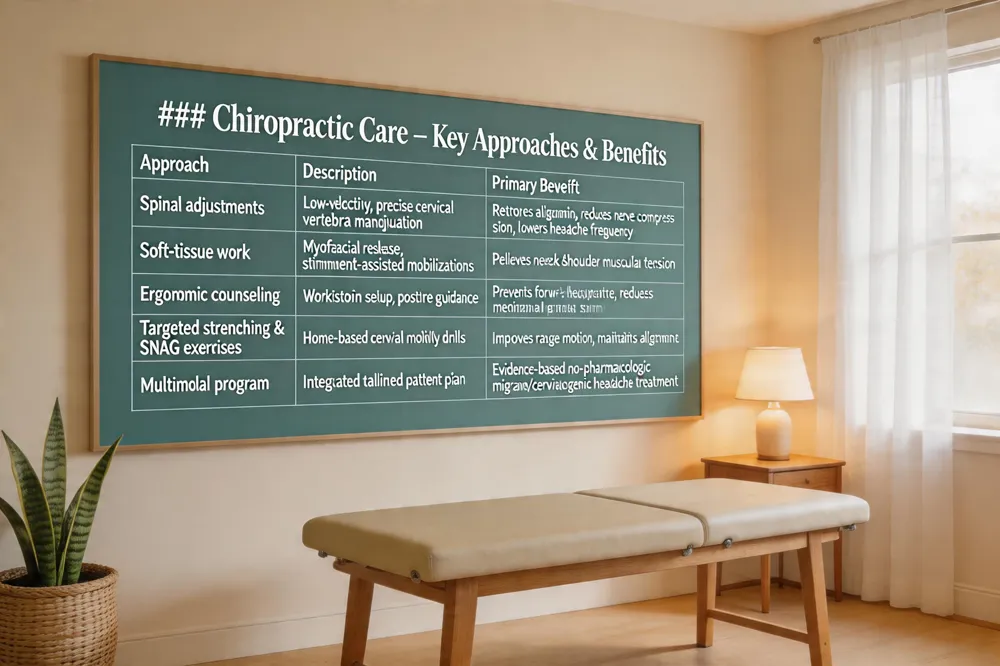 Chiropractic care can be an effective, drug‑free option for people who suffer from daily headaches. By evaluating spinal alignment, posture, and neck‑shoulder muscle tension, a chiropractor identifies common mechanical triggers of tension‑type and cervicogenic pain. Gentle spinal adjustments, soft‑tissue work, instrument‑assisted mobilizations, ergonomic counseling, and targeted stretching relieve tight muscles, reduce nerve compression, and lower headache frequency and intensity.
Evidence‑based guidelines now list spinal manipulation as a first‑line, non‑pharmacologic treatment for migraine (when combined with multimodal care) and for cervicogenic headache. Low‑load craniocervical mobilization is recommended for long‑term management of episodic or chronic tension‑type headache. Treatment frequency and dosage are individualized based on clinical judgment and patient response.
Research, including systematic reviews, shows modest pain relief for tension‑type and cervicogenic headaches with spinal manipulation and a low risk of adverse events. While evidence for migraine alone is limited, multimodal programs that incorporate manipulation, massage, and exercise improve outcomes.
For cervicogenic headache, care focuses on precise upper‑cervical adjustments, myofascial release, postural correction, and home SNAG exercises, restoring mobility and reducing nerve irritation.
In tension‑type headache, correcting cervical misalignments and providing soft‑tissue techniques, posture education, and ergonomic advice reduces muscular tension, offering lasting, medication‑free relief.
Managing Migraine Triggers Without Medication
Non‑Pharmacologic Migraine Trigger Management
| Trigger | Management Strategy | Practical Tips |
|---|---|---|
| Stress | Mindfulness, deep‑breathing, yoga, progressive muscle relaxation | 10‑min daily meditation; 5‑min breathing (4‑4‑6) before stressful events |
| Dehydration | Consistent fluid intake | 2–3 L water daily; set reminders; carry a water bottle |
| Irregular meals | Regular balanced meals | Eat every 3–4 h; include protein & complex carbs; avoid long fasting |
| Caffeine | Moderate intake & gradual taper if reducing | 100‑150 mg/day (≈1 cup coffee); reduce by 10 % per day if cutting back |
| Alcohol / red wine | Limit consumption, hydrate alongside | ≤1 drink/day; drink a glass of water per alcoholic drink |
| Weather / barometric pressure | Anticipate changes, stay hydrated | Check forecasts; increase water intake on low‑pressure days |
| Screen‑time & lighting | Blue‑light filters, 20‑20‑20 rule | Use screen protectors; every 20 min look 20 ft away for 20 s |
 Stress‑reduction strategies: Regular mindfulness, deep‑breathing, yoga or progressive muscle relaxation lower cortisol and prevent muscle tension in the neck and shoulders, a common migraine precursor.
Consistent hydration: Drinking 2–3 liters of water daily (≈8 8‑ounce glasses) keeps cerebral blood vessels from constricting and reduces the frequency of both tension‑type and migraine attacks.
Regular meal timing: [Skipping meals] or long fasting periods cause low blood‑sugar spikes that provoke headaches; aim for balanced meals every 3–4 hours to stabilize glucose.
Caffeine moderation and withdrawal: Moderate intake (≈100‑150 mg daily) can be protective, but abrupt cessation triggers vasodilation headaches. If you depend on caffeine, taper slowly over a week.
Alcohol and red‑wine limits: [Alcohol], especially red wine, causes dehydration and histamine release; limit consumption and accompany drinks with water.
Weather and barometric‑pressure awareness: Rapid pressure drops or temperature swings can precipitate migraines—monitor forecasts and stay hydrated when weather changes are expected.
Screen‑time and lighting adjustments: Bright or flickering screens aggravate photophobia; use blue‑light filters, dim indoor lighting, and follow the 20‑20‑20 rule to rest the eyes.
Why am I suddenly getting migraines every day? A new or intensified trigger—heightened stress, irregular sleep, hormonal shifts, dietary changes, medication overuse, or chronic neck tension—can spark daily attacks. Identifying and adjusting these factors breaks the cycle.
Why are my headaches triggered so easily? Over‑sensitivity to common stressors (poor sleep, dehydration, stress, hormonal swings, certain foods, bright lights, strong odors) amplifies pain signals, especially when neck muscles are tense. Reducing these stressors and correcting spinal alignment calms the nervous system.
What helps headaches naturally? Adequate hydration, 7‑9 hours of regular sleep, meditation or deep‑breathing, cold/heat packs, magnesium‑rich anti‑inflammatory foods, and gentle chiropractic adjustments to relieve neck tension are proven drug‑free strategies.
Common migraine triggers in women include [hormonal fluctuations] (menstruation, pregnancy, menopause), stress, irregular sleep, aged cheese, chocolate, caffeine, alcohol—especially red wine—and sensory factors (bright lights, strong odors, weather changes).
Uncommon migraine triggers can be rapid barometric‑pressure shifts, strong perfumes or chemicals, certain medications (e.g., oral contraceptives), fasting, and sensory overload from flickering lights or loud noises.
Practical Home Relief Techniques
Quick Home Relief Techniques – How‑to
| Technique | How to Apply | Expected Relief |
|---|---|---|
| Cold or warm compress | Apply 15‑20 min to forehead/temples/neck; switch after 15 min if needed | Cold → vasoconstriction; Warm → muscle relaxation |
| Self‑massage (temples & neck) | Gently knead temples & base of skull for 1‑2 min | Releases tension, reduces pain perception |
| Acupressure (LI4 point) | Press thumb‑index webbing for 30‑60 sec while breathing | Blunts migraine/tension pain within seconds |
| Deep‑breathing (4‑4‑6) | Inhale 4 s, hold 4 s, exhale 6 s; repeat 5‑10 cycles | Lowers cortisol, eases muscle tightness |
| Posture micro‑breaks | Every 30‑60 min: roll shoulders, chin‑to‑chest stretch | Prevents strain‑induced headaches |
| Screen‑break (20‑20‑20 rule) | Every 20 min look at object 20 ft away for 20 s | Reduces eye‑strain‑related tension |
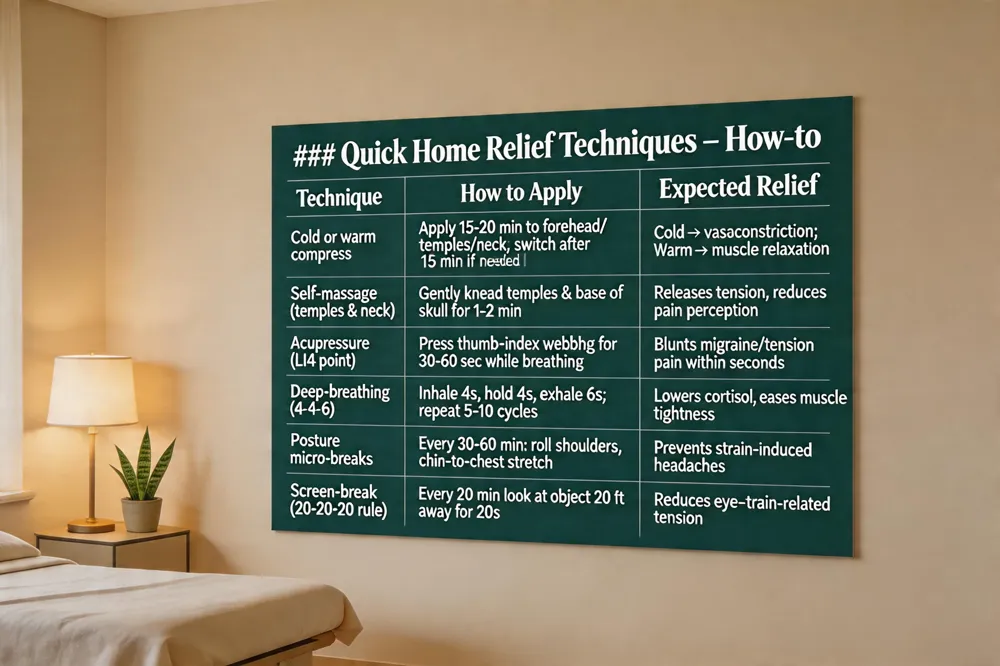 When a headache strikes, act quickly: sit in a dark, quiet room, hydrate with a glass of water, and apply a cold or warm compress to the forehead, temples, or neck for 15‑20 minutes. For instant relief, press the thumb‑index webbing (LI4 point) while taking a Deep‑breathing cycle (inhale 4 seconds, hold 4, exhale 6). This combined stimulus can blunt pain perception within seconds.
Cold or warm compress application – A cold pack constricts swollen vessels; a warm pad relaxes tense muscles. Switch after 15 minutes if needed.
Self‑massage of temples and neck – Gently knead the temples and the base of the skull; this releases muscular tension that often fuels headache pain.
Acupressure point (thumb‑index webbing) – Hold firm pressure for 30‑60 seconds; the LI4 point is widely reported to curb migraine and tension‑type pain.
Deep‑breathing and relaxation – Slow diaphragmatic breaths reduce cortisol and muscle tightness, creating a calming cascade that eases headache intensity.
Posture micro‑breaks – Every 30‑60 minutes, roll shoulders, chin‑to‑chest, and stretch neck muscles to prevent strain‑induced pain.
Screen‑break routine (20‑20‑20 rule) – Every 20 minutes, look at something 20 feet away for 20 seconds; this reduces eye‑strain‑related tension headaches.
Quick‑relief FAQ
- How to stop a headache immediately at home? Sit in darkness, hydrate, apply a compress, massage temples/neck, press LI4, and practice deep breathing.
- How to get rid of a headache in 5 seconds? Apply an ice‑wrapped cloth to temples while pressing LI4, then perform a rapid 4‑4‑6 breathing cycle.
- How to stop a headache immediately at home? Use a cold compress, hydrate, massage tension points, practice deep breathing, and minimize sensory input (dim lights, reduce noise).
Frequently Asked Questions & Next Steps
FAQ Summary
| Question | Brief Answer | Suggested Next Step |
|---|---|---|
| Should I go to a chiropractor for headaches? | Yes, for tension‑type, cervicogenic, or neck‑related headaches | Schedule an evaluation; discuss posture, hydration, stress management |
| What do neurologists think of chiropractors? | Generally supportive for mechanical neck pain; recommend screening for artery‑dissection risk | Seek collaborative care; ensure chiropractor uses low‑velocity techniques |
| Chiropractor for headaches near me | Our Gastonia, NC clinic specializes in drug‑free headache relief | Book an appointment; ask about ergonomic counseling and home exercises |
| Why am I suddenly getting migraines every day? | New/intensified triggers (stress, sleep, hormones, diet, neck tension) | Identify trigger(s) via diary; implement hydration, regular meals, posture breaks, chiropractic care |
| Why are my headaches triggered so easily? | Over‑sensitivity to common stressors combined with muscular tension | Reduce exposure (light, odor, weather), improve neck alignment, practice relaxation |
 Should I go to a chiropractor for headaches?
Yes—if your headaches are tension‑type, cervicogenic or linked to neck and shoulder muscle tension, a chiropractor can help. Evidence‑based spinal adjustments improve alignment, relieve muscular tightness, and reduce headache frequency. Lifestyle counseling on posture, hydration, regular meals, and stress‑reduction (e.g., yoga, meditation) further supports relief. Stress‑relieving activities such as yoga and meditation can help. Migraines or cluster headaches often require medical evaluation, but many patients find drug‑free chiropractic care beneficial as part of a comprehensive plan.
What do neurologists think of chiropractors?
Neurologists recognize that spinal manipulation can effectively address mechanical neck pain and tension‑type headaches. They advise careful screening for cervical artery‑dissection risk and typically recommend collaboration with chiropractors rather than primary neurological diagnosis. When appropriate, chiropractor‑provided adjustments, especially low‑velocity techniques, are considered a safe adjunct to conventional care.
Chiropractor for headaches near me
Our Gastonia, NC clinic specializes in treating tension‑related and cervicogenic headaches through gentle adjustments, therapeutic exercises, and ergonomic counseling. We offer flexible scheduling and a drug‑free approach aimed at lasting relief.
Why am I suddenly getting migraines every day?
A rapid increase often signals new or intensified triggers such as heightened stress, irregular sleep, hormonal shifts, dietary changes, medication overuse, or chronic neck tension. Identifying and modifying these factors—maintaining hydration, consistent meals, proper posture, and stress‑management techniques—can break the cycle and reduce migraine frequency.
Take Charge of Your Headache Health
Understanding the most common headache triggers—stress, dehydration, irregular meals, poor sleep, caffeine swings, hormonal shifts, bright lights, strong odors, weather changes, alcohol, and posture—lets you take steps toward relief. Simple habits such as hydration, meals every 3‑4 hours, consistent 7‑9 hours of sleep, moderate caffeine, stress‑reduction practices (meditation, yoga, deep‑breathing), avoiding trigger foods, and maintaining ergonomic posture can lower attack frequency. Chiropractic care complements these measures by correcting spinal misalignments, easing neck‑muscle tension, improving blood flow, and restoring nervous‑system balance. Schedule an initial assessment, keep a headache diary, and work with a chiropractor to tailor a prevention plan that fits your lifestyle.