Welcome to Southeast Family Chiropractic
At Southeast Family Chiropractic our mission is to provide trustworthy, patient‑centered wellness through gentle, evidence‑based chiropractic care for every stage of life. Our practice philosophy puts families first—educating parents, listening to their concerns, and creating personalized treatment plans that support natural growth, optimal nervous‑system function, and overall health. We embrace a family‑focused model that treats newborns, toddlers, school‑aged children, pregnant patients, and adults under one roof, fostering continuity of care from conception through adulthood. To deepen our expertise, all clinicians are certified by the International Chiropractic Pediatric Association (ICPA). ICPA certification (CACCP) equips us with specialized pediatric and perinatal techniques, access to the latest research, and inclusion in a trusted referral directory that connects families with qualified practitioners. This credential reinforces our commitment to safe, low‑force adjustments, enhances patient confidence, and aligns perfectly with our holistic, family‑wellness approach.
ICPA Membership Benefits – Boosting Practice Visibility and Research Impact
ICPA Membership Benefits – Quick Reference
| Benefit | Description |
|---|---|
| Find a Chiropractor Directory | Listed in a high‑traffic directory (≈1 M annual visits) that acts as an SEO engine, driving families searching for pediatric/pregnancy care directly to your practice. |
| Practice‑Based Research Network (PBRN) | Automatic entry to contribute de‑identified patient data, positioning your clinic as a research leader and influencing evidence‑based standards. |
| Pathways to Family Wellness Magazine | Quarterly complimentary subscription; use print editions for in‑office education or discounted gifts to new parents to reinforce trust. |
| Discounts on Seminars & Products | Substantial savings on pediatric and pregnancy seminars, partner product lines, and collaborative opportunities with health providers and parenting groups. |
| Networking & Referral Opportunities | Access to exclusive collaborations with other providers, expanding referral sources and community visibility. |
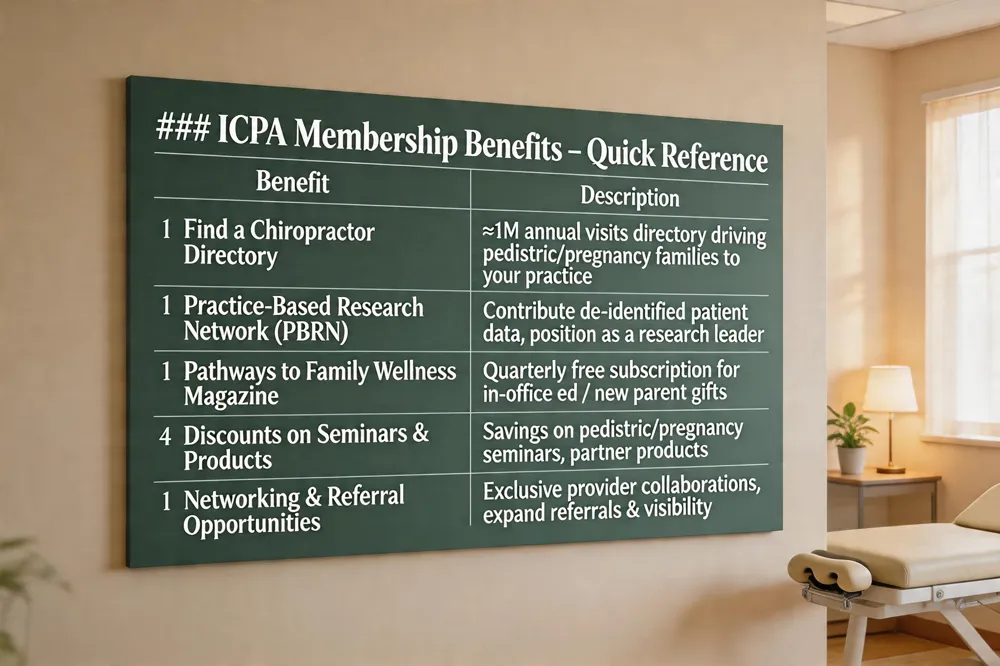 International Chiropractic Pediatric Association (ICPA) places every member in its public “Find a Chiropractor” directory, a site that receives up to one million visits each year.
This high‑traffic platform functions like a powerful SEO engine, driving families searching for pediatric and prenatal chiropractic care directly to your practice and dramatically increasing online visibility.
Members also gain automatic entry into the ICPA Practice‑Based Research Network (PBRN). By contributing de‑identified patient data, you help shape evidence‑informed standards for family chiropractic care while showcasing your practice as a leader in research‑driven outcomes.
Every member receives a complimentary quarterly subscription to Pathways to Family Wellness, the ICPA’s public‑facing magazine. Use the print edition as an in‑office education tool or give discounted gift subscriptions to new parents—each issue delivers up‑to‑date research, wellness tips, and success stories that reinforce patient trust.
In addition, ICPA membership unlocks substantial discounts on pediatric and pregnancy seminars, product lines from collaborating partners, and exclusive collaborative opportunities with other health providers and parenting organizations. These savings reduce training costs, expand your service offerings, and position your clinic as a trusted hub for family‑centered wellness.
Understanding the 3 T’s in Chiropractic
The 3 T’s – Overview Table
| T | Definition | Primary Impact on Health |
|---|---|---|
| Thoughts | Chronic mental stress keeping the nervous system in a sympathetic “fight‑or‑flight” state. | Disrupts hormonal balance, immune function, and spinal health; mindfulness, breathing, and sleep help restore parasympathetic tone. |
| Trauma | Acute injuries (e.g., car accidents) and repetitive micro‑trauma (e.g., poor posture). | Causes abnormal joint loading and nerve interference; addressed through adjustments, corrective exercises, and ergonomic changes. |
| Toxins | Harmful substances: inflammatory foods, sugary drinks, alcohol, environmental pollutants (mold, heavy metals, contaminated water). | Increases systemic inflammation; managed via nutritional counseling, detox protocols, and lifestyle modifications. |
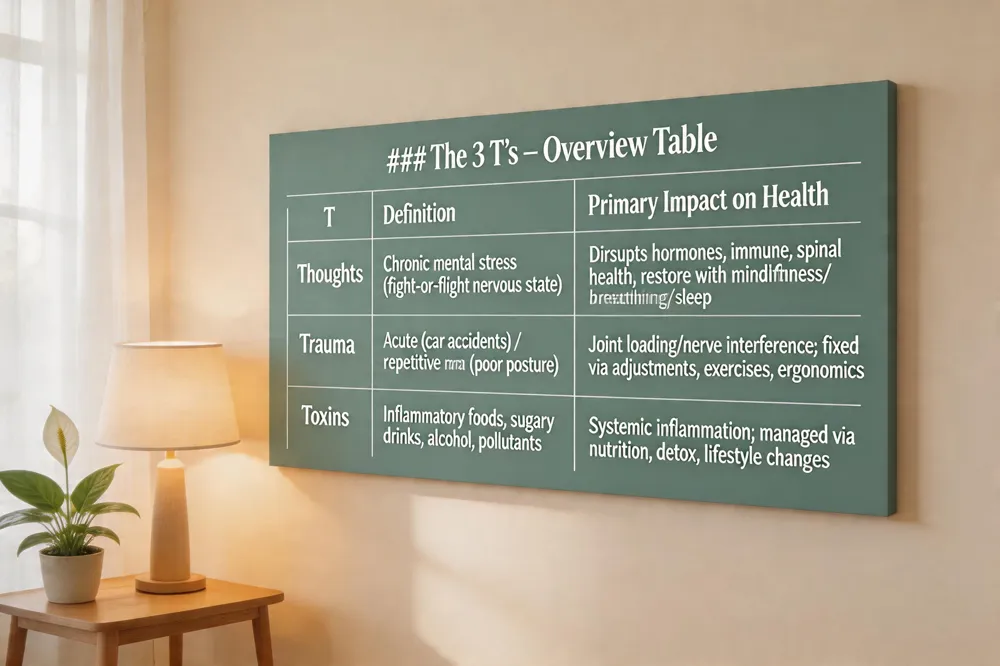 The “3 T’s” in chiropractic are thoughts, trauma, and toxins—the three primary factors D.D. Palmer identified in 1910 as the underlying causes of subluxation and nerve interference.
Thoughts represent chronic mental stress that keeps the nervous system in a sympathetic “fight‑or‑flight” mode, disrupting hormonal balance, immune function, and spinal health. Managing stress through mindfulness, breathing exercises, and adequate sleep helps the body return to a parasympathetic, restorative state.
Trauma includes both acute injuries—such as car accidents or falls—and repetitive micro‑trauma from everyday habits like prolonged desk work, poor posture, or repetitive motions. Addressing trauma with appropriate adjustments, corrective exercises, and ergonomic changes reduces abnormal joint loading and promotes proper nervous system signaling.
Toxins refer to harmful substances we ingest or encounter, including inflammatory foods, sugary drinks, alcohol, and environmental pollutants like mold, heavy metals, or contaminated water. Nutritional counseling, detoxification protocols, and lifestyle modifications lower systemic inflammation and support the body’s innate healing capacity.
By systematically addressing thoughts, trauma, and toxins, chiropractors help restore optimal spinal alignment, improve nervous system function, and enhance overall wellness for patients of all ages.
Webster Certification Explained
Webster Technique Certification – Key Points
| Feature | Details |
|---|---|
| Origin | Developed in 1986 by Dr. Larry Webster under the ICPA to create a safe, pregnancy‑specific adjustment. |
| Clinical Focus | Gentle pelvic balancing, ligament tension relief, nerve function improvement to optimize fetal positioning. |
| Patient Benefits | Reduced low‑back, pelvic, and round‑ligament pain; enhanced comfort in third trimester; smoother labor. |
| Training Requirements | Hands‑on workshops, evidence‑informed research study, practical exam; strict safety protocols throughout. |
| Professional Trust | Recognized by obstetricians, midwives, doulas; increases referrals for prenatal chiropractic care. |
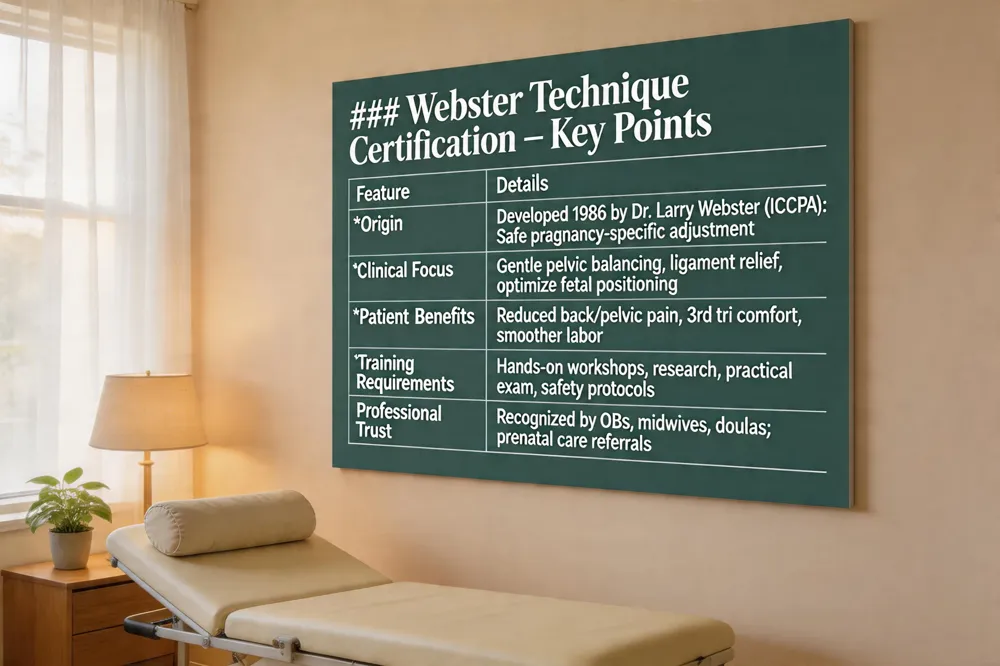 The Webster Technique originated in 1986 when Dr. Larry Webster founded the International Chiropractic Pediatric Association (ICPA) to protect children’s access to chiropractic care and to develop a safe, pregnancy‑specific adjustment. Today, a Webster‑certified chiropractor has completed the ICPA’s advanced training that focuses on gently balancing the pelvis, relieving tension in ligaments, and improving nerve function to create optimal space for fetal positioning. This specialization offers concrete benefits for pregnant patients: reduced low‑back, pelvic and round‑ligament pain, improved comfort during the third trimester, and a higher likelihood of a smoother, less invasive labor. The certification requires strict safety protocols, including hands‑on technique workshops, evidence‑informed research, and a practical exam, ensuring that every adjustment is low‑force, age‑appropriate, and fully compliant with current clinical guidelines. Because the designation signals rigorous, evidence‑based expertise, patients and other providers—ob‑gyns, midwives, doulas—trust a Webster Technique certified practitioner and are more likely to refer families for prenatal chiropractic care. In short, being Webster certified means the chiropractor can safely and effectively support pregnancy health while fostering interdisciplinary collaboration.
Certification Pathways: From DC to CACCP
Certification Pathways – Summary Table
| Pathway | Core Requirements | Typical Duration |
|---|---|---|
| Doctor of Chiropractic (DC) | Accredited DC program + NBCE Part I‑IV exams + state licensure + CPR/BLS. | 3‑4 years (education) + exam period. |
| ICPA Pediatric Certification (CACCP) | 20 courses (~200 hrs) with 60 hrs in‑person, hands‑on workshops, comprehensive essay exam; 12 hrs CE biennially. | 14‑18 months coursework + 3‑6 months for capstone exam (≤3 years total). |
| Certified Chiropractic Assistant (CCA) | 24 hrs PACE‑approved training (or 2,000 hrs office experience) + CCCA exam + 300 hrs supervised practice. | Few months to 1 year. |
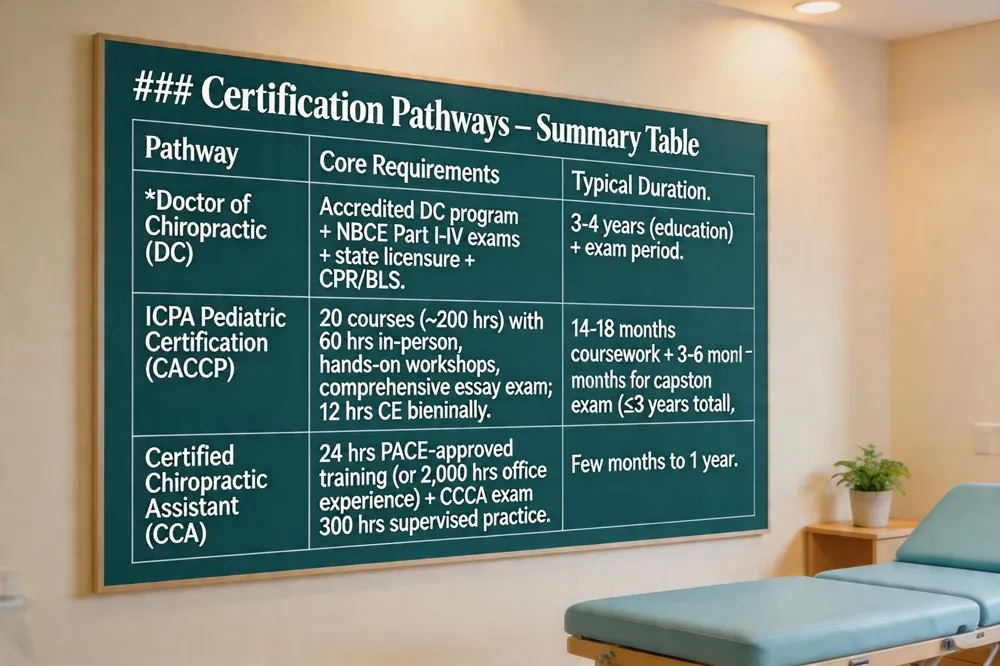 To practice as a chiropractor in the U.S., you must first earn a Doctor of Chiropractic (DC) degree from a Council on Chiropractic Education‑accredited program and pass the four‑part National Board of Chiropractic Examiners (NBCE) exams. State licensure, CPR/basic‑life‑support certification, and a completed application follow, granting a legal license to treat patients.
The ICPA Pediatric Certification (CACCP) builds on that foundation. It requires 20 courses (≈200 hours) including 60 hours of in‑person training, hands‑on workshops, and a final comprehensive essay exam. Most practitioners complete the coursework in 14‑18 months and the capstone exam within an additional 3‑6 months, staying within a three‑year window from the first seminar. Successful graduates earn the CACCP credential and are listed in the ICPA Find a Chiropractor directory.
Maintaining CACCP status demands 12 hours of ICPA‑approved continuing‑education (CE) every two years; attending the ICPA Gathering satisfies the full biennial requirement. This CE keeps clinicians current with evidence‑informed family‑wellness practices.
Becoming a Certified Chiropractic Assistant (CCA) typically takes a few months to a year. After meeting age and education criteria, candidates complete 24 hours of PACE‑approved training (or 2,000 hours of office experience), pass the Certified Chiropractic Clinical Assistant exam, and log an additional 300 hours of supervised practice before certification is granted.
Financial Growth for Chiropractors – Salary, Side‑Hustles, and Referral Dynamics
Financial Growth Opportunities – Snapshot
| Income Stream | Description | Potential Earnings (Annual) |
|---|---|---|
| Standard Practice Salary | Average $70‑$71 k per year (national average). | $70k‑$71k |
| Tele‑Health Packages | Virtual consultations, exercise plans, follow‑ups. | $5k‑$20k (depending on volume) |
| Specialized Wellness Programs | Weight‑loss coaching, metabolic testing, preventive workshops (recurring). | $10k‑$30k |
| Corporate Wellness Contracts | On‑site ergonomic assessments, employee health services. | $15k‑$40k |
| Pop‑Up/Mobile Services | Services at gyms, sports teams, community events. | $5k‑$15k |
| Passive Income | Renting treatment rooms, selling branded products, affiliate commissions. | $3k‑$12k |
| Referral Boost via ICPA Directory | Increased patient acquisition from up to 1 M annual website visits. | Variable – can significantly raise overall revenue. |
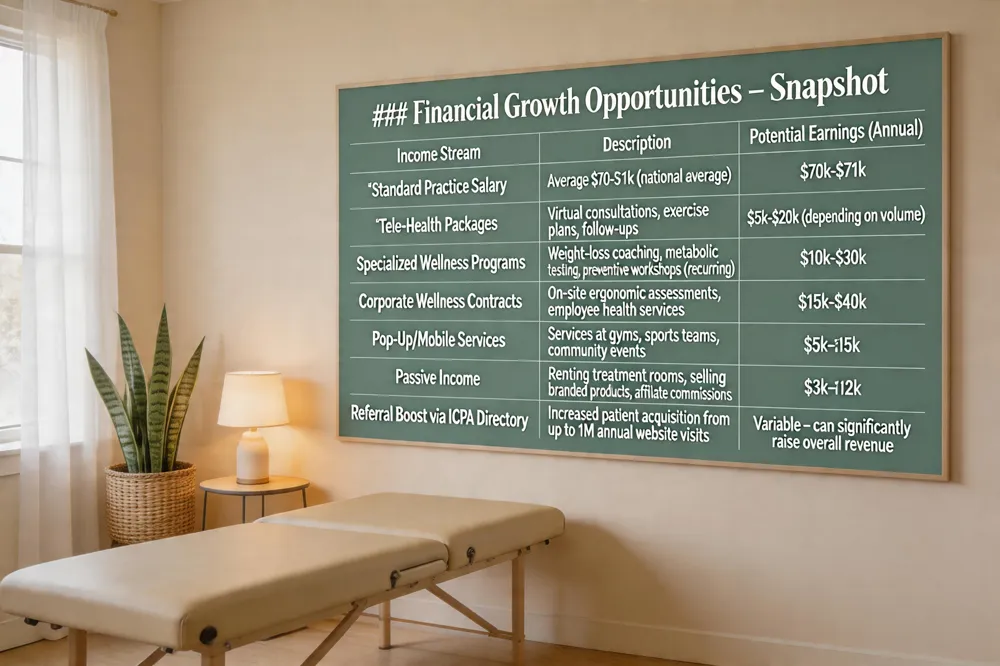 Physical therapists generally earn a higher average salary than chiropractors. National data show chiropractors making roughly $70,000‑$71,000 per year, while physical therapists typically earn between $80,000 and $92,000 annually, with specialized PT roles often exceeding $100,000. Chiropractors can boost earnings through side‑hustles such as tele‑health packages that deliver virtual consultations, exercise plans, and follow‑up guidance; specialized wellness programs (weight‑loss coaching, metabolic testing, preventive health workshops) that generate recurring revenue; corporate wellness contracts that provide on‑site ergonomic assessments and employee health services; pop‑up or mobile chiropractic services at gyms, sports teams, or community events; and passive income streams like renting treatment rooms to complementary providers, selling branded products, or earning affiliate commissions. Visibility in the ICPA’s public “Find a Chiropractor” directory—receiving up to one million visits annually—dramatically increases patient acquisition, positioning members as trusted family‑wellness specialists. Some physicians hesitate to endorse chiropractic care because they perceive a lack of robust scientific evidence, especially for non‑musculoskeletal conditions, leading to skepticism about its efficacy.
Putting It All Together – Your Path to Family‑Focused Wellness
The International Chiropractic Pediatric Association (ICPA) equips chiropractors with a 200‑hour evidence‑informed curriculum that builds confidence in treating newborns, toddlers, school‑age children, and pregnant patients. Practitioners who earn the CACCP credential gain access to a robust research network, discounted seminars, a high‑visibility listing in the "Find a Chiropractor" directory (which receives up to one million visits annually), and a complimentary subscription to the patient‑education magazine Pathways to Family Wellness. For families, this translates into safer, low‑force adjustments, improved sleep and immune function for children, reduced back pain and better pelvic alignment for expectant mothers, and a trusted point of contact for lifelong wellness.
At Southeast Family Chiropractic in Gastonia, NC, we have woven every ICPA standard into our daily practice. All of our clinicians are ICPA‑certified, use the Webster Technique for prenatal care, and follow the pediatric protocols outlined in the CACCP program. Our office displays the latest Pathways newsletters, offers free educational handouts, and participates in the ICPA Practice‑Based Research Network, ensuring that each patient benefits from the most current, evidence‑based care.
Ready to experience family‑focused chiropractic wellness? Call our office today at (704) 555‑1234 or visit southeastfamilychiropractic.com to schedule a complimentary consultation. Learn more about how ICPA certification can enhance your health journey and how you can join the path to a healthier, happier family.