Welcome to a Pain‑Free Spine
Pilates is a low‑impact exercise method that centers on controlled movement, deep breathing, and precise spinal alignment. By repeatedly engaging the transverse abdominis, multifidus, pelvic floor and diaphragm, it builds a sturdy “corset” around the lumbar spine, improving posture and reducing the load on intervertebral discs. Research from Healthline, the NHS, and the Mayo Clinic shows that regular Pilates practice lowers pain intensity and disability scores in people with chronic low‑back pain, largely because a stable core prevents excessive anterior pelvic tilt and supports a neutral spine during daily activities.
At Southeast Family Chiropractic in Gastonia, NC, Pilates is woven into a broader, non‑invasive treatment plan. Certified instructors assess each patient’s movement patterns, then tailor mat or Reformer sessions that complement chiropractic adjustments. This holistic blend of manual therapy, core strengthening, and education empowers patients to maintain spinal health long after the office visit.
Why Core Training Matters for Posture and Pain
| Benefit | Explanation |
|---|---|
| Improved spinal stability | Deep muscles (TA, multifidus, pelvic floor, diaphragm) act as an “inner brace” that keeps the lumbar spine in neutral alignment. |
| Reduced load on discs & ligaments | Even load distribution prevents excessive arching or slouching, lowering mechanical stress that triggers chronic pain. |
| Shock‑absorption during movement | Core stabilizers absorb impact forces when lifting, bending or twisting, protecting intervertebral discs from compression. |
| Pain intensity reduction | Systematic reviews (Franks 2023, Fernandez‑Rodriguez 2022, HSS 2020) show 20‑40 % pain decrease with regular Pilates/Core programs. |
| Disability score improvement | Core‑focused exercise improves functional ability compared with usual care or non‑specific exercise. |
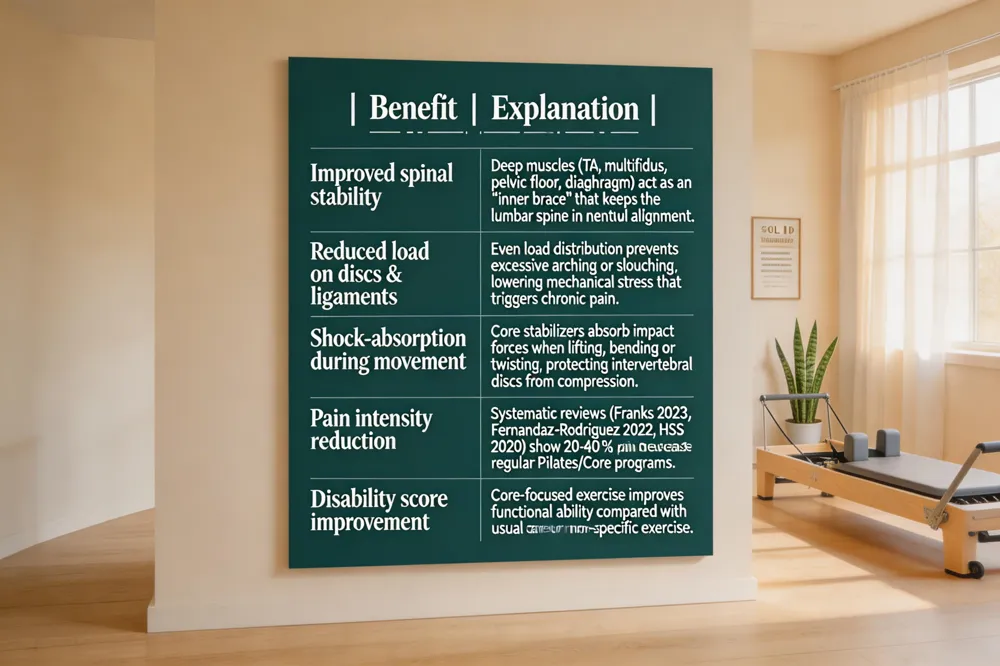 Core training builds an “inner brace” of deep abdominal, lower‑back, pelvic‑floor and gluteal muscles that work together to stabilize the lumbar spine. By engaging the transverse abdominis, multifidus, diaphragm and pelvic floor, this brace distributes load evenly across vertebrae, preventing excessive arching or slouching. Maintaining a neutral spine alignment reduces strain on ligaments, intervertebral discs and surrounding musculature, which directly lessens the mechanical triggers of chronic back pain.
A strong core also functions as a shock absorber: during everyday actions such as lifting, bending, or twisting, the deep stabilizers absorb impact forces and protect the discs from compression. This protective effect is reflected in research—systematic reviews and randomized trials (e.g., Franks 2023, Fernandez‑Rodriguez 2022, HSS 2020) consistently show that regular Pilates or core‑strengthening programs cut pain intensity by 20‑40 % and improve disability scores compared with usual care or non‑specific exercise.
How does core training improve posture and reduce back pain? By creating a balanced inner brace, core training keeps the spine in neutral alignment, reduces abnormal loading on discs and ligaments, and provides shock‑absorbing support during movement. The result is better posture, fewer pain episodes, and a lower risk of future spinal injury.
Understanding the Root Causes of Poor Posture
| Primary cause | Contributing factors |
|---|---|
| Habitual slouching & inactivity | Sedentary lifestyle, prolonged sitting/standing, ergonomic deficiencies. |
| Muscle imbalances | Tight hip flexors, hamstrings, chest muscles pull pelvis/spine out of alignment; weak glutes, core, upper‑back fail to support neutral spine. |
| Ergonomic flaws | Poor workstation design, unsupported chairs, repetitive awkward tasks reinforce slouched posture. |
Addressing cause | Increase awareness, regular movement breaks, ergonomic adjustments, and targeted core strengthening. |
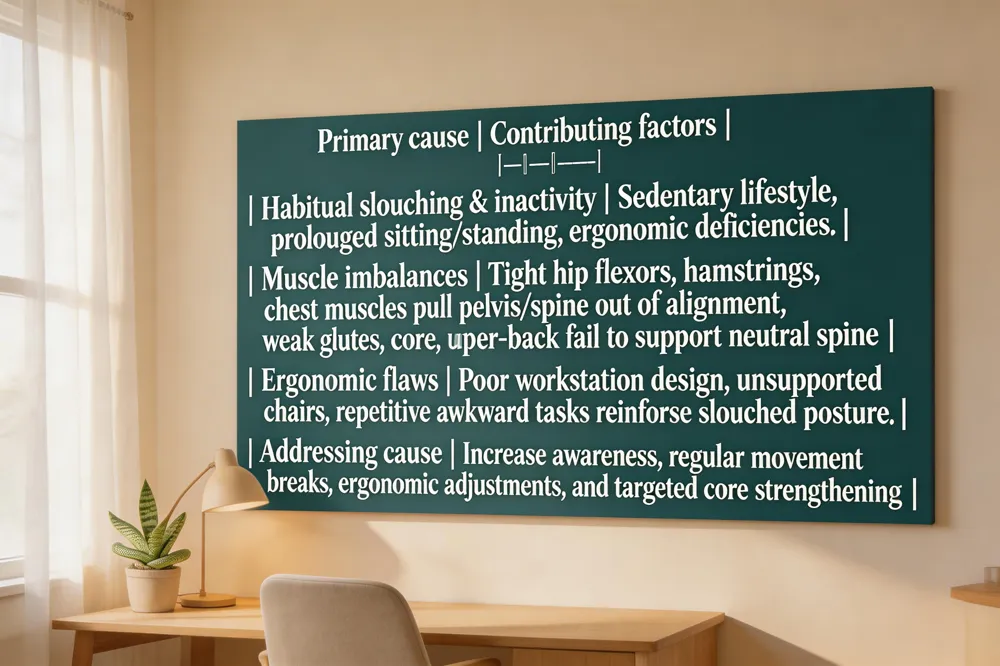 Poor posture rarely stems from a single factor; it is the result of several inter‑related habits and conditions. Habitual slouching is the most direct cause: repeated forward‑head and rounded‑shoulder positions train the body to adopt a collapsed spinal curve, weakening the deep stabilizers (transverse abdominis, multifidus) while over‑activating superficial muscles. Sedentary lifestyle compounds this problem because long periods of sitting or standing still limit the activation of postural muscles, allowing them to become under‑used and fatigued. Over time, muscle imbalances develop—tight hip flexors, hamstrings, and chest muscles pull the pelvis and thoracic spine out of alignment, whereas weak glutes, core, and upper‑back muscles fail to support a neutral spine. Finally, ergonomic factors such as poorly designed workstations, unsupported chairs, and repetitive tasks force the body into awkward positions, reinforcing the slouched habit.
Answer to the main cause: The primary cause of poor posture is the habit of prolonged slouching and inactivity that develop over time. When we spend many hours sitting or standing in non‑ergonomic positions, the deeper “static” muscles that normally support the spine become under‑used, while the faster‑twitch muscles fatigue and tighten. This imbalance leads to muscle tension, shortened muscle fibers, and a loss of the natural S‑curve of the spine. Sedentary lifestyle and repetitive, poorly‑aligned movements reinforce these habits, making poor posture a self‑perpetuating cycle. Addressing the root cause requires increased awareness, regular movement, and ergonomic adjustments.
Safe Core Practices for Individuals with Scoliosis
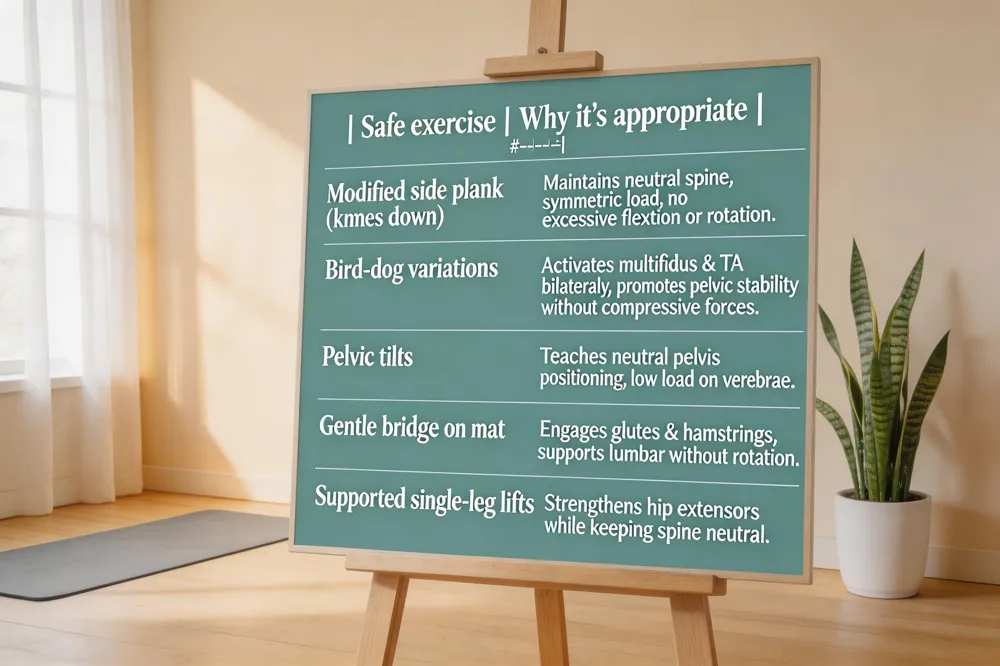
| Safe exercise | Why it’s appropriate |
|---|---|
| Modified side plank (knees down) | Maintains neutral spine, symmetric load, no excessive flexion or rotation. |
| Bird‑dog variations | Activates multifidus & TA bilaterally, promotes pelvic stability without compressive forces. |
| Pelvic tilts | Teaches neutral pelvis positioning, low load on vertebrae. |
| Gentle bridge on mat | Engages glutes & hamstrings, supports lumbar without rotation. |
| Supported single‑leg lifts | Strengthens hip extensors while keeping spine neutral. |
 People with scoliosis should steer clear of core moves that place the spine in repeated flexion, such as traditional crunches, because they compress the vertebrae and can aggravate the curve. Side‑flexion exercises—especially those done with weight or resistance—should be avoided, as they load the concave side of the spine and can deepen the imbalance. Rotational core drills that involve heavy twisting, like cable or band rotations, are also risky because they create excessive movement in already mobile segments. Any exercise that forces one side of the body to work harder than the other, including unilateral weighted twists, should be modified or omitted.
Spinal compression risks arise when the pelvis is not kept neutral, when excessive intra‑abdominal pressure is generated, or when the lumbar spine is forced into extreme flexion or extension. These positions increase disc loading and may exacerbate scoliosis‑related pain.
Balanced alternatives focus on neutral‑spine, symmetrical activation of the deep core. Examples include modified side planks, supported single‑leg lifts, bird‑dog variations, pelvic tilts, and gentle bridges performed on a mat. These exercises strengthen the transverse abdominis, multifidus, and pelvic floor without compressing or rotating the spine, promoting stability while respecting the unique curvature of a scoliotic spine.
Pilates: A Proven Ally Against Lower Back Pain
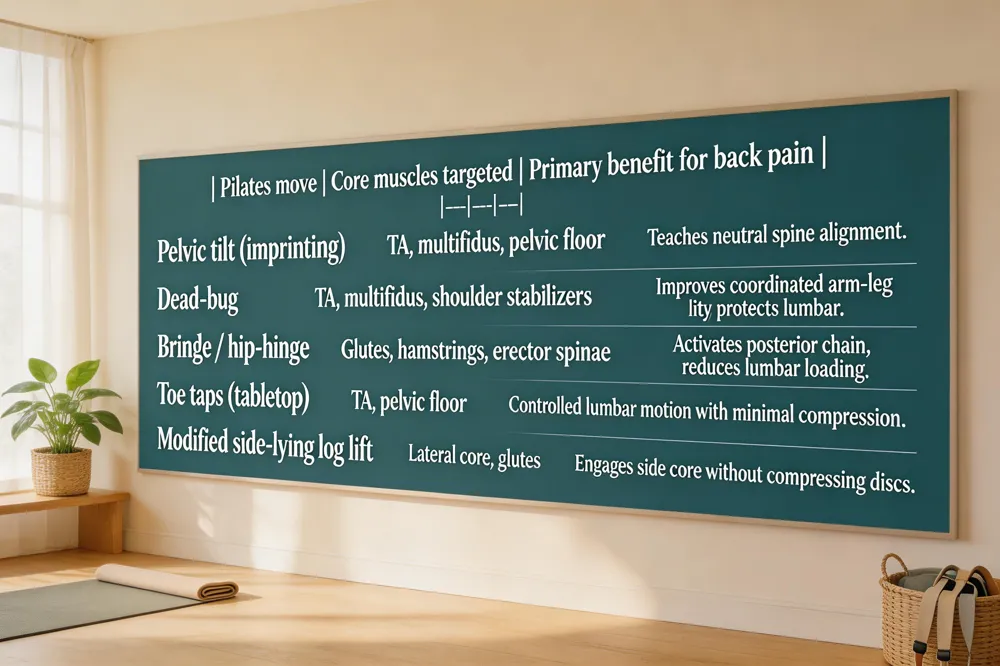
| Pilates move | Core muscles targeted | Primary benefit for back pain |
|---|---|---|
| Pelvic tilt (imprinting) | TA, multifidus, pelvic floor | Teaches neutral spine alignment. |
| Dead‑bug | TA, multifidus, shoulder stabilizers | Improves coordinated arm‑leg stability, protects lumbar. |
| Bridge / hip‑hinge | Glutes, hamstrings, erector spinae | Activates posterior chain, reduces lumbar loading. |
| Toe taps (tabletop) | TA, pelvic floor | Controlled lumbar motion with minimal compression. |
| Modified side‑lying leg lift | Lateral core, glutes | Engages side core without compressing discs. |
 How does Pilates help with lower back pain?
Pilates strengthens deep core muscles—the transverse abdominis, multifidus, pelvic floor, diaphragm, and back extensors—forming a natural brace that stabilizes the spine and reduces load on lumbar discs. Controlled diaphragmatic breathing increases intra‑abdominal pressure, keeping the pelvis neutral during daily activities. Low‑impact, lengthening movements enhance flexibility of the hip flexors, hamstrings, and thoracic spine, relieving tension that often pulls on the lower back. Repetitive, coordinated motions improve proprioception and posture awareness, allowing the body to move efficiently and avoid harmful patterns that aggravate pain.
How does Pilates help with lower back pain?
Pilates strengthens deep core muscles—the transverse abdominis, multifidus, pelvic floor, diaphragm, and back extensors—forming a natural brace that stabilizes the spine and reduces load on lumbar discs. Controlled diaphragmatic breathing increases intra‑abdominal pressure, keeping the pelvis neutral during daily activities. Low‑impact, lengthening movements enhance flexibility of the hip flexors, hamstrings, and thoracic spine, relieving tension that often pulls on the lower back. Repetitive, coordinated motions improve proprioception and posture awareness, allowing the body to move efficiently and avoid harmful patterns that aggravate pain.
Pilates exercises for lower back pain Key moves include pelvic tilts (imprinting) to teach neutral spine positioning, the dead‑bug for coordinated arm‑leg stability, bridges or hip‑hinges to activate glutes and hamstrings, toe taps in a tabletop position for controlled lumbar motion, and modified side‑lying leg lifts to engage the lateral core without compressing discs. Perform each exercise slowly, focusing on a “corset‑like” abdominal engagement, and aim for 8‑10 mindful repetitions per set. Consistent practice redistributes forces across the spine, improves posture, and reduces stiffness.
Pilates for back pain beginners Start with gentle core‑activating moves such as pelvic tilts, chest lifts, and standing roll‑downs to teach spinal articulation without strain. Progress to beginner‑friendly exercises like the dead‑bug, bridge, and toe taps, emphasizing breath‑driven alignment and a neutral spine. Perform 8‑10 controlled repetitions of each exercise 2‑3 times per week to build endurance and improve posture. Always consult a healthcare professional before beginning, and stop any movement that causes pain.
Fast Relief Strategies for Acute Lower Back Discomfort
| Strategy | How to apply |
|---|---|
| Gentle low‑impact activity | 5‑10 min walk or water exercise to boost circulation without stressing spine. |
| Targeted stretches | Cat‑cow, child’s pose, knee‑to‑chest (5‑10 s each, deep breaths). |
| Ice therapy | First 48 h, 10‑15 min per session to reduce inflammation. |
| Heat therapy | After icing, 10‑15 min to relax muscles and improve blood flow. |
| OTC NSAID (e.g., ibuprofen) | As needed for pain, follow dosing guidelines. |
| Red‑flag monitoring | Seek professional care if pain >1 week, worsens, or includes numbness, tingling, bowel/bladder changes. |
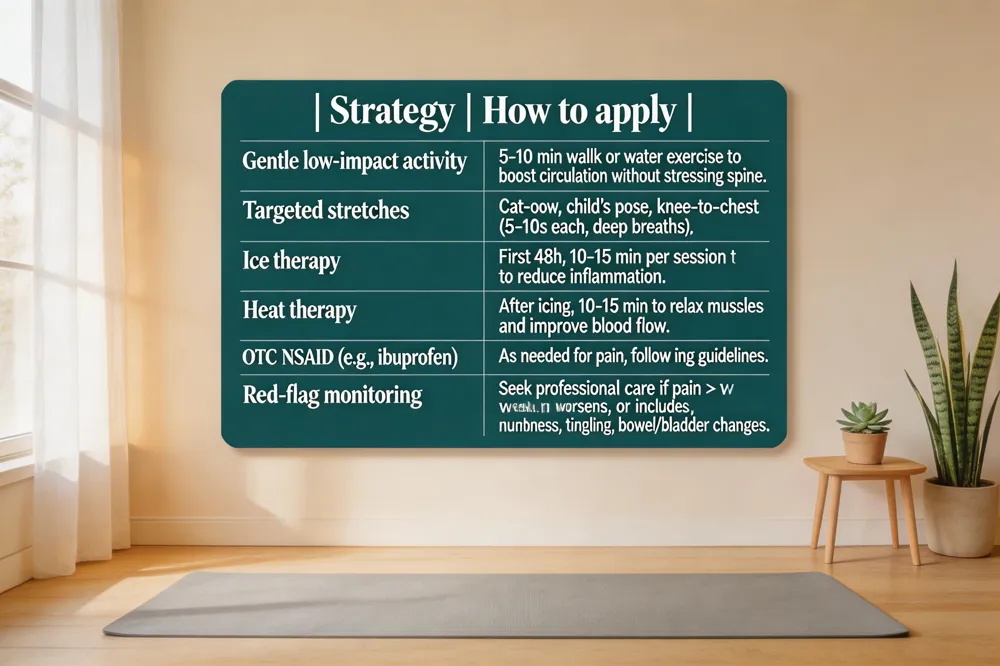 When a sudden flare‑up hits, start with gentle, low‑impact activity such as a 5‑10‑minute walk or water‑based movement; this boosts circulation without stressing the spine. Pair the walk with targeted stretches—cat‑cow, child’s pose, or a knee‑to‑chest stretch—holding each for 5‑10 seconds while breathing deeply to release lumbar tension.
Heat and cold therapy work hand‑in‑hand: apply an ice pack for the first 48 hours (10‑15 minutes) to dampen inflammation, then switch to a heating pad for another 10‑15 minutes to relax tight muscles and improve blood flow. Over‑the‑counter ibuprofen can further reduce pain, but avoid prolonged bed rest, which may delay healing.
If pain persists beyond a week, worsens, or is accompanied by numbness, tingling, or bowel/bladder changes, seek professional care promptly. A chiropractor or physician can assess alignment, provide manual therapy, and tailor a safe exercise program—often incorporating Pilates for core stability—to prevent future episodes.
Quickly, ice, then heat, stretch, move, and monitor symptoms; professional evaluation is essential when red‑flag signs appear.
Building Permanent Postural Health
| Component | Example actions |
|---|---|
| Core strengthening (2‑3 ×/wk) | Pelvic tilts, bird‑dog, glute bridges, modified side planks – 30‑45 s holds or 10‑15 reps. |
| Stretching (daily) | Thoracic extensions, doorway chest stretch, hip‑flexor release – 5‑minute sequence post‑core. |
| Ergonomic adjustments | Screen at eye level, feet flat, lumbar roll, micro‑breaks every 30‑45 min. |
| Chiropractic maintenance | Periodic adjustments to correct lingering misalignments and reinforce neuromuscular patterns. |
| Integrated routine | Combine core work, stretch, ergonomics, and chiropractic care for automatic, lasting posture. |
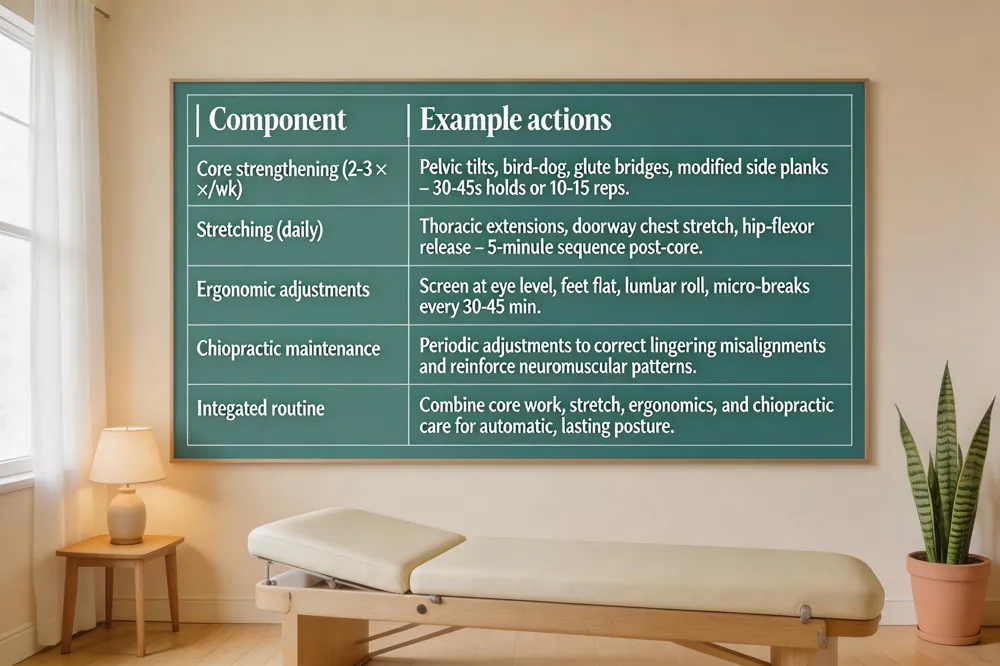 Consistent core strengthening is the foundation of lasting posture improvement. Pilates‑based moves such as pelvic tilts, bird‑dogs, glute bridges and modified side planks activate the deep transversus abdominis, multifidus, pelvic floor and glutes, creating a natural corset that supports the lumbar spine. Performing these exercises 2‑3 times per week builds endurance, keeps the pelvis neutral and reduces the anterior tilt that strains the lower back.
Stretching tight muscle groups balances this strength. Daily thoracic extensions, doorway chest stretches and hip‑flexor releases lengthen the muscles that tend to pull the shoulders forward and the pelvis into excess flexion. A short 5‑minute stretch sequence after each core session restores flexibility and prevents compensatory patterns.
Ergonomic adjustments turn the environment into a posture‑supporting ally. At home or work, position the computer screen at eye level, keep feet flat on the floor or on a footrest, and use a lumbar roll or rolled towel to maintain the natural lumbar curve. Take micro‑breaks every 30‑45 minutes to stand, walk, or perform chin‑tucks and scapular retractions, reinforcing proper alignment throughout the day.
Regular chiropractic care provides the final piece of the puzzle. Periodic adjustments gently correct lingering misalignments, improve joint mobility and reinforce the neuromuscular patterns developed through core work and ergonomic habits. When core strengthening, targeted stretching, smart ergonomics and chiropractic maintenance are combined, proper posture becomes an automatic, permanent state rather than a conscious effort.
Beginner Core Strengthening Routine
| Exercise | Duration / Reps | Sets |
|---|---|---|
| Forearm plank | 30‑45 s (or 10‑15 controlled reps) | 2‑3 (non‑consecutive days) |
| Side plank (knees down) | 30‑45 s each side | 2‑3 |
| Bird‑dog | 10‑15 reps per side | 2‑3 |
| Dead‑bug | 10‑15 reps per side | 2‑3 |
| Glute bridge | 30‑45 s or 10‑15 reps | 2‑3 |
| Progression | Add 10‑15 s hold, extra set, or light band resistance after 4‑6 weeks. | |
| Breathing cue | Inhale to prepare, exhale to brace belly (corset‑like) while maintaining neutral spine. |
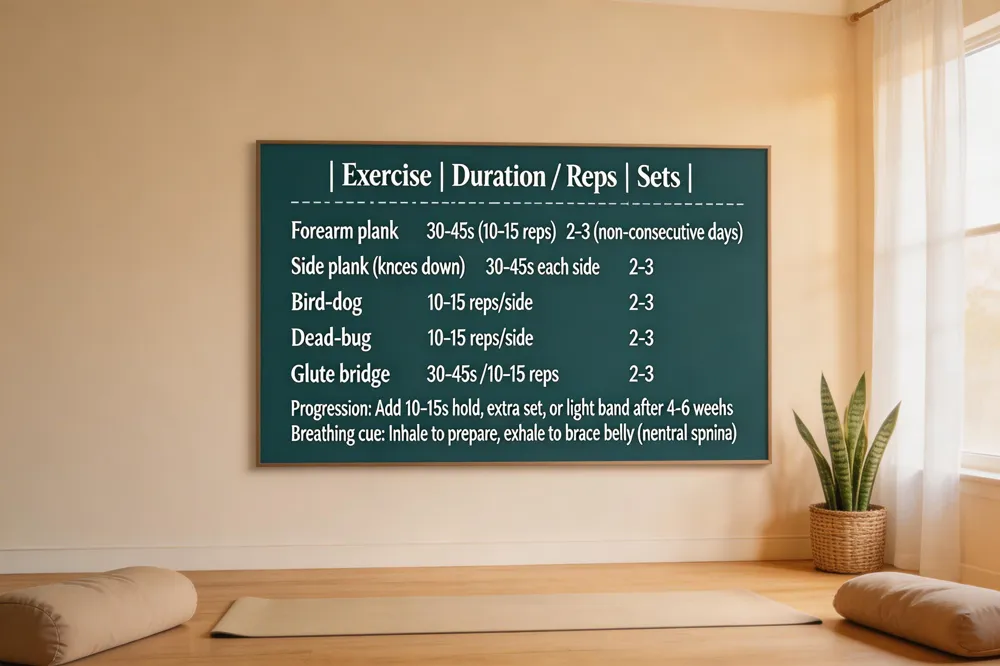 A solid beginner core routine starts with low‑impact, body‑weight foundation moves that engage the deep stabilizers emphasized in Pilates research.
Forearm planks, side planks, bird‑dog, dead‑bug, and glute bridges are ideal because they activate the transverse abdominis, multifidus, pelvic floor and glutes while keeping spinal load minimal. Perform each exercise for 30‑45 seconds (or 10‑15 controlled repetitions) and rest 15 seconds before moving to the next; repeat the circuit 2‑3 times on non‑consecutive days.
Progression guidelines – As endurance improves, extend hold times by 10‑15 seconds, add a second set, or introduce light resistance such as a resistance band around the knees for bridges. Advanced variations like a modified side plank with a lifted leg or a bird‑dog with a small dumbbell can be added after 4–6 weeks of consistent practice.
Breathing and neutral spine cues – Inhale to prepare, exhale to brace the belly as if preparing for a gentle punch, maintaining a neutral pelvis and small lumbar gap. Diaphragmatic breathing creates intra‑abdominal pressure that supports the spine during each movement.
Core strengthening exercises for beginners – The routine described above meets the needs of novices, offering 30‑45‑second holds or 10‑15 repetitions, 2‑3 sets, three times weekly, with an emphasis on a neutral spine and steady breath. Progression follows increased duration, extra sets, or light resistance, enhancing spinal stability, posture, and pain reduction.
Core strength exercises for seniors – Gentle seated variations (seated twist, side bend, resisted knee lift) and floor‑based options (seated dead‑bug, wall push‑ups, modified side planks) can be performed from a sturdy chair or on a mat. Aim for one‑minute intervals per exercise, repeating the circuit twice for a 10‑minute routine. Keep movements slow, breathing controlled, and maintain a neutral lower‑back alignment to protect joints while improving balance and functional stability.
Integrating Pilates with Chiropractic Care
| Integration benefit | Example implementation |
|---|---|
| Synergistic pain reduction | Pilates activates deep core; chiropractic restores joint mobility → lower lumbar strain. |
| Posture improvement | Core stability + spinal adjustments reinforce neutral alignment. |
| Faster functional recovery | Combined modalities shown to accelerate return to daily activities (Healthline, Cleveland Clinic, HSS). |
| Sarcopenia mitigation | Pilates + active lifestyle preserves muscle mass in older adults. |
| Posture corrector guidance | Provides tactile feedback; best used alongside strengthening, stretching, ergonomics, and professional care for lasting change. |
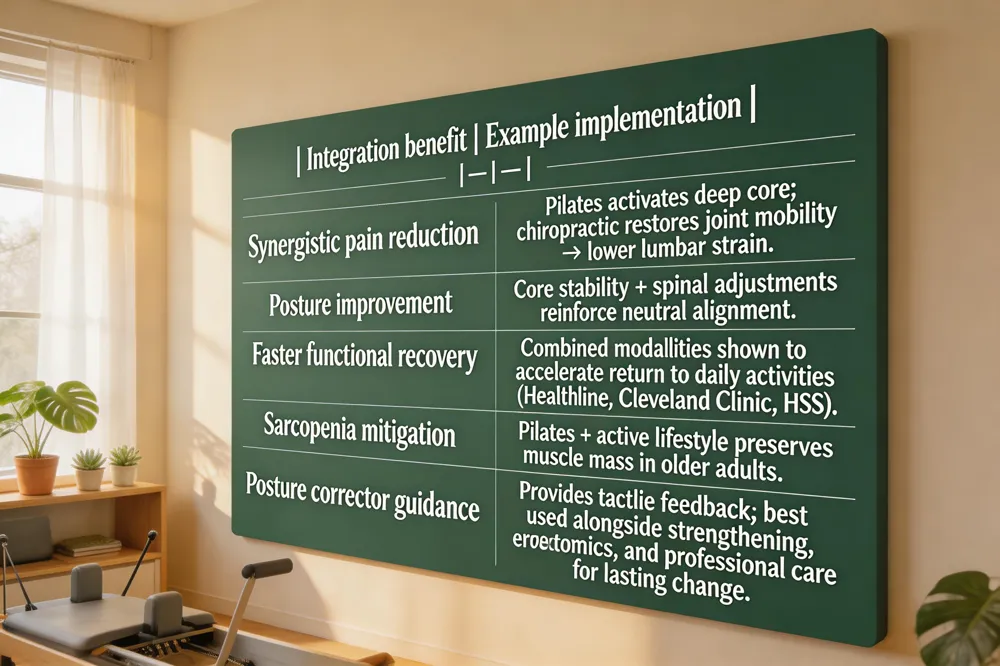 A holistic treatment plan that blends Pilates with chiropractic adjustments offers a synergistic approach to chronic lower‑back pain. Pilates provides deep core activation—targeting the transverse abdominis, multifidus, pelvic floor and diaphragm—while chiropractic care restores joint mobility and corrects spinal misalignments. When these modalities are combined, patients experience reduced lumbar strain, improved posture, and faster functional recovery, as shown in multiple studies (e.g., Healthline, Cleveland Clinic, HSS). Southeast Family Chiropractic in Gastonia, NC, embodies this philosophy by offering personalized Pilates sessions alongside manual adjustments, ensuring each movement respects the patient’s unique spinal mechanics.
Is Pilates good for sarcopenia? Yes. Pilates, paired with a balanced diet and active lifestyle, helps older adults preserve muscle mass and strength, mitigating sarcopenia and boosting confidence in daily activities.
Do posture correctors work? They give immediate tactile feedback that raises awareness of slouching and can cue activation of weak upper‑back muscles, serving as a short‑term “reminder.” However, they do not correct underlying strength imbalances, tight chest muscles, or ergonomic factors. For lasting improvement, they must be used alongside targeted strengthening, stretching, ergonomic adjustments, and professional chiropractic or physical‑therapy care. In short, posture correctors are an adjunct tool for awareness, not a stand‑alone solution.
Take the Next Step Toward a Stronger, Pain‑Free Back
Pilates and targeted core work create a stable, neutral spine by engaging the transversus abdominis, multifidus, pelvic floor and diaphragm. This deep‑muscle activation reduces lumbar load, improves posture, and eases chronic back pain, as shown by multiple clinical studies. Regular sessions increase endurance of the glutes and hip stabilizers, promote balanced flexibility of hamstrings and hip flexors, and teach mindful breathing that supports intra‑abdominal pressure during daily activities. Because a strong core works hand‑in‑hand with spinal adjustments, a chiropractic assessment can identify specific alignment issues and tailor a safe progression of Pilates movements. Southeast Family Chiropractic in Gastonia offers personalized wellness plans that combine expert adjustments, Pilates instruction, and ergonomic counseling. Book your initial evaluation today and step into a program designed to keep your back strong, aligned, and pain‑free for the long term. Our team will monitor your progress, adjust exercises as needed, and ensure lasting spinal health together.